Rawlings tells trustees of research, admissions and salaries progress
By Jacquie Powers
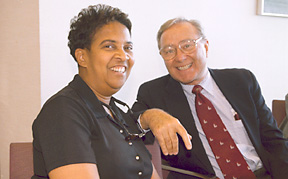
President Hunter Rawlings briefed smiling members of the Cornell Board of Trustees, at its final meetings May 25 and 26, on three key areas in which the university has made great strides over the past academic year: research, admissions and faculty and staff salaries.
The board also heard reports from other administrators on progress toward diversity and a new program of senior faculty seminars.
After applauding all the good news, the board approved a $1.8 billion spending plan for the university for 2001-02 at the meeting in the Trustee Meeting Room of the Herbert F. Johnson Museum of Art on campus.
Cornell was very successful this year in competition for state funds for research, Rawlings said. He noted that the university has been named a state STAR Center for Genomic Technologies and Information Sciences, as part of the New York State Office of Science, Technology and Academic Research (NYSTAR). Funding for the center awaits the outcome of the state budget negotiations in Albany.
In addition, Rawlings pointed to three other research awards:
- $2.8 million from NYSTAR over two years to establish a new Center for Advanced Technology (CAT), to be called the Alliance for Nanomedical Technologies. The Cornell-led alliance will use industrial backing to research and develop microscale optical detection devices. The project director is Carl Batt, the Liberty Hyde Bailey Professor in the Department of Food Science.
- $2.6 million from NYSTAR to establish an Academic Research Center (ARC) for plant genomics research and faculty development. Lead investigator on the new center, which will receive $1.6 million, is William Crepet, professor of plant biology. One million dollars of the award is designated for faculty development for the laboratory of Mark Saltzman, professor of chemical engineering.
"Cornell has fared extremely well," Rawlings said. "These are signal examples of how we are advancing in these research areas."
Rawlings also drew a round of applause when he announced that admissions applications this year were up 6.5 percent, with a 25.7 percent admit rate, down from 33 percent two years ago. The yield is up as well, he added.
"We've had a banner year in admissions," he said. "These are very good pieces of news. We're more competitive and much more selective. And students are choosing Cornell in greater numbers."
Finally, Rawlings reported that he was pleased that progress was made this year in improving both faculty and staff salaries, although the formal multiyear improvement program does not begin until July 1. He said faculty salaries in the endowed colleges rose from 10th to ninth place among Cornell's peer institutions, and in the contract colleges, from 11th place to 10th.
He said some progress was made in staff salaries in select areas and he expects "to make further progress in the coming year."
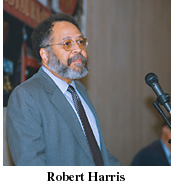
Robert Harris, vice provost for diversity and faculty development, reported that his office has placed great attention on interactional as well as structural diversity over the past year.
"Structural diversity is important for us to increase the number of women and minority students, staff and faculty, but we need to consider interactional diversity in how individuals experience the campus once they arrive here. Interactional diversity involves the campus climate and the extent to which we have a welcoming and supportive campus environment. ... A major challenge for us is understanding that diversity requires a change in our practices to become inclusive, that we can no longer do things the way we have always done them and that we cannot expect women and minorities to become clones of traditional students, staff and faculty."
Provost Biddy Martin reported on the first faculty seminar that was initiated last fall and took place once a week over the academic year. The seminar, which included Rawlings, Martin, 15 leading faculty and five postdoctoral students, explored the social sciences -- where they stand at Cornell, where they are going internationally and where Cornell's should be heading.
"It's a complex picture and one we feel we need to get a better grasp of for the future," Martin said.
A report written by the faculty at the conclusion of the seminar found major problems in the social sciences at Cornell that need addressing over the long term, although there are "pockets of distinction," she said. "Our social scientists are scattered throughout the colleges and are not collected into centers of excellence."
Martin said there would be two faculty seminars next year. One will continue discussion of the social sciences, but this time will be problem-based. The other will address the humanities, focusing on race and ethnicity in the field of American studies.
"These faculty seminars are unique at Cornell and were started in an effort to promote intellectual exchange on campus," Martin said. "We've made them a priority and, in fact, supplied funds to hire people to help teach classes of the participants. I'm happy to report that while Hunter and I became obstreperous at times, we found it both intellectually challenging and rewarding and believe the other participants did as well."
The $1.8 billion spending plan approved by the trustees for 2001-02 is 5.4 percent more than the $1.7 billion that is forecast in expenditures this year.
The budget includes a 4.2 percent increase in tuition and fees, a projected 14.5 percent net increase in investment income, an expected 0.6 percent increase in unrestricted gifts and an expected 11.8 percent increase in restricted operating gifts from 2000-01.
CU Trustees vote to close university's Ward Center
The Cornell Board of Trustees voted May 25 to accept the recommendation of President Hunter R. Rawlings to begin the process to close the Ward Center for Nuclear Studies and to decommission the nuclear reactor associated with the center.
The decision by the trustees was taken after a 40-minute, in-depth discussion in which the trustees reviewed both the written and oral arguments that had been submitted to them on both sides of the question.
The initial recommendation to close the center and decommission the reactor was made by the Local Advisory Committee, a standing committee of the Cornell Faculty Senate, after a three-month study of the issue initiated by Vice Provost for Research Robert Richardson.
Prior to the board's consideration of this issue, and in accordance with the university's by-laws, Harold Tanner, chair of the board of trustees, appointed a special committee of trustees to meet on May 24 with a group of faculty opposed to the administration's recommendation. The ad hoc committee, after meeting with the faculty group, unanimously recommended the approval of the administration's resolution.
Media Contact
Get Cornell news delivered right to your inbox.
Subscribe