Panelists look at real estate's rosy present and speculate on its future
By Linda Myers
Looking for an investment opportunity? Try commercial real estate, which is doing so well these days -- because of an abundance of low-interest capital -- that earnings from Prudential's real estate arm, for one, will exceed profits from the firm's mainstay insurance business.
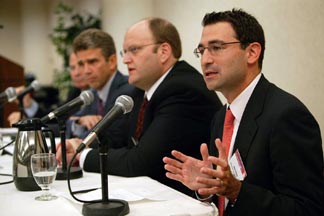
So reported Cornell alumnus J. Allen Smith at "Real Estate Strategies in Times of Change," the 23rd Annual Cornell Real Estate Conference, held Oct. 6-7 in on the Cornell University campus. Smith, who is now managing director of Prudential Real Estate Investors, was part of a panel of three experts discussing how real estate firms have adapted and prospered as markets have evolved, in the Statler ballroom.
The conference, sponsored by the Cornell Program in Real Estate, was attended by 110 senior executives and managers in real estate and 30 Cornell master's degree in real estate candidates.
"The conference provides an opportunity for real estate executives to reconnect each year around timely issues and at the same time allows our students to interact with industry leaders," said David Funk, director of the Program in Real Estate.
Panelist Daniel Hurwitz, whose firm, Developers Diversified Realty (DDR), develops large, open-air retail shopping centers, was bullish about real estate's immediate future. "The development business is as robust as it's ever been," he said, with $15 billion in annual revenues from such tenants as Target, Home Depot, Lowe's and Wal-Mart, and a waiting list for new tenants.
"It's the peak of liquidity in real estate," reported Jonathan Gray, senior managing director of the Blackstone Group -- meaning that property is so desirable it can quickly be converted into cash.
The biggest problem: competition from other real estate investment firms (REITs) for attractive properties. Blackstone's strategy? "We play above the clouds," said Gray, explaining that the firm has fewer competitors since it "moved up in size for a better dynamic."
Other problems: "When everyone has money, deals are more complex," said Hurwitz. However, "we have not seen a weakening of the consumer, regardless of gas prices. Retails sales in this country have never gone down, and we don't see the consumer giving up now."
"If interest rates go up, will real estate be in trouble?" asked Richard Saltzman, president of Colony Capital, LLC, who moderated the panel.
"Real estate continues to look attractive," Smith said. "We're being used as a fixed-income surrogate, and a small change in Treasury interest rates isn't going to do anything to 'cap' rates."
"That's not true on the development side. Those groups are feeling pressure," said Hurwitz.
Gray also worried that cheap leverage to service high debt would lead to negative leveraging over time.
Other concerns?
Hurwitz said he was worried about the rising cost of land and the high price of delays, which he called "a killer for every project."
And all panelists agreed that attracting and retaining the best people was an ongoing challenge.
The right person isn't necessarily the smartest, Hurwitz said. "You can always buy brains, but it takes a unique person who has the charisma and stamina to face down 300 screaming people in a zoning board meeting" and persevere, he said.
Eunice Omole, a first-year student in the Program in Real Estate, who attended the conference, said, "It was an opportunity to receive real answers on the changes in the economy, the housing bubble and the future of the industry as well as meet the 'movers and shakers' in the industry."
Omole, who hopes to go into development in emerging markets after she graduates, met high-level developers, bankers, lawyers, CEOs and a congressman at the conference, as well as one of her heroes, real estate entrepreneur Robert Toll '63, whom she called "a true pioneer in home building."
And Charlie Yu, a second-year real estate program student, said the conference helped him understand better the forces that are keeping housing prices high in certain residential markets -- among them demographics and regulatory constraints. "Affordability is certainly an issue that will need to be solved before it causes social problems," he said.
In addition to offering a two-year master's degree in real estate, the Program in Real Estate serves as a focal point for links with the real estate industry and the Cornell Real Estate Council, an alumni advisory group to the program whose members are real estate professionals.
Media Contact
Get Cornell news delivered right to your inbox.
Subscribe