‘Marine camp’ brings Long Island kids to the beach
By Caitlin Hayes, Cornell Chronicle
From the moment her students stepped into the calm, bayside cove at Jones Beach State Park, youth group organizer Clariona Griffith knew this field trip would be different – because none of the kids did the typical kid-thing of splashing each other.
They were too busy.
The students, aged 10 to 14, were ankle-deep in the water and squealing, grabbing silverside fish from a large, curtain-like net, a seine, that educators had just dragged through the water and along the bottom of the bay. The kids peered into the shells of hermit crabs and caught European green crabs in their landing nets.
The activity started off a day-long field trip on July 17 offered by the Marine Summer Field Trip Program, a collaboration between Cornell Cooperative Extension (CCE) Nassau County, New York Sea Grant (NYSG) and the New York State Department of Parks, Recreation, and Historic Preservation. The program, which hosts eight sessions throughout July and August for different youth organizations in Nassau County, engages more than 200 kids every summer with local marine wildlife and ecology, as well as water safety and sustainability education.
“What they’re getting right now is exposure to nature,” said Griffith, who owns a childcare center offering full-time, afterschool and summer programming for youth in Hempstead, New York, the largest township in the country and one of the most economically and racially diverse on Long Island. “Even though we live in Nassau County, we’re not exposed to this fresh air. This is some of their first time stepping in water and realizing and appreciating the life that’s in it.”
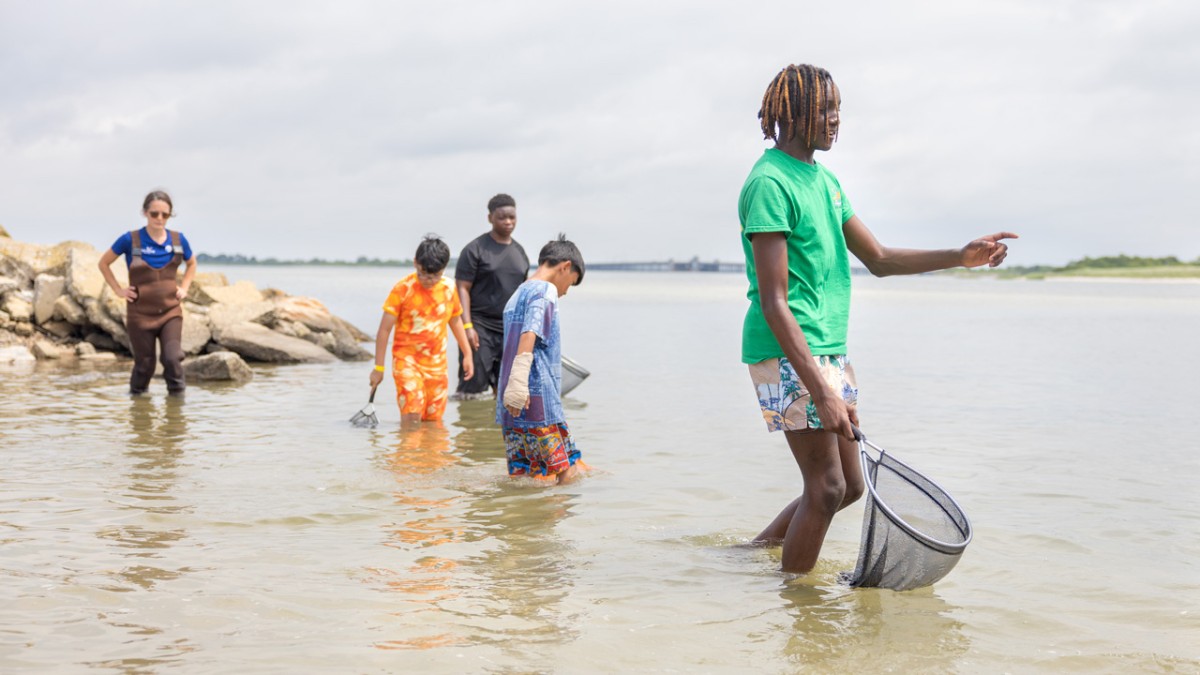
Students from the Children and Youth Hub Station in Hempstead, New York, use individual landing nets to catch European green crabs at Jones Beach State Park.
Affectionately called “marine camp” by staff, the field trip is free for participating organizations, which often serve under-resourced communities. While all the students from Hempstead had been to the beach before, some kids who participate have never seen the ocean, despite living on an island.
“The intent of the program is to reach those youths who don’t have many opportunities to get out here,” said Michael Fiorentino, natural resources team leader for CCE Nassau County.
Fiorentino said the program aims to combat the discrimination and systemic racism that is part of Long Island’s history. In the 1930s, developers intentionally designed the Jones Beach area to keep public transportation from reaching the beaches, for instance, building low overpasses that buses couldn’t clear.
“We’ve seen, even years later, this still persisting in our communities, where if you didn’t grow up going to the beach, you’re not going to go,” Fiorentino said, “which is why we think it’s important to intentionally bring youth in for these types of experiences.”
The program is in its eighth year and was started in Suffolk County by NYSG, a cooperative program funded by the National Oceanic and Atmospheric Administration (NOAA) and housed at Cornell and the State University of New York. Antoinette Clemetson, marine fisheries specialist for NYSG, said during one of the first years of the program, a youth group organizer recounted that his students had abruptly stopped talking when their bus came to the Robert Moses Bridge, which extends from the mainland to the barrier islands and beaches of Long Island. At that point, a hush fell.
“These kids had never been to the beach, and going over the bridge, they were just amazed looking outside the window,” Clemetson said. “We want to bring groups that don’t have the opportunity to come to the coast. And we also want to spur interest in marine biology in our students, that curiosity and excitement.”
Chloe Dymek, natural resource program coordinator for CCE Nassau County, taps into CCE’s 4-H network of youth organizations to schedule the field trips; a state park program reimburses the groups for transportation expenses and parking fees; and all three partners combine expertise to create a daylong curriculum with a focus on active learning.
“I look forward to this all year,” said Hayden Uresk, outreach and school program coordinator at the Jones Beach Energy & Nature Center, which hosts the program in the park every year. “Getting kids outside, having fun. There’s nothing better.”
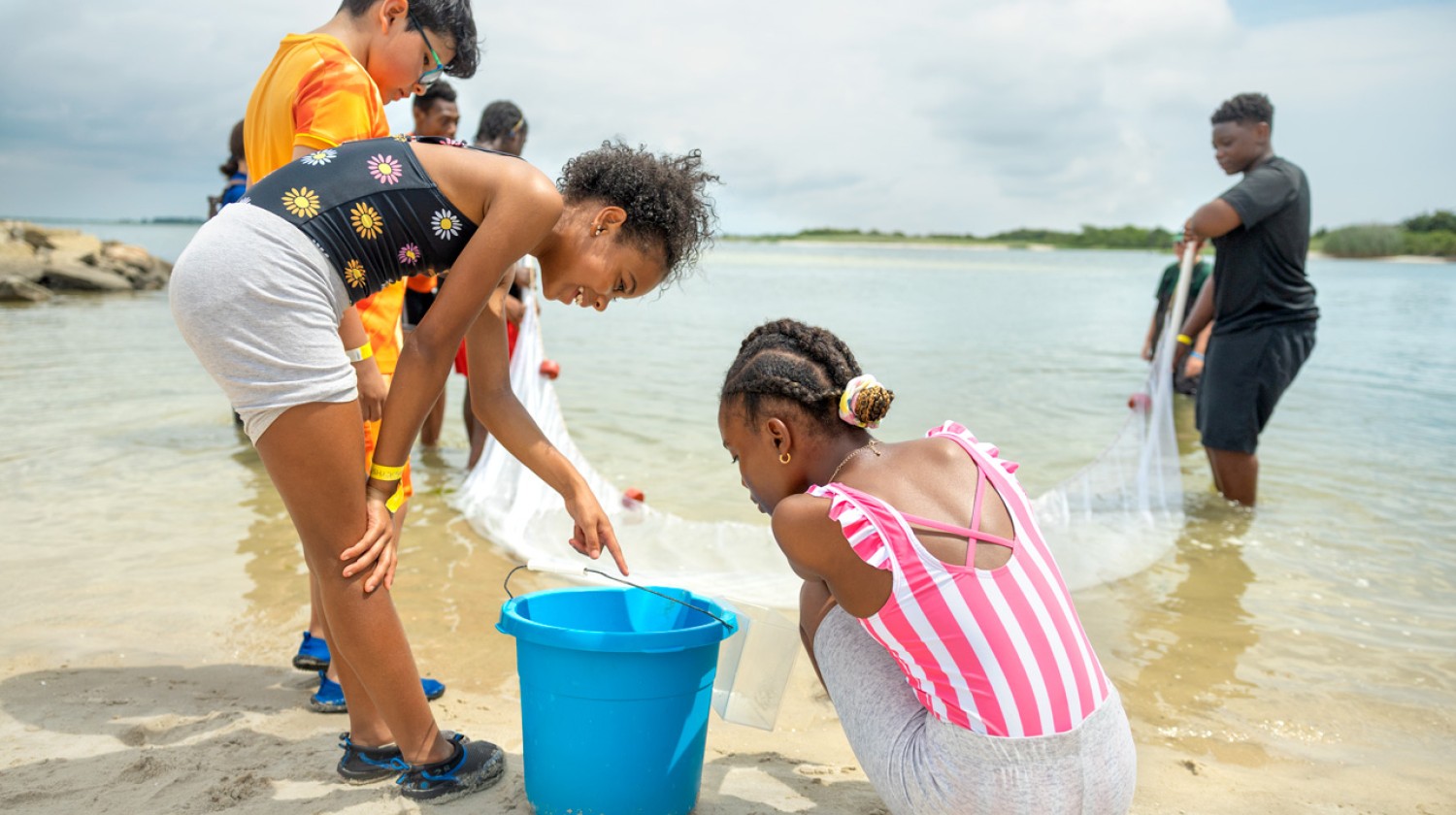
Kassidy Bates (left), 10, and Genayah Desousa, 10, from Hempstead, New York, point to fish and crabs hauled in from the bay at Jones Beach State Park.
‘A good day’
When the 11 students and three youth counselors from Hempstead came off the bus on July 17, they seemed reserved, maybe expecting to be a little bored. But a primary team of eight educators – four from the center, two from NYSG and two from CCE Nassau County – quickly mobilized the group. They helped students apply sunscreen and bug spray, fitted them with water shoes and gave them nets to carry to a small, bayside cove, dotted with seagulls and terns.
When the first seine haul came in full of small silverside fish, crabs (and one “bunker” or menhaden), the students transformed.
“There’s an army of fish in there,” shouted Dominic Ayerve, 10. The students carried fish from the nets to buckets of water for better observation and, after a demonstration from educators, took turns managing the seines themselves. “We are legend,” said Aiden Ince, 10, after hauling in another clutch of silversides. Miguel Gumana, 10, caught the catch of the day – a blue crab – and carried it around in a small plastic tank for his peers to see.

Summer camp students from Hempstead, New York identify piping plover eggs in an image, during a presentation on the threatened bird species on July 17 at Jones Beach State Park.
“Just seeing the reactions on their faces is the most rewarding,” Fiorentino said. “When we pull the bait fish up in the seine nets, they go crazy. It’s just very powerful.”
Griffith’s afterschool and summer program, the Children and Youth Hub Station, is part of a larger center that provides care for kids ages 2 to 14, including in the evenings when Griffith said more parents are working second jobs. For her older kids, Griffith’s goal is to provide as many educational opportunities and life skills as possible.
“We take the kids and make sure we do that enrichment and create different, fun learning activities and expose them to as many things as we can while their parents can’t,” she said. “We see it as co-parenting with the parents during the summertime and school year. We want the kids to be able to say, ‘We had an amazing time, and we learned a lot.’”
The marine field trip checked those boxes. “And who knows where their future lies – maybe they will want to be marine biologists or go into the Navy,” Griffith said. “This is a great opportunity for them to study and see.”
After seining, students spent the afternoon back at the Jones Beach Energy & Nature Center, an impressive, 12,000 square-foot, net-zero building constructed in 2020 that’s nestled into the landscape. The center, which has hosted the program since 2021, is open to the public year-round and offers educational programming for all ages.
Students ate lunch on the center’s back deck, overlooking a swath of untouched grassy dunes that stretch to the horizon, with the Atlantic beaches beyond. They then went indoors out of the heat, where they toured exhibits that feature both the natural landscape and ecology of Long Island and how that landscape has been transformed by people – as well as how it can be preserved as climate change brings stronger storms and rising sea levels.

Students participating in Cornell Cooperative Extension Nassau County's 'Marine Camp' learn how to use large, curtain-like nets called seines to haul in small fish and crabs at Jones Beach State Park.
At one exhibit, students turned a wheel to make water slosh inside a tank, simulating how the dune grasses slow waves and reduce erosion. When Lillian Simons, a center educator, asked the students to describe what they saw, more than half of the students raised their hands. At a touch tank with spider and hermit crabs, students asked about the purpose of a horseshoe crab’s tail (to turn itself over) and whether spider crabs would attack people (no).
Students perked up when educators at their next activity mentioned virtual reality. After a short lesson led by Kathleen Fallon, NYSG coastal processes specialist, on deploying a life ring, wearing a life jacket and navigating rip currents, students donned headsets and, with software developed by NYSG, navigated simulations of a rip current where they had to swim parallel to shore to escape the pull.
“Water safety has been a big focus for us this year,” said Fiorentino, who added that the programming aligns with Gov. Kathy Hochul’s New York SWIMS initiative, which aims to address equity gaps and expand access to safe swimming. “We want to make sure that kids are adequately prepared. If they weren’t brought down here by their parents or guardians or through school programs, they may not know how to safely navigate these areas.”
The program ended with a walk through a native pollinator garden, snacks and play in an area inspired by whale biology.
Kassidy Bates, 10, and Genayah Desousa, 10, sat on sculptures of whale vertebrae and said they wanted to come back, to catch more fish and crabs and maybe see a turtle.
“Kids get to find out about things they don’t know,” Kassidy said about the program. “They touch things they’ve never touched and learn about different animals they’ve never seen before.”
Behind them, students played a xylophone and yelled into a talk tube. Program educators timed students as they ran across a log balance beam, lending the smaller kids their hands.
The bus was late to pick them up, but the students did not seem to mind.
Kassidy leaned sideways on her whale vertebrae to draw in the sand with a stick and said, “For some reason, it felt like a good day.”
Media Contact
Get Cornell news delivered right to your inbox.
Subscribe