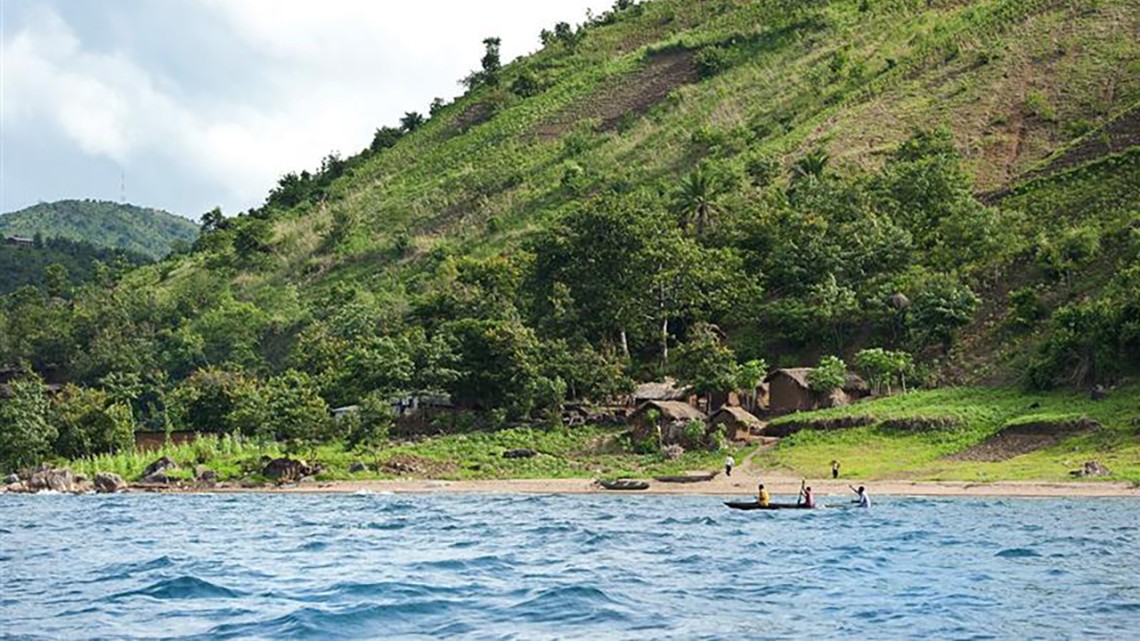
Since 2013, Cornell Atkinson and The Nature Conservancy have partnered on 26 projects to make an impact on critical sustainability issues. Photo provided.
News directly from Cornell's colleges and centers
Cornell Atkinson-The Nature Conservancy awards promote biodiversity, climate resilience
By Krisy Gashler
For 12 years, The Nature Conservancy (TNC) and the Cornell Atkinson Center for Sustainability have partnered to bridge the gap between scientific breakthroughs and real-world action on critical sustainability issues. Cornell Atkinson announced this week that six new projects will receive 2025 grant funding to address topics that include improving New York City’s climate resilience through urban forestry, modernizing hydropower dams in the Balkans, and protecting freshwater biodiversity in Eastern Africa.
“The partnership model that Cornell Atkinson and TNC have developed is firmly rooted in the intent and practice of the land-grant system, to serve the public good,” said Catherine Kling, Tisch University Professor in the Charles H. Dyson School of Applied Economics and Management, and a TNC collaborator and 2025 award recipient. “The fact that Cornell Atkinson and TNC have recognized the potential for this novel approach as a modern innovation in achieving on-the-ground implementation of research conducted at universities is a testament to both of them.”
Since 2013, Cornell Atkinson and TNC have partnered on 26 projects, including efforts to maximize sustainability in livestock production, understand the tradeoffs of installing solar panels on waterbodies, and balance the competing needs of climate resilience and crop yields in agriculture.
“The environmental challenges we face are too big and complex for any one organization to solve,” said John Poulsen, global director of science capacity at TNC. “Scientific collaboration like that between TNC and Cornell is critical for success and especially powerful when each institution brings different strengths and resources. New ideas are born from the diversity of experiences and motivations, and we need new ideas to deliver real-world impact.”
This year, six Cornell-TNC projects have been funded through Cornell Atkinson’s Innovation for Impact Fund. They will collaboratively explore:
Modernizing Existing Dams to Meet Energy and Environmental Objectives in the Western Balkans. Aging hydropower plants in the Western Balkans lack modern environmental safeguards to minimize disruptions to fish migration, natural flow regimes, and sediment transport, with serious consequences for freshwater biodiversity. Researchers will assess how much of the existing fleet can be modernized to meet both energy balancing needs and contemporary environmental objectives.
- Cornell PI: Alexander Flecker, professor of ecology and evolutionary biology in the College of Agriculture and Life Sciences (CALS); Carla Gomes, Ronald C. and Antonia V. Nielsen Professor of Computing and Information Science in the Bowers College of Computing and Information Science.
- TNC: Katie Kennedy, Tara Moberg, Mate Zec, Igor Vejnovic
- Collaborators: Rafael M. Almeida (Indiana University)
Simulating Capacity for Ecosystem Services at Solar Facilities on Abandoned Minelands in Southern Appalachia. The Starfire Renewable Energy Center is being built at one of the largest former coal mines in the country. Researchers seek to inform site design and project permitting to achieve multiple sustainability objectives, including understanding how to optimize vegetation enhancement at solar facilities on minelands.
- Cornell PIs: Steve Grodsky, assistant professor courtesy, and Ginger Allington, assistant professor, both in the Department of Natural Resources and the Environment in CALS
- TNC: Liz Kalies, Nathan Cummins
Untangling the Causes of Tree Mortality with Remote Sensing to Increase Urban Climate Resilience. Growing recognition of trees’ benefits to public health and climate resilience has prompted cities around the world to set ambitious targets for tree canopy coverage. Researchers will use remote-sensing technologies to create comprehensive models of tree mortality across New York City, and inform policies in urban planning and forestry to enhance the health of trees and therefore people.
- Cornell PI: Daniel Katz, assistant professor of soil and crop sciences in CALS
- TNC: Michael Treglia
Accelerating Farmer Adoption of Conservation Practices: Economic Experiment Evidence that Reduce Hypothetical Bias. Conservation practices on agricultural fields, such as leaving buffer areas of perennial vegetation near waterways, can improve water quality outcomes by minimizing soil and nutrient erosion. Researchers seek to generate accurate estimates of Midwestern farmers’ willingness to adopt conservation practices, to identify fields where such practices are most needed, and to inform policy guidance.
- Cornell PIs: Catherine Kling, Tisch University Professor, and Wendong Zhang, associate professor of applied economics and management, both in the S.C. Johnson College of Business
- TNC: Randy Dell, Emily Zimmerman, Shamitha Keerthi
- Collaborators: Gregory Howard (East Carolina University)
Guiding Biodiversity Protection & Aquaculture Siting in Lake Tanganyika Using eDNA. Lake Tanganyika in eastern Africa is a global hotspot of freshwater biodiversity and an important source of human nutrients, with a growing aquaculture industry. Researchers will leverage environmental DNA (eDNA) – low-impact genetic testing of water samples – to survey species across the Tanganyika coastline to support lake-wide conservation planning.
- Cornell PI: Peter McIntyre, associate professor of natural resources and the environment in CALS; Jared Freeman, forthcoming postdoctoral scholar in CALS
- TNC: Colin Apse, Tuyeni Mwampamba
What Does ‘Well Connected’ Mean in the Context of Target 3 of the Global Biodiversity Framework? The United Nations’ 2030 biodiversity goals call for conserving at least 30% of land and sea ecosystems, and ensuring that protected areas be “well-connected.” This project will develop indicators that classify protected-area connectivity as low, medium, or high, at the individual area level and at landscape levels. Researchers will assess the applicability of their indicators and thresholds through national case studies.
- Cornell PI: Gary Tabor, professor of practice of natural resources and the environment in CALS
- TNC: Erin Poor, Kimberly Hall, Carrie Schloss, Aaron Jones
- Collaborators: Annika Keeley (Center for Large Landscape Conservation)
Requests for proposals for the 2026 round of grant funding for Cornell and TNC partners are now open; applications are due Nov. 24.
Krisy Gashler is a writer for the Cornell Atkinson Center for Sustainability.
Media Contact
Get Cornell news delivered right to your inbox.
Subscribe