Strength in numbers: ROTC welcomes largest class in decades
By James Dean, Cornell Chronicle
Along with Cornell-issued ID cards, room keys and tote bags, a select group of incoming students recently picked up gear issued by the federal government: camouflage uniforms.
“When they hand me my uniform, it’s the real deal: I’m officially a U.S. Army cadet,” said Andy McMurray ’29 of Long Island, who is entering the College of Agriculture and Life Sciences and Cornell’s Reserve Officers’ Training Corps (ROTC). “That’s something I’ve always wanted, so I’m looking forward to it.”
McMurray is one of 33 new Army cadets joining Cornell’s Tri-Service Brigade – the most since 1992. They include 29 Big Red first-years and four from other college campuses in the region that train at Cornell. Another 21 new midshipmen will nearly double the cohort working toward commissions in the Navy and Marines, while 19 rookie Air Force cadets – 10 from Cornell – top the totals from recent years.
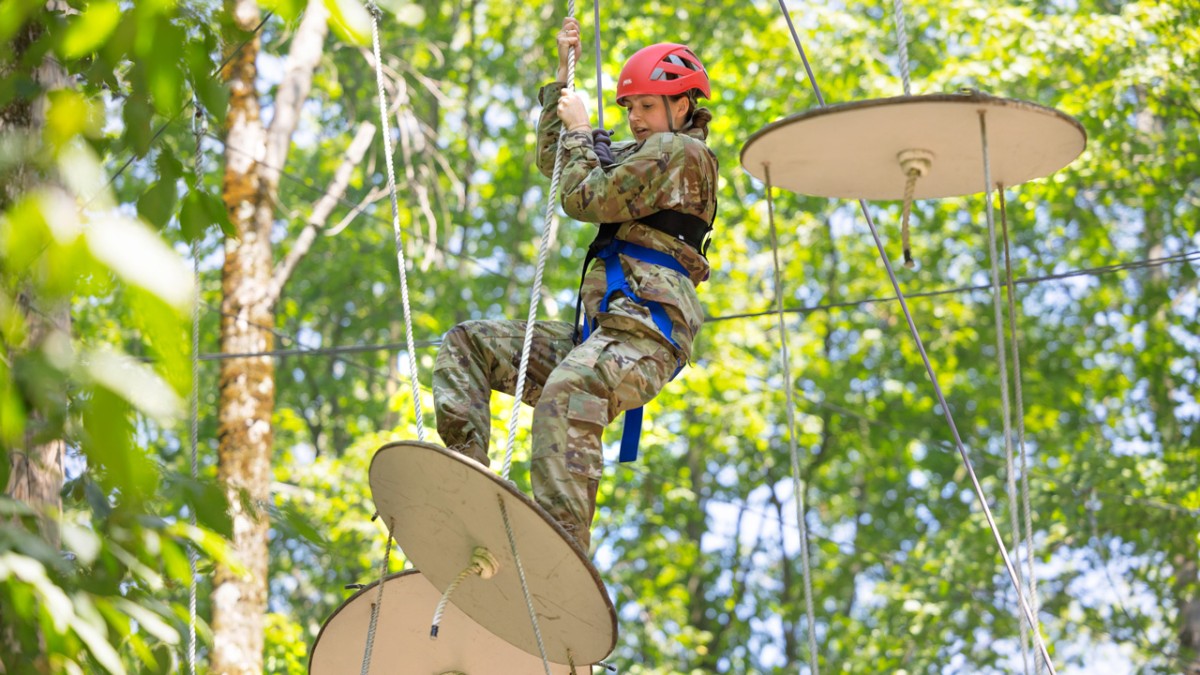
The incoming class of Army ROTC students engage in team building skills at Hoffman Challenge Course.
Leaders attribute Cornell’s growth to proactive outreach with ROTC scholarship applicants, coordination with admissions teams, older students’ record of success and Cornell’s tradition of supporting military service – dating to its origins as New York’s land-grant university.
“It’s a boon to have such big classes coming into ROTC,” said Navy Capt. Michael Mosbruger, professor of naval science. “These students pursue studies preparing them to be future leaders of the United States, they tend to stay in school and finish, and then they give back to the country and to their school later in life.”
Soon after arriving for orientation, Army ROTC cadets took a fitness test – passing is required to activate scholarships – and were issued equipment. They navigated ropes at the Hoffman Challenge Course operated by Cornell Outdoor Education, and practiced firing M4 rifles armed with digital ammunition for the first time at the New York Army National Guard’s Ithaca armory.
Katherine McComas, Ph.D. ’00, vice provost for engagement and land-grant affairs, assured the student cadets they are an important part of Cornell’s story, noting that military education has been “stitched into the fabric of our university” since its founding. Corey Earle ’07, visiting lecturer in American studies in the College of Arts and Sciences, elaborated on that history, explaining that military instruction was “part of Cornell’s DNA.”
McMurray, whose parents are Army veterans, didn’t need much convincing. He grew up visiting ROTC’s home in Barton Hall – a former World War I armory and drill hall – while his father, retired Army Col. John McMurray ’91, was stationed at Fort Drum, and decided it offered an ideal path to a medical career.
But reviewing data, Army Lt. Col. Derek Fitzpatrick, professor of military science, sensed untapped potential among scholarship applicants, a high percentage of whom identified Cornell as a preferred school.
Believing more could thrive at Cornell, he discussed the opportunity with McComas and Lisa Nishii, senior vice provost for enrollment management and undergraduate education. He communicated with admissions officers including Kyle Downey, a former Army reservist who leads Cornell’s undergraduate admissions for veteran and ROTC students, to ensure they were aware of students who had applied for or had won ROTC scholarships.
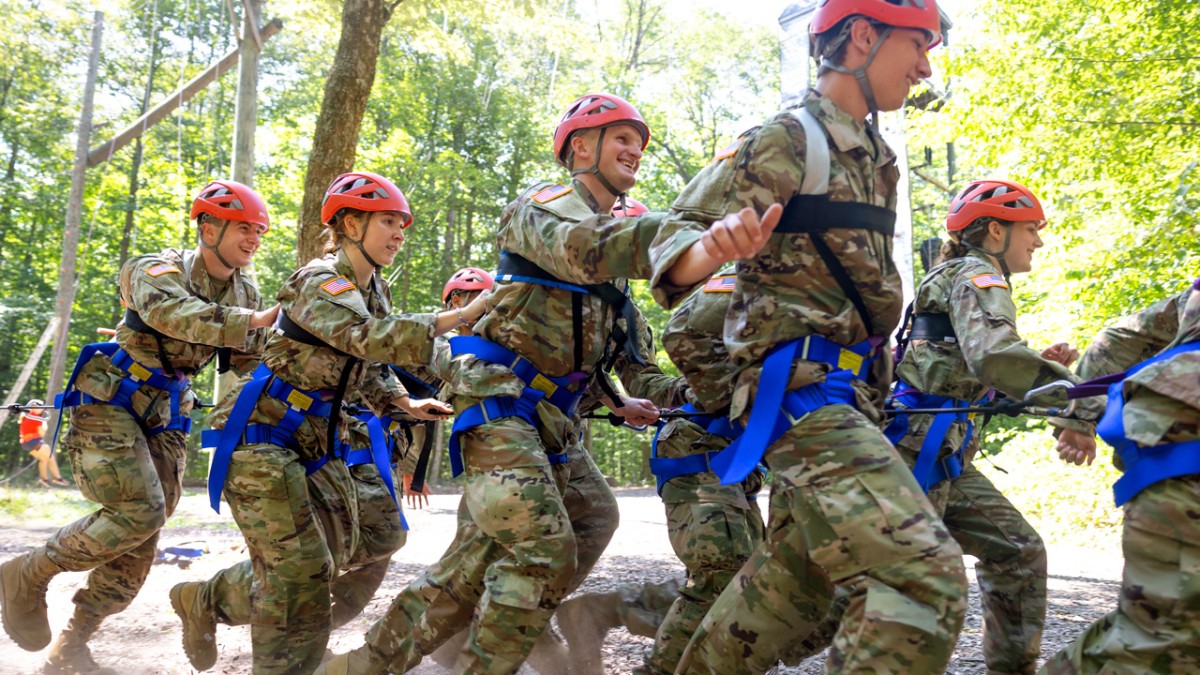
Cornell’s Tri-Service Brigade has 33 new Army cadets – the most since 1992.
Fitzpatrick and colleagues initiated contact with promising candidates, conducted scores of interviews and pitched Cornell’s advantages. They include an Ivy League education along with top-notch training facilities, from centrally located Barton Hall to more than 10 acres on nearby Mount Pleasant dedicated to orienteering and small-unit tactics; those skills factor into how officer candidates are ranked nationally.
“We’re engaging with some very savvy high school seniors who are driven and know what they want to achieve,” Fitzpatrick said. “It was just about the personal engagement of reaching out to these applicants and saying, ‘Bring your scholarship to Cornell, and you have a great opportunity to train and succeed and go where you want to go in the Army.’”
Some recent evidence supporting that claim: During Army Cadet Summer Training at Fort Knox in Kentucky, Fitzpatrick said, rising seniors from the “Excelsior Battalion” combined to rank Cornell in the top 15% of all 274 Army ROTC programs nationally.
Thomas Boifort ’29, a new Army cadet from Orinda, California, won admission to three service academies, but decided to explore a more traditional college experience through ROTC. When he planned a visit to Ithaca, he said Fitzpatrick responded immediately, provided helpful information and offered support throughout the application process. Boifort said that engagement that made a “huge difference” in his ultimately choosing Cornell and the College of Arts and Sciences.
Sonia Nkansah ’29, of Somerset, New Jersey, similarly scheduled a meeting with Fitzpatrick during a campus visit. She soon found herself touring Barton Hall; meeting cadets from her home state and who shared her interest in policy; and learning about Cornell’s military’s legacy.
“Cornell’s ROTC culture wasn’t just passive, but it was building you to be passionate about an Army career,” said Nkansah, a student in the Cornell Jeb E. Brooks School of Public Policy. “I thought that was cool, because it’s important to know what you’re getting into and to be excited for leadership roles.”
Brigade leaders believe this year’s strong ROTC class is not an aberration but reflects sustainable processes moving forward. The incoming cadets and midshipmen, meanwhile, also see strength in their numbers.
“It’s going to increase the camaraderie, because there’s going to be more people on campus who I can relate to, and we’re all in the same boat,” Boifort said. “I think it’ll make us stronger.”
Media Contact
Get Cornell news delivered right to your inbox.
Subscribe