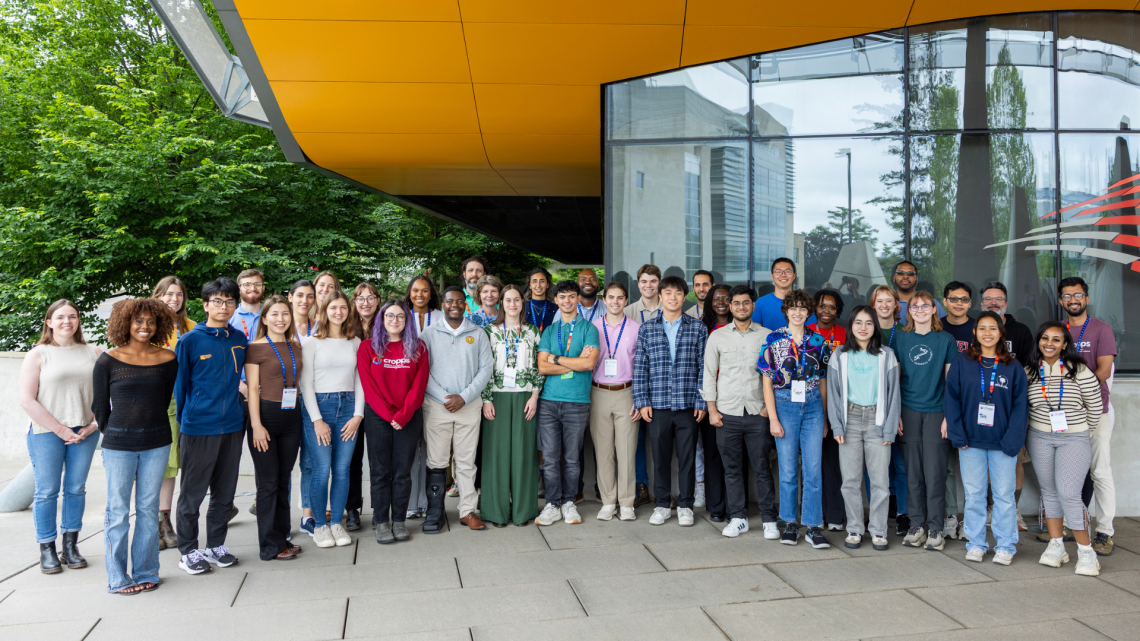
The extended CROPPS REU team.
News directly from Cornell's colleges and centers
Planting the future: Students dive into CROPPS summer research
By
Over the summer, thirteen undergraduates from across the country came to Ithaca to participate in the Center for Research on Programmable Plant Systems’ (CROPPS) Research Experience for Undergraduates (REU). Funded by the National Science Foundation, the 10-week program placed students in CROPPS labs at Cornell University. They worked on interdisciplinary projects in digital biology, from gene delivery to automation of plant tissue protocols.
“CROPPS is realizing its vision of opening a dialogue with plants and each of our 2025 REU participants reflect just how mature our research is,” said Darius Melvin, CROPPS assistant director and REU lead. “Not only can we achieve the goal of a programmable plant system, but we can also ensure that budding researchers are part of its development. Our REU program broadens participation in transdisciplinary research among undergraduates from many educational backgrounds.”
Because CROPPS is a multi-campus research center, students also worked in labs at the Boyce Thompson Institute (BTI) in Ithaca, with some placed in research labs at the University of Illinois Urbana-Champaign (UIUC).
The CROPPS REU program provides stipends, housing, and travel, ensuring students can access hands-on research in plant science and engineering. Nationally, REU’s support thousands of student researchers – approximately 6,000 undergraduates - each year, providing hands-on research experience.
“This broad participation is intentional, as CROPPS believes everyone has a place in transdisciplinary research, and their unique perspectives contribute to optimal outcomes,” Melvin said.
Projects in the 2025 cohort ranged from delivering mobile RNA clusters and investigating phosphorus cycling to using lipid nanoparticles to transfer genetic material into tomato cells. Others programmed plant growth, studied regeneration with laser-based imaging, or contributed to foundational knowledge about plant-environment interactions.

Noor AlBader, BTI postdoctoral student, explains CROPPS research to students on REU Welcome Day.
“My biggest takeaway was the opportunity to engage in a research project from start to finish,” said Ankai Jin, an electrical engineering major at UCLA. “I learned how to start a project from scratch—seeking help from mentors and embracing setbacks. In the end, I valued the opportunity to present my research to the plant science community.”
The REU reflects CROPPS’ commitment to experiential learning. A collaborative initiative led by Cornell with partners at BTI, UIUC, Tuskegee University, Colorado State University and the University of Arizona, CROPPS aims to develop programmable plant systems—plants that sense conditions and respond to the environment. Early research is exploring applications in moisture and nitrogen detection, pest defense and yield optimization.
“This experience has showed me what it is like to be a graduate student and has given me confidence that I can succeed in graduate school,” said Allison Kokal, a plant biotechnology major at the University of Illinois Urbana-Champaign. “It was very empowering; it truly was life changing.”
Mentorship and professional development were central to the summer. Faculty, postdocs and graduate students guided participants, while workshops in experimental design, science ethics, communication and graduate school preparation helped them build confidence and skills.
“My biggest takeaway from the CROPPS REU was to not be afraid to share my ideas,” said Aidana Kudaibergenova, a computer science major at Santa Monica College. “I realized that speaking up and putting your thoughts out there is the only way one can grow and make an impact.”
Beyond the lab, the students built community through outings to Ithaca’s waterfalls, social events and shared meals. These activities fostered collaboration, peer support and lasting connections.
For many, the REU is a launching pad toward graduate study, careers in research, or roles in sustainability and agricultural innovation. It also supports CROPPS’ vision of building a more capable scientific workforce.
As the 2025 cohort concluded its summer in Ithaca, CROPPS students leave with hands-on lab skills, a stronger scientific identity, new professional networks and a shared commitment to addressing global challenges in agriculture and climate resilience.
“My biggest takeaway from the REU experience at CROPPS is how collaborative research can be,” said Sophia Speller, a biology major at Xavier University of Louisiana, who also shared how the experience confirmed her desire to pursue a PhD in plant science and become a researcher. “I saw the connection between the work everyone is doing in CROPPS. It has amazed me, and I am excited for my future contribution to research.”
Henry C. Smith is the communications specialist for Biological Systems at Cornell Research and Innovation.
Media Contact
Get Cornell news delivered right to your inbox.
Subscribe