News directly from Cornell's colleges and centers
Cornell showcases semiconductor leadership at 2025 SUPREME annual review
By Adriana Ferreira
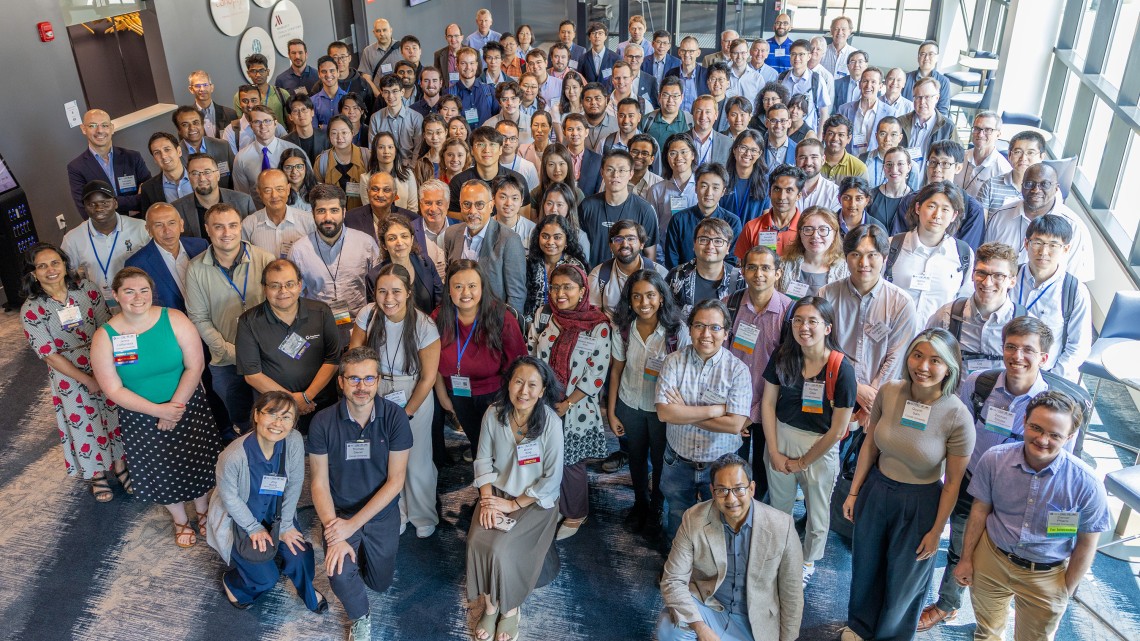
Cornell University hosted the 2025 annual review of the SUPREME research center July 29–31, bringing together more than 150 researchers, students, industry leaders and government officials at the new Ithaca Downtown Conference Center and on campus to highlight advances in next-generation semiconductor technology.
SUPREME — short for Superior Energy-efficient Materials and Devices — is a microelectronics center funded through the JUMP 2.0 program of the Semiconductor Research Corporation (SRC) and its partners. Led by Cornell, the center unites more than 25 faculty across 13 universities along with 250+ student researchers and 150+ industry liaisons to advance semiconductor technology while training the next generation of interdisciplinary scientists and engineers.
Cornell’s interim vice provost for research, Gary Koretzky, emphasized the importance of partnerships during his opening remarks, and how collaborations with industry advance fundamental science and drive real-world impact. “I am absolutely thrilled about the relationships with the students, both undergraduate and graduate,” Koretzky said. “They are our future scientists and our future workforce.”
Cornell sits at the center of a growing national semiconductor ecosystem — not only advancing foundational research, but also serving as a hub for technology transfer, workforce development and cross-sector innovation. With more than a dozen academic institutions and industry partners, including IBM and Taiwan Semiconductor Manufacturing Co. (TSMC), SUPREME exemplifies how Cornell-led efforts are expanding the reach and relevance of academic research beyond campus.
The three-day event began with lab tours across Ithaca’s campus and a welcome reception in Duffield Hall, followed by two days of technical presentations. Faculty from Cornell, the Massachusetts Institute of Technology (MIT), Georgia Institute of Technology, Stanford University, the University of Notre Dame, the University of Texas at Austin, Yale University, Boise State University and others shared updates on materials discovery and advanced processing, digital and analog devices, memory and applications, interconnects and metrology.
Students participated in lightning talks and poster sessions, presenting their work to sponsors and industry mentors and contributing to a growing talent pipeline. The event also featured remarks from Roman Caudillo, JUMP 2.0 director, and representatives from the Defense Advanced Research Projects Agency (DARPA), along with two Industry Keynotes by TSMC Deputy Director Iuliana Radu on advanced transistors and IBM Fellow Dan Edelstein on development of interconnects. Awards were given for outstanding student presentations.
The review reaffirmed Cornell’s leadership role in driving semiconductor innovation nationwide. “We are increasingly depending on computing and communications devices that are based on electronic systems, and we can make the materials and devices more efficient,” said Grace Xing, the William L. Quackenbush Professor at Cornell in electrical and computer engineering (ECE) & materials science and engineering (MSE), who directs the SUPREME center with co-director Tomás Palacios, professor of electrical engineering and computer science at MIT. Xing also emphasized on the good progress that SUPREME has made towards implementing new ways of research, including machine learning and artificial intelligence approaches that allow for the rapid and efficient synthesis, characterization, and screening of a large number of materials. These approaches are crucial for accelerating the discovery and development of new materials and processes needed to meet the increasing demands of the semiconductor industry.
SUPREME’s progress also reflects Cornell’s growing leadership in an area of urgent national need. As the United States increases investment in reshoring semiconductor manufacturing and rebuilding innovation capacity, centers like SUPREME are essential — not only for advancing fundamental science but also for creating pipelines of skilled talent, startup opportunities and scalable technologies.
By convening leaders across academia, government and industry in Ithaca, the 2025 review demonstrated how Cornell is elevating its research reputation, expanding interdisciplinary impact and positioning its researchers at the forefront of national innovation.
Media Contact
Get Cornell news delivered right to your inbox.
Subscribe