Through the Brooks Global Policy Exchange, students from Cornell, Ecuador, and soon Singapore are tackling policy challenges together while gaining real-world lessons in cross-cultural understanding and collaboration.
News directly from Cornell's colleges and centers
Brooks Global Policy Exchange adds new partner as model thrives
By Giles Morris
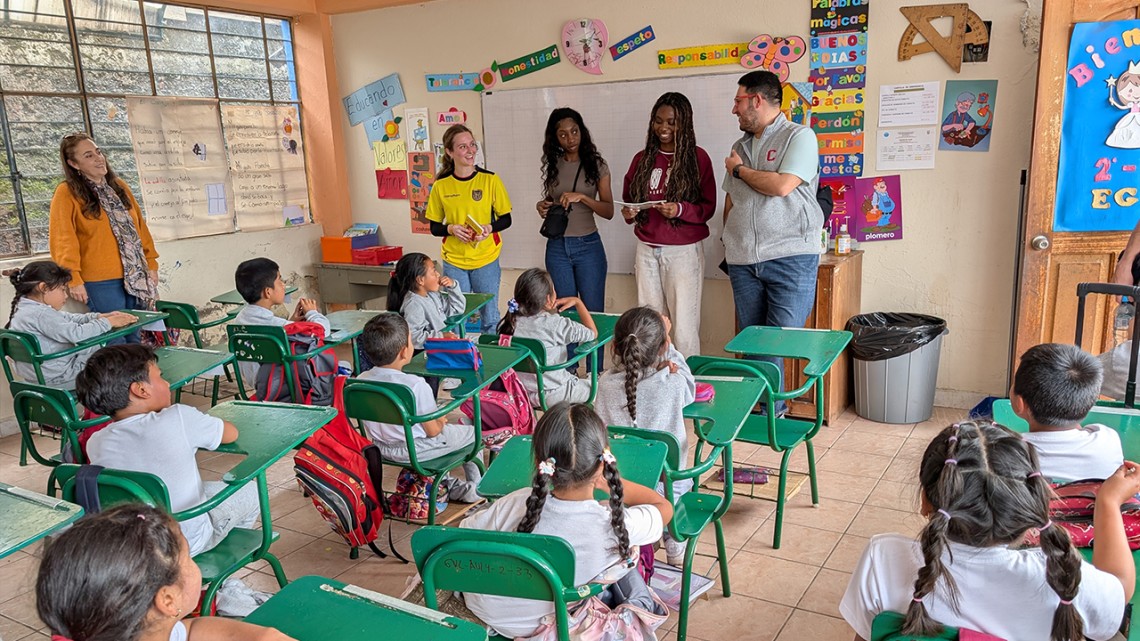
In April, Brooks junior Ariela Aslani ’26 helped to host 10 of her peers from the Universidad San Francisco de Quito (USFQ) in Ecuador, who arrived in Ithaca, New York, as part of the Brooks Global Policy Exchange, a reciprocal global learning experience that pairs teams of students from across universities and cultures to examine policy solutions over a 15-week course collaboration.
“This program challenged my assumptions about what cultural understanding really looks like. It’s not about mastering facts or frameworks, but about being present, listening deeply, and staying curious,” said Aslani. “It reaffirmed my interest in continuing with international work, and I’ll carry forward a stronger sense of empathy, adaptability, and cross-cultural communication into whatever academic, professional, or personal path I pursue.”
The program pairs Brooks’ course Sustainability Education Policy in the U.S. and Ecuador with a similar one taught at USFQ. Both courses meet in person for weekly seminars that explore education and sustainability policy challenges in the domestic context. Then online, students work in cross-institutional, bilingual teams to conduct comparative research identifying innovative policy solutions to address challenges in both contexts.
After getting to know each other as research collaborators and virtual classroom peers, the students take turns visiting each other in person and engaging with community-based organizations, policymakers, and stakeholders in Quito and upstate New York to learn how they are confronting local challenges with culturally relevant approaches.
The project was piloted in 2023, but last spring was the first time USFQ students came to campus as part of the Brooks Policy Exchange. Its genesis can be traced to a 2021 Cornell Global Hubs networking salon hosted by Global Cornell, where its founders, Cornell Brooks School Associate Teaching Professor Julie Ficarra, USFQ Professor and Director of the Service Learning Institute Karla Diaz, and USFQ Professor Nascira Ramia met to discuss ways partner institutions could create new kinds of international partnerships that could spark more meaningful exchanges.
With help from an International Cornell Curriculum Development grant, four years into the journey the Brooks Global Policy Exchange is working in the classroom in ways that its leaders believe can have more far-reaching impacts.
“Students with international policy interests often want to leap straight into another geographic context. Our exchange model asks them to start at home by examining a policy challenge in our own community and share those insights with USFQ colleagues to co‑imagine solutions,” Ficarra said. “Hosting USFQ students in Ithaca and being that link between them and a community partner or policymaker gives Cornell students a rare chance to experience what it’s like to be on the other side of that research lens and to build the cultural humility needed for meaningful cross‑cultural work.”
The Global Policy Exchange is the first of its kind to employ a Collaborative Hybrid International Learning (CHIL) methodology, which combines virtual exchange and physical student mobility. Ficarra, Diaz, and Ramia are collaborating on a study measuring the comparative global learning student outcomes between CHIL, virtual exchanges, and traditional study abroad programs. Ficarra presented this research at the Forum on Education Abroad in Toronto in March, and Diaz and Ramia reported findings at the International Association for Research on Service Learning and Community Engagement in Durban, South Africa, in August.
“Comparing program models to get at what really makes the biggest difference in global learning helps us design more effective international programs,” said Diaz. “Quantifying change in students’ attitudes toward cultural humility, critical reflection, and civic action builds our confidence that this model works.”
When Ficarra reported on the pilot program during the 2024 Cornell Global Hubs meeting in London, it attracted the attention of a third partner institution, the National University of Singapore (NUS), which will join the exchange in spring 2026.
NUS students will engage in comparative policy research with Cornell and USFQ students online. Cornell and NUS students will conduct fieldwork in Quito, and USFQ students will conduct fieldwork in New York, creating a trilateral exchange, another first for Cornell.
“This program illustrates the sort of collaborative institutional exchange that embodies and builds on Cornell’s Land Grant to the World ethos,” said Cornell Vice Provost for International Affairs Wendy Wolford. “We are thrilled to see the university’s Global Hubs fostering long-term, multidirectional programs that prepare our students for global careers and instigate real collaboration at every level between the participating institutions.”
Giles Morris is assistant dean for communications in the Cornell Jeb E. Brooks School of Public Policy.
Media Contact
Get Cornell news delivered right to your inbox.
Subscribe