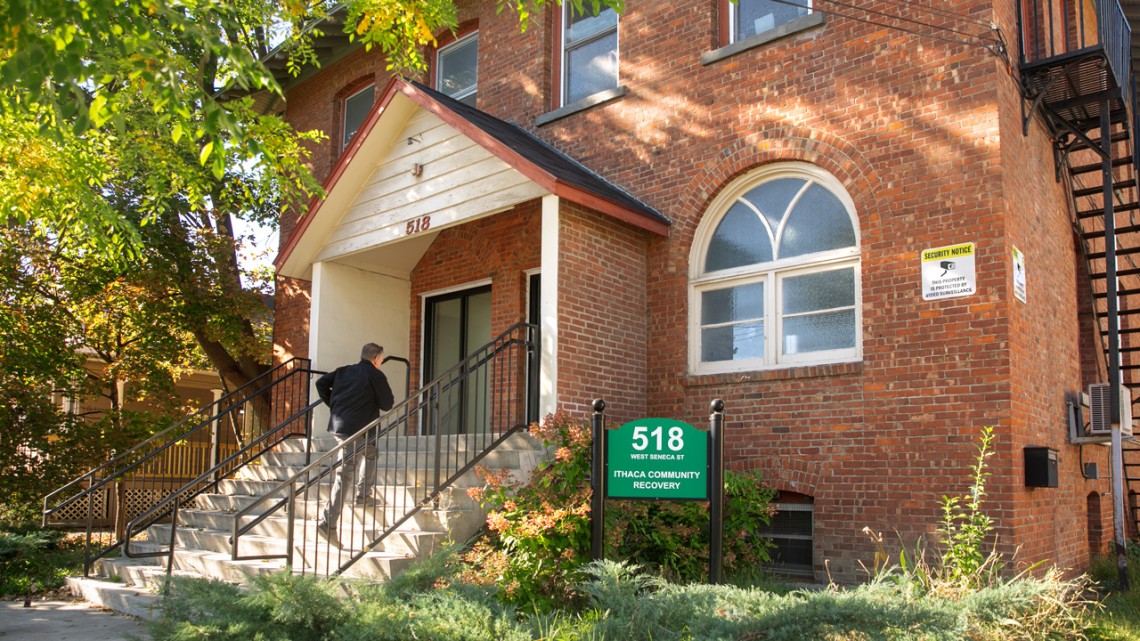
Ithaca Community Recovery, located in downtown Ithaca, schedules more than 200 meetings a month for 35 groups - a new platform designed by project team Hack4Impact will make it easier to populate, track and edit the calendar.
Students design crucial tool for Ithaca’s recovery community
By Caitlin Hayes, Cornell Chronicle
For someone in recovery, a support-group meeting can be a lifeline, a point in the future they can depend on for the help they need. The nonprofit Ithaca Community Recovery (ICR) hosts more than 200 such meetings a month – and managing the calendar has been no small task for the all-volunteer board.
After two years of collaboration, students on the Cornell Engineering project team Hack4Impact delivered to ICR a tool that will streamline scheduling and make the calendar more reliable for those in recovery who rely on it.
“It’s such a bad thing to have a meeting advertised, and it doesn’t happen,” said Scott Sherwood, a former president of ICR, who worked with the students on the project. “But trying to keep a good schedule is a really difficult thing, and then to communicate that out in a way that automatically updates – it’s something we really need.”
ICR hosts meetings for around 35 groups that provide support for those recovering from substance abuse, gambling addiction, domestic violence and more, with an estimated 30,000 points of contact with people in the community every year. Many of the meetings are held in-person at ICR’s downtown location, but there are often hybrid or online options as well. A volunteer for ICR makes sure there’s no overlap in booking the spaces and the organization’s four Zoom accounts, and ensures public-facing calendars are up-to-date; it’s one of the group’s most important, difficult and time-consuming roles.
The new app will make it much easier to assign and see the location and Zoom link associated with meetings, and it will automatically update the website when changes are made. The calendar will be broadcast on a monitor, bought with funds from the Rotary Club of Ithaca, that is visible through the front doors of ICR’s building at 518 West Seneca St.
“It could be 2 a.m. on your worst night ever, and maybe you’re sleeping in that alcove at the building’s entrance. Now you’re going to be able to look in and see when the next meeting is,” Sherwood said. “That can change a life.”
Students said they hope the new platform makes ICR’s services even more accessible and frees ICR volunteers to do more important work.
“Accessibility makes all the difference,” said Sophie Wang ’26, project lead and an information science, systems and technology major in the Cornell Ann S. Bowers College of Computing and Information Science and Cornell Engineering. “We’re hoping with this platform, we can make it easier for them and help break down barriers and stigmas.”
Designing the platform has given 24 students, over three semesters, the chance to learn the latest software applications and languages.
“Being on this project, I feel like I learned how to learn – how to learn a new tech language, a new stack,” Wang said. “And the project is very up-to-date with what’s popular in the current industry. … We’ve been able to do a lot of work that people in more senior roles in industry would do.”
Tuni Le ’26, project lead and a computer science and math major in Cornell Bowers and the College of Arts and Sciences, said being able to work for a real partner, for longer than a semester, has been the best preparation for the workplace. And his connections with Sherwood and others in the Ithaca recovery community have motivated him and the team to do their best work.
“It’s really a different kind of challenge than you would get in a class,” Le said. “It’s been exciting to continue working on something that has real-world impact that you can see, because you’re able to see these people and connect and be a part of their journey.”
A student-run maintenance committee, serving all of Hack4Impact’s projects, will be available to ICR if any problems with the platform arise.
Wang and Le said their overall work with Hack4Impact – which has executed more than 20 projects across four countries – has reinforced a desire to use their technical skills and talents to make a positive impact and has given them a blueprint for the work they want to do in the future.
“Working on these projects, both getting to learn the technical skills, the soft skills, while also contributing to the greater community – it’s just solidified what I find important,” Wang said. “It’s had an impact not only on what I want for my career but also my own personal values.”
Le agreed. “In high school I had this community service that I loved to do, but then I was good at computers, too. I didn’t know if I could bring those two together,” he said. “Hack4Impact gave me opportunities where I’m able to do what I’m good at and what I love.”
Media Contact
Get Cornell news delivered right to your inbox.
Subscribe