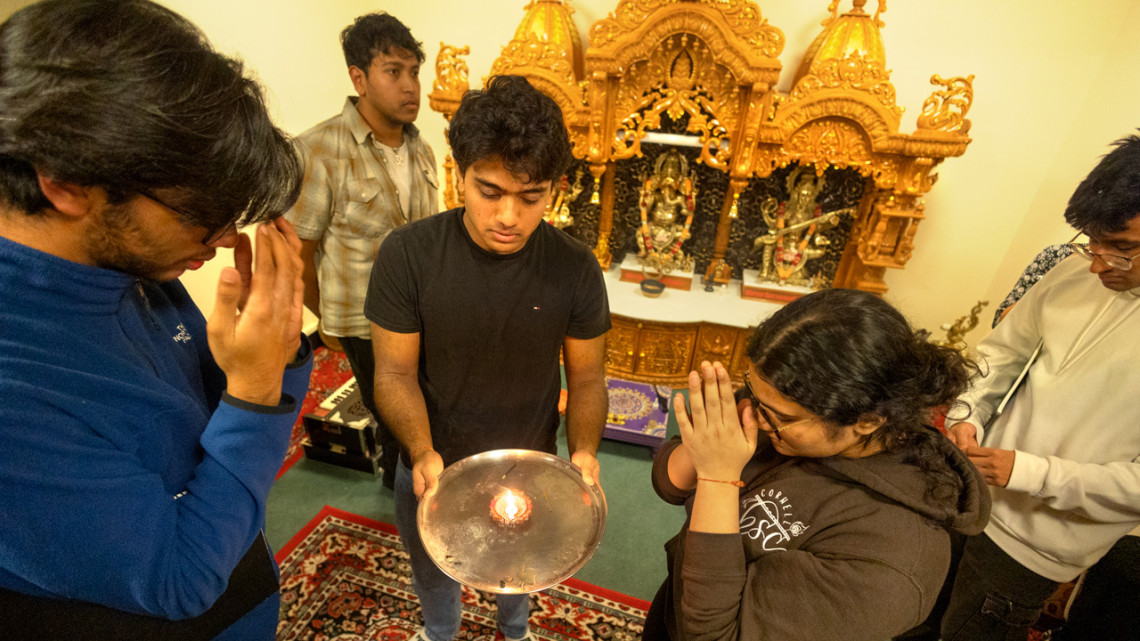
Megh Prajapati ’26, (center) former Hindu Student Council president, and Esha Shah ’27 (right), HSC’s current president, take part in blessings in the Hindu Temple room in Anabel Taylor Hall. They pass their hands over the flame and then over their heads and faces to receive sacred energy from the light of the diya.
‘Good vibes’: Campus spaces support flourishing religious communities
By Holly Hartigan, Cornell Chronicle
Megh Prajapati ’26 describes the Hindu temple as being like a fireplace in a cold house.
“There’s so much going on in the world, so much going on in the community,” he said. “It’s always changing. And then there’s this one space that’s always going to be a constant source of good vibes and positivity.”

Members of the Hindu community chant in the temple room.
Prajapati and his fellow students on the Hindu Student Council (HSC) have built their own warm space: a temple room on the second floor of Anabel Taylor Hall, a place to pray, to meditate, to gather and to house their murtis – golden idols that embody gods and goddesses.
Significantly larger and more welcoming than the previous Hindu prayer space in the building, more people are using the room on a regular basis, including devotees from outside Cornell.
The rising participation is part of a wider trend of increased attendance at religious events across faith groups on campus. As students express their interest in religion, faith-based organizations and the campus itself are evolving to meet their needs.
“We’ve seen increased engagement pretty much across all of our religious traditions,” said Joel Harter, associate dean of students and director of the Office of Spirituality and Meaning-Making and Cornell United Religious Work.
“It’s essential to the health and well-being of students to provide this space,” he said. “It’s part of our mission of helping students, giving them the opportunity to engage with different cultures, identities and traditions, and teaching students how to do that well.”
For example, the Diwan Center for Muslim Life at Cornell opened in Anabel Taylor Hall’s third floor last year, providing prayer and community spaces and an ablution station. The Steven K. and Winifred A. Grinspoon Hillel Center for Jewish Community at Cornell is building a center on West Campus. Attendance at Sunday Catholic Masses has increased from approximately 300 in 2019 to approximately 500 today, and students are increasingly participating in discussions and presentations on religion, according to Elizabeth Lyon Hall, Ph.D. ’21, executive director of the COLLIS Institute for Catholic Thought and Culture.
“I think they are looking for truth and also for experiences of beauty and goodness and shared traditions,” Lyon Hall said.

Shria Shyam, HSC executive board member and a doctoral student in Cornell Engineering’s School of Civil and Environmental Engineering, sings during the community’s weekly bhajan in the auditorium adjacent to the Hindu Temple room.
In the Hindu community, “We have more people coming to our weekly services,” said Prajapati, who is a biological sciences major in the College of Agriculture and Life Sciences. “We have more people coming in to pray and meditate now, and I think that shows us that there really always was a need.”
As HSC president last year, Prajapati spearheaded fundraising to commission artists in India to hand carve the wooden temple, which fills one wall in the richly carpeted room. HSC members, their families and the Cornell community donated $16,000, and the Interfaith Council contributed the final $8,000. Prajapati’s parents traveled to India to find a vendor and assist with logistics.
“It was a whole journey,” Prajapati said, “with long nights, long hours talking on the phone with vendors, negotiating, securing the design and getting it in the building.”
The temple provides a home for three Hindu deities, carefully selected for a university community: Ganesh, remover of obstacles; Saraswati, goddess of knowledge or wisdom; and Lakshmi, goddess of prosperity.
The community officially inaugurated the temple with a ceremony on Sept. 6 that drew around 300 people.
The group’s previous closet-sized space fit only one or two people, and they had to move their murtis in and out of storage, risking breakage.
“The importance of a space is critical in Hinduism, because it’s the home for the gods, and to have that on campus was very, very important,” Prajapati said. “Every week there would be murtis in the closet. During a service, we would bring them out to the room, we would set them up and at the end they would have to go back into the closet. There was always a little bit of sadness associated with that.”
Organ music in the nearby chapel distracted from prayers, and they had to discourage people from leaving offerings and couldn’t burn incense.
“We realized we needed a space that was purely our own, where not only would we be able to pray, we would be able to pray the way that we want,” said Spoorthi Patil ’25, a biomedical engineering major in Cornell Engineering and former HSC president.
The new room can accommodate approximately 20 people, but its location adjacent to an auditorium space means the group can hold its larger weekly services and other events nearby.

The new Hindu temple room on the second floor of Anabel Taylor Hall offers a place to pray, meditate, gather and house Hindu murtis – golden idols that embody gods and goddesses.
Esha Shah ’27, HSC’s current president and a computer science major in Cornell Engineering and the Cornell Ann S. Bowers College of Computing and Information Sciences, said the room has encouraged devotees to linger and chat.
“I feel so much joy when I see people’s shoes outside the temple, and I know there are people inside,” Shah said.
Community members travel from as much as 30 minutes away to use the temple room, which surprised the students, but the next-nearest temple is almost an hour away.
“Every person I see use the room, it’s like my heart has fireworks,” said Shivani Singh ’23, currently a third-year law student, who studied industrial and labor relations in the ILR School and is a former HSC president. “It’s just been very emotional to see what we’ve been able to do for the community.”
Prajapati said he thinks increased attendance at religious events reflects efforts that have been growing steadily over the past two decades.
“Students like us in all these different faith-based organizations have been working tremendously over the past few years to create the infrastructure and create micro-environments within Cornell’s culture where people can feel safe to pray, where people can feel safe to practice their religion,” he said. “I think the administration has done a great job of supporting that.”
The permanent, consistent space has brought the Hindu community together and fostered conversations with people using the building in a similar way, across faith groups.
“What happens is, you meet other people who are doing the same things as you,” Shah said. “I feel like that conversation that you have with them then increases that interest in religion and creates new perspectives and new ideas.”
Media Contact
Get Cornell news delivered right to your inbox.
Subscribe
