How evergreen trees shaped human history
By Beth Saulnier
In the early 1770s, American colonists furious over British meddling in their trade of a key agricultural product finally had enough and rose up – an act of rebellion that would ultimately spark a revolution.
But this wasn’t the Boston Tea Party.
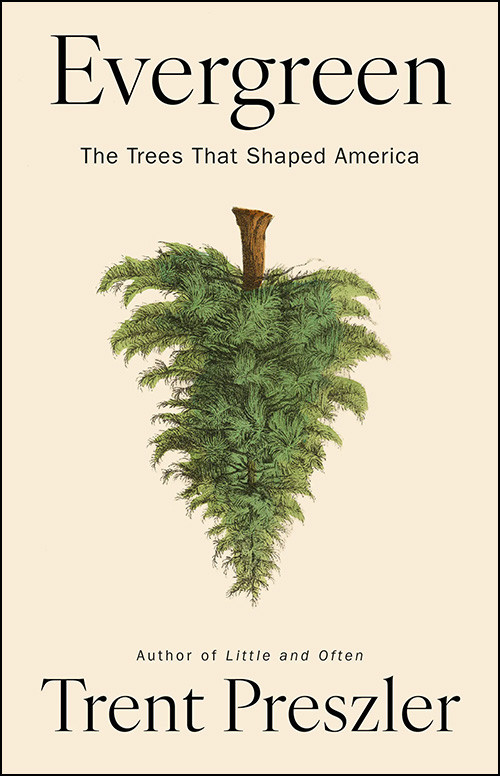
It was the Pine Tree Riot – a bit of rural lawbreaking by some New Hampshire residents that would inspire their Massachusetts brethren a year later. And it’s just one of the myriad ways that evergreens have played a transformative role in human history – chronicled in “Evergreen,” a new book by Trent Preszler, M.S. ’02, Ph.D. ’12, a professor of practice in the Dyson School of Applied Economics and Management, in the Cornell SC Johnson College of Business.
“It’s like the courtroom drama that would unfold if you brought evergreens onto the witness stand and swore them in,” Preszler said. “They kept the receipts about everything, from world wars to religion to construction booms. I basically just wrote down everything that they’ve been trying to tell us for 365 million years.”
That includes the trees’ connection to slavery in the Deep South, where workers were forced to clear-cut land for cotton cultivation; the environmental toll of today’s artificial Christmas trees, which Preszler decries as yet another source of plastic waste; and how the timber industry offered an unlikely refuge for gay men in an era when homosexuality was criminalized.
Why did Rome fall? As Preszler describes it, the main reason wasn’t lead pipes, mad Caesars or military overreach: It ran out of wood. Vast stands of Aleppo pines that once graced the Apennine Mountains were razed to fuel iron smelters and even heat bathhouses – like Rome’s famed Baths of Caracalla, which consumed 10 tons of firewood daily.
“The Romans had to maraud through Europe and Northern Africa because they were desperate for more wood,” Preszler said. “They needed more trees, and eventually it was their downfall.”

Trent Preszler, M.S. ’02, Ph.D. ’12, a professor of practice in the Dyson School of Applied Economics and Management, in the Cornell SC Johnson College of Business
And ancient Rome was hardly the last civilization to capitalize on its evergreens – and then suffer for having used them up.
“This is human folly,” he said. “It’s the pattern that has repeated throughout history: We deplete our resources, then throw our hands in the air and ask, ‘What are we going to do now?’”
That’s where the Pine Tree Riot comes in.
A key impetus for Britain’s expansion across the Atlantic was the quest for tall, straight trees to serve as masts for its naval ships, having exhausted the island nation’s native supply.
After a brisk lumber trade grew up in the colonies, Britain decreed that mast-worthy white pines – those with trunks more than 24 inches wide – were property of the Crown. Royal surveyors would carve a special mark into the forbidden trees; naturally, the colonists would swiftly fell them for lumber.
So Britain doubled down, declaring that all white pines were off limits, and even sending a sheriff to arrest some New Hampshire sawmill operators for illegal harvesting. On April 14, 1772, that road-weary lawman stopped at a tavern for a drink of ale – and was promptly ambushed by a band of irate locals led by an anti-royalist sawyer named Ebenezer Mudgett.
“A veteran of countless disputes with Crown officials, Mudgett and his friends dragged the hapless sheriff outside, held him upside down by his ankles, and whipped him mercilessly with pine boughs – an ironic punishment delivered with savage glee,” Preszler writes.

Spray-painted Christmas trees he saw at a Long Island tree farm a few years ago inspired Trent Preszler's interest in evergreens.
Preszler’s interest in evergreens started with some oddly colored Christmas trees. A few years ago, he went shopping at a Long Island tree farm and encountered specimens spray-painted outlandish, unnatural colors.
“Being both a botanist and an economist, I was fascinated by the fact that we took the most natural thing in the world – probably our most renewable resource – a tree, and it still wasn’t good enough; we had to spray paint it gold and pink and blue,” he recalls.
“And they were the bestsellers,” he said. “People were driving off with them, and I was in awe at how commercial the whole entire enterprise had become. That sparked curiosity: If I followed this story, where would it go?”
In his research, Preszler explored the essential role that spruces played in aircraft construction during World War I. He learned about traditional Native American forestry practices, including controlled burns – and the environmental catastrophes that ensued when Europeans quashed those traditions.
But perhaps the most surprising story he encountered was the role of logging in LGBTQ history of the 19th and early 20th centuries – something that Preszler, himself a gay man, never knew.
“In that era, logging was the most dangerous profession on Earth,” he said. “They used axes to cut down trees that were 30 feet wide. If you worked a 10-year career as a lumberjack in the late 1800s, you stood about a 50-50 chance of being crushed to death.”
At that time, Preszler notes, the word “homosexuality” didn’t exist in English; sex between men was punishable by incarceration, institutionalization and even forced sterilization.
“This ostracized subculture of men with no other options in life – destitute and poor and sad – turned to the forests,” he said. “And the timber barons of the time were eager to hire a labor force that was expendable and invisible.”
As a result, he says, from around the 1849 California Gold Rush through World War I, the majority of timber-cutters were queer men – a population also heavily represented in the Civilian Conservation Corps of the 1930s.
“I was shocked to find archival photos of men in lumber camps holding hands, having ‘bachelor weddings,’” he says. “It turns out that it was a whole culture; the forest became their refuge.”
Beth Saulnier is editor-in-chief of Cornellians.
Media Contact
Get Cornell news delivered right to your inbox.
Subscribe