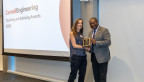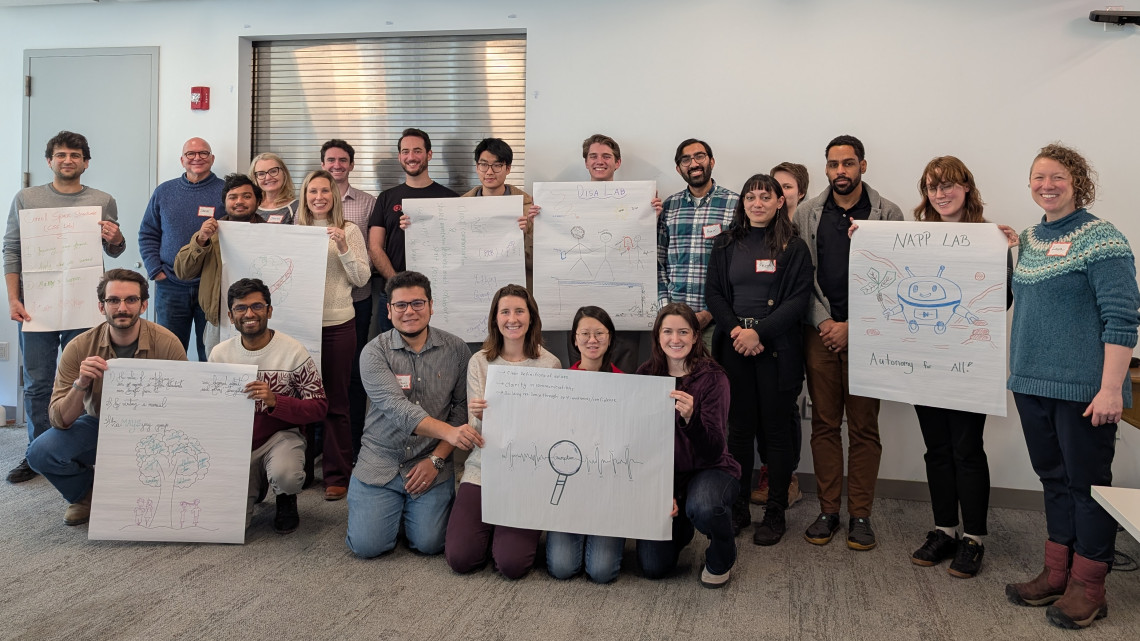
Participants of the Radical Humanity in Research program, founded by Laura Schoenle, associate director of undergraduate research in Cornell Engineering’s Office of Inclusive Excellence (right), showcased their respective group’s shared values during a program celebration event on Dec. 18 in Upson Hall. This semester’s participants included members from research groups led by Julia Dshemuchadse, assistant professor of materials science and engineering; Megan Holycross, assistant professor of earth and atmospheric sciences; Karl Lewis, assistant professor of biomedical engineering; Jacob Mays, assistant professor of civil and environmental engineering; Nils Napp, assistant professor of electrical and computer engineering; Elaine Petro, assistant professor of mechanical and aerospace engineering; Fabien Royer, assistant professor of mechanical and aerospace engineering; and Yu Zhong, assistant professor of materials science and engineering.
News directly from Cornell's colleges and centers
New program centers mentorship, culture in research groups
By Syl Kacapyr
In addition to advancing discovery through their research, scientists and engineers at Cornell are shaping how the next generation learns, collaborates and thrives. That dual mission was on display Dec. 18, when Cornell Engineering faculty and students gathered in Upson Hall to celebrate the first participants to complete Radical Humanity in Research, a new program designed to strengthen the human foundations of high-impact research.
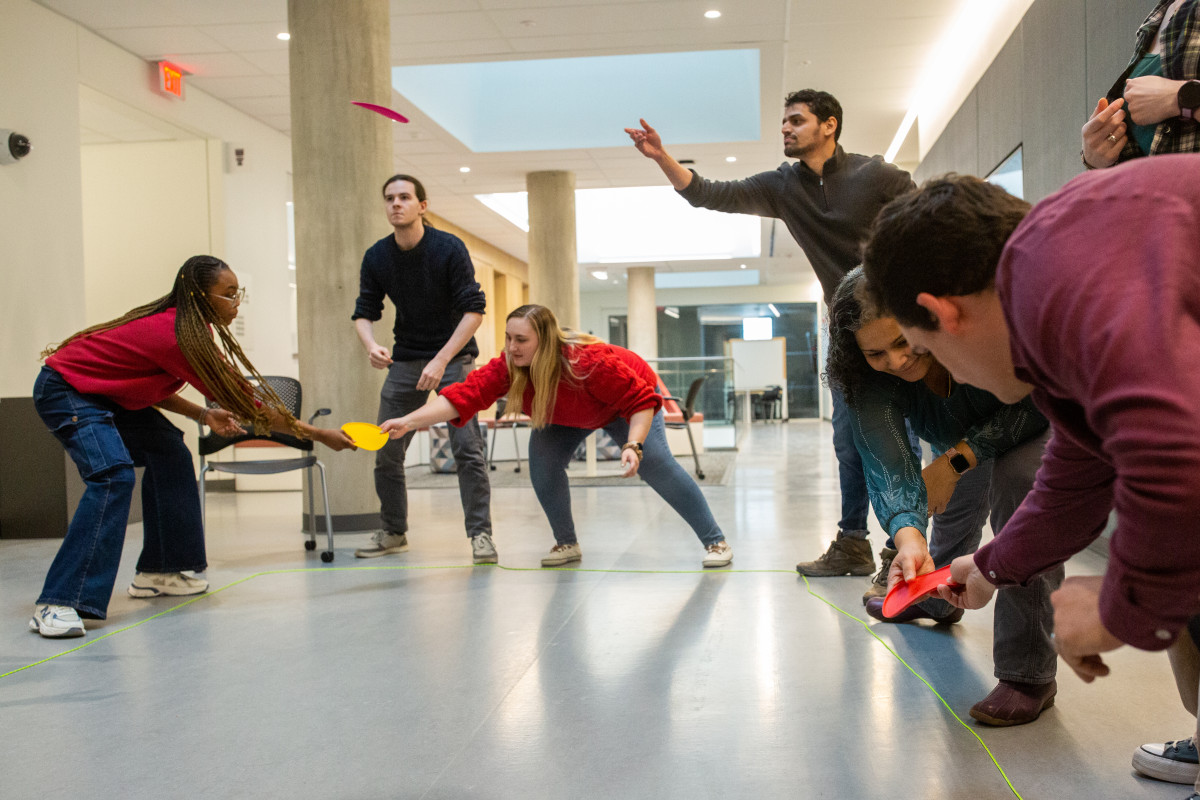
Participants of the Radical Humanity in Research program during a teambuilding workshop designed to strengthen communication, mentorship and shared expectations.
Launched as a pilot program in January with three research groups, Radical Humanity in Research has since grown to include eight more groups across Cornell Engineering. The multi-week, team-based professional development program facilitates interactive workshops for research groups and executive coaching for faculty, with the goal of cultivating a values-centered research culture built on communication and mentorship.
“The outcome of a research group isn’t just papers, products and the things we often hold up as evidence of distinction in research,” said Lynden Archer, the Joseph Silbert Dean of Engineering, during remarks at the celebration event. “It's fundamentally about the quality of the people that you've developed. Faculty members have a certain set of characteristics about how they engage their mentees that, ultimately, will lead to successful research that impacts human beings and the development of human talent.”
The program was conceived and led by Laura Schoenle, associate director of undergraduate research in Cornell Engineering’s Office of Inclusive Excellence, who said it was designed with pre-tenure faculty in mind, particularly those at a pivotal moment when their research groups are growing. As faculty add graduate students, postdocs and undergraduates to their groups, the demands of leadership expand.
“The real central tenant underlying the program is that as we prioritize the humanity of researchers and help them intentionally cultivate connection and culture, research can then follow,” Schoenle said. “I’m proud that Cornell Engineering is investing in this kind of professional development, and I’m excited to see how it will ripple outward into labs, departments and disciplines.”
Among the participants reporting on their program experience at the celebration event was Karl Lewis, assistant professor of biomedical engineering, who said that group discussions facilitated during the workshops were both challenging and beneficial.
“One of the things that came out of our discussions, in addition to a very clear list of our values as a group, is this sort of collective awareness that having discussions between different people requires a lot of intention for translation,” Lewis said. “A lot of the work that our facilitator helped us get through was getting on the same page around core issues to each of us in the group.”
Ankit Disa, assistant professor of applied and engineering physics, said he appreciated formal training on how to capitalize on his group members' different skills, backgrounds and motivations. In a workshop exercise, he and his students discussed what they like about how their lab operates, and what they would like to see done differently.
“We never had those conversations before, so just the openness and getting comfortable having those conversations was the first step,” Disa said. “The next thing we did was work on how to give feedback to each other so that we're not in conflict and we're really collaborating to figure out ways to help each other grow.”
Schoenle worked with a number of collaborators to make the program successful. These include specialists in engineering education research - Alexandra Werth, assistant professor in the Meinig School of Biomedical Engineering, and Alexandra Coso Strong, associate professor in the Systems Engineering program and the Robert Frederick Smith School of Chemical and Biomolecular Engineering. The support of Hadas Kress-Gazit, associate dean for diversity and academic affairs at Cornell Engineering, and additional facilitation from the Organizational Development and Effectiveness Team at Cornell’s Division of Human Resources were also invaluable.
Media Contact
Get Cornell news delivered right to your inbox.
Subscribe