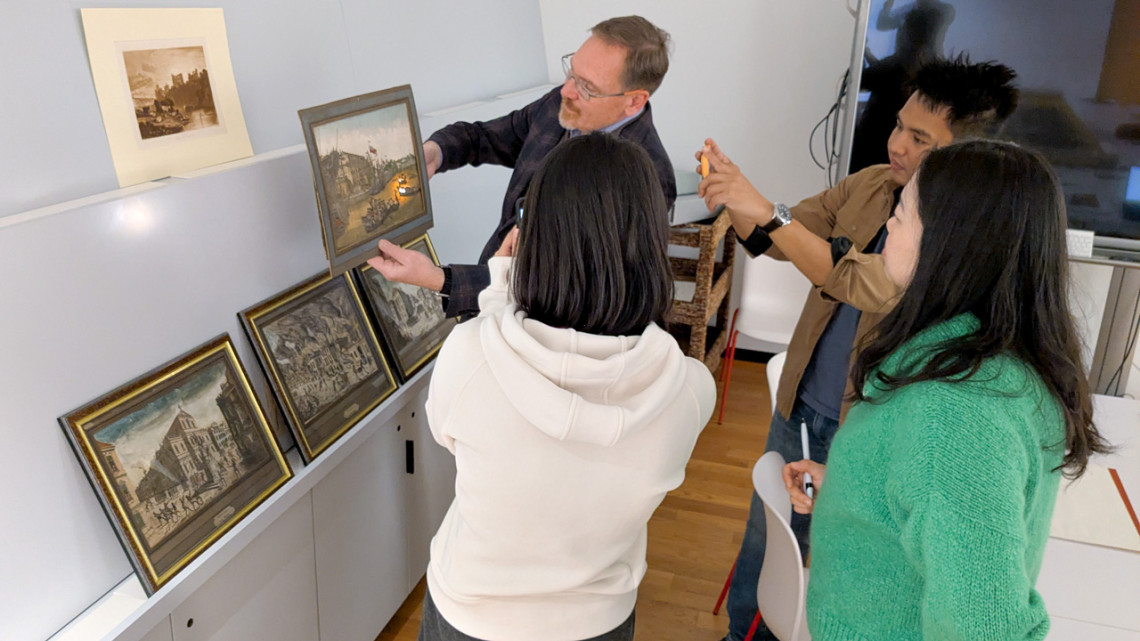
Andrew C. Weislogel, the interim chief curator at the Herbert F. Johnson Museum of Art, shows students a piece depicting staffage in an early scene of New York Harbor.
Museum installation focuses on small figures in large landscapes
By Kathy Hovis
The tiny figures in landscape paintings may be barely noticeable, but sometimes they reveal a deeper story about the scene or the person who created it.
A new student-led installation at the Herbert F. Johnson Museum of Art explores how the figures, known as “staffage,” indicate scale in paintings and also tell larger stories about the art.
In the tradition of European landscape painting, staffage figures “give the painting a sense of depth, but also a possibility of narrative, some kind of literary component,” said Benjamin Anderson, associate professor in the Department of History of Art and Visual Studies in the College of Arts and Sciences, who taught a fall 2025 Society for the Humanities seminar that inspired the installation.
“The general idea was that the entire painting was executed and then the staffage was added,” Anderson said. “In fact, some painters didn’t do their own staffage.”
After studying and reading about the aesthetics and politics of landscape painting in the seminar, students viewed various works featuring staffage from the museum’s permanent collection, selected by Anderson and Jakub Koguciuk, the museum’s Lynch Postdoctoral Associate for Curricular Engagement.
Students then combed through the museum’s online catalog to choose a work that illustrated or expanded upon the idea. Students researched their chosen artwork, ranging from European prints to Asian art, and wrote descriptions that appear in the installation.
“Jakub and I were really keen on exhibiting more students’ writing in the museum,” Anderson said. “This is a much wider range of voices than you usually get in the museum.”
The installation will be on display until early March in the museum’s Richard Sukenik ’59 Teaching Gallery.
“The teaching gallery space allows us to ask students to help us tell the stories of the works of art we do not usually see,” Koguciuk said. “For instance, we decided to pair a baroque landscape by Salvator Rosa with a Qing-dynasty Chinese scroll representing an archery contest. Even though they come from disparate cultures, the comparison has a lot to teach us about the modes of landscape representation.”
Alberto Salgado, a master’s student in landscape architecture, chose a piece entitled “Five Monkeys” by artist Mori Sosen for the display. In this case, the animals were clearly painted first and the landscape added after.
“This painting serves as a harmonious balance between serenity and turbulence, beauty that is literal and beauty that is subliminal,” Salgado wrote in his descriptive label accompanying the painting.
Salgado said he chose the painting so he could explore how animals could also serve as staffage in a piece.
“I was drawn by the inquisitive nature that the monkeys portrayed, particularly as one of them attentively observes a wasp as it hovers near its nest,” he said. “In this case, the monkeys that are depicted somehow enhance the landscape painting by acting as a proxy through which my curiosity is then projected toward the landscape painting just as much as the monkeys appear to engage and act curiously toward the wasp.”
Elja Sharifi, a doctoral student in history of art and visual studies, chose a Persian manuscript painting that depicts a scene from the epic poem “Shahnameh.” The hero of the story, Rustam, is seen shooting arrows toward a prince.
“Since I grew up in Afghanistan speaking Persian and reading Firdausi’s ‘Shahnameh,’ this work is deeply meaningful to me because of its cultural and personal identity ties to my homeland,“ Sharifi said. “I found the painting particularly well-suited to this exhibit due to the presence of several figures within an elaborate landscape setting and the abundance of detail throughout the image.”
Kathy Hovis is a writer for the College of Arts and Sciences.
Media Contact
Get Cornell news delivered right to your inbox.
Subscribe