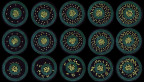
A jellyfish robot from Rob Shepherd’s lab.
The robots are here. And they mean business.
By Laura Reiley, Cornell Chronicle
From hospital wards to crop fields, from microscopic swarms to biohybrid machines powered by fungi, robotics research at Cornell spans an astonishing range of scale, application and ambition.
In this week’s episode of Research Matters, Cornell professor Robert Shepherd explores a radically reimagined future of robotics – one built not from bolts and steel, but from living tissues, fungal networks and soft, 3D-printed materials.
Shepherd, the John F. Carr Professor of Mechanical Engineering in Cornell Duffield College of Engineering, explains how biohybrid robots are powered by living cells, how mycelium can function as both building material and sensing network, and how volumetric 3D printing allows entire soft robots, complete with internal skeletons, to be created in a single step. Shepherd’s work in soft robotics has helped shape the field internationally.
Shepherd’s lab focuses on flexible materials, embedded sensing and actuators that mimic the adaptability of biological tissue. His research explores how robots can be built from compliant materials that stretch, bend and respond dynamically to their environments – a sharp contrast to traditional rigid machines. Across multiple projects, Shepherd’s work has advanced the idea that softness is not a limitation but a capability, enabling safer human-robot interaction and new forms of movement.
He has integrated mushroom mycelia with robotic systems, using the fungi’s natural electrical signaling to influence robotic behavior. These biohybrid robots blur the boundary between organism and machine, raising new questions about sensing, control and the role of living materials in engineering.
In another project, his team developed a soft robotic gripper that can inject plant leaves with extraordinary precision. The device gently grasps delicate foliage while delivering targeted treatments, minimizing damage and improving efficiency. By marrying soft actuation with precision control, the system could enable more sustainable crop management practices.
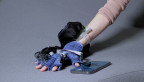
And in a third, he and fellow researchers created a rugged new electronic braille display powered by tiny, carefully controlled explosions. Instead of relying on thousands of fragile mechanical parts, the soft robotic system uses miniature bursts of ignited gas to rapidly pop up small silicone dots that form braille characters, then lock them in place until reset. Built from flexible, sealed rubber sheets, the device is more durable and resistant to dirt and spills than traditional braille readers.
Shepherd is in good company. Recent stories from across the university highlight a robotics ecosystem that is at once deeply technical and profoundly human-centered – designing systems that relieve swelling in patients’ hands, reduce the burden on nurses, assist people with disabilities and even rethink how machines interact with living organisms. Together, the projects underscore how Cornell has become a hub for robotics innovation, with faculty helping to redefine what soft, adaptive machines can do.
Media Contact
Get Cornell news delivered right to your inbox.
Subscribe