Human patrols boost migrating amphibians
By Holly Hartigan, Cornell Chronicle
Conditions rarely beloved by humans – 42 degrees, raining, dark – are perfect for salamanders.

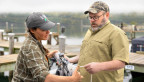
Graduate student Stephen Bredin, president of Tompkins County Amphibian Patrol (TCAMP), holds a spotted salamander he found during a patrol in early March. It can take a migrating salamander 10-15 minutes to cross a road.
As winter ends, all around the Northeast, salamanders and frogs emerge from their upland habitats ready to find a mate. But when a road stands between them and the temporary spring pools where they lay their eggs, as many as 20-30% of a local population can be killed by cars in a single night.
That’s why in Tompkins County and beyond, volunteers are donning reflective vests and headlamps and heading out into that cold, dark rain to help the local salamanders and their frog brethren cross roads safely.
They are part of Tompkins County Amphibian Patrol (TCAMP), a 3-year-old organization run by two Cornell graduate students: founder and president Stephen Bredin and vice president Stephanie Tran. They lead an annual community science project to collect amphibian road mortality data, assigning volunteers to patrol routes and providing safety gear, data sheets and training. In spring 2025, 215 volunteers surveyed more than 100 road sites across Tompkins County, documenting 7,000 amphibians. Approximately 3,000 of those had been killed.
“These guys, unfortunately, need our help,” said Brandon Hedrick, assistant professor in the Department of Biomedical and Translational Sciences in the College of Veterinary Medicine (CVM), and a TCAMP advisory board member. “It’s a huge mortality risk to walk across a road at like 0.5 meters per minute.”
Road mortality isn’t the only factor threatening salamander populations. They’re also sensitive to habitat loss, climate change, disease and pollution.

Bredin shows a group of TCAMP volunteers a spotted salamander during a patrol March 11 on Sapsucker Woods Road. Spotted salamanders can live 16-20 years and will make the journey from their upland burrows to temporary pools of water – called vernal pools – every few years to breed.
“Amphibians are among the most threatened vertebrate groups on the planet,” said Bredin, who is pursuing a master’s degree in the field of wildlife conservation in natural resources and the environment in the College of Agriculture and Life Sciences (CALS). “Almost half of all amphibian species are threatened or endangered, and 60% of salamander species are threatened or endangered, and they’re declining rapidly.”
‘A special type of crazy’
This year, warm weather in early March inspired a few eager amphibians to emerge and several teams of volunteers to patrol, including a group self-titled A Newt Hope, which braved the darkness and drizzle to walk a portion of Sapsucker Woods Road, near the Cornell Lab of Ornithology.
On March 5, they found zero amphibians but one brave little spider, and on March 6, they found one spotted salamander and a Jefferson salamander, plus a couple spring peepers, the tiny but noisy frogs whose chirps fill the air on warm spring nights. More salamanders ventured out of their upland homes on March 11, but there are likely still more nights of migration to come.
“You’ve got to be a special type of crazy to come out here in the rain to help save little salamanders,” said A Newt Hope team member Sam Rimm-Kaufman, MLA ’25, “but it is fun, and very rarely do you have an opportunity to be that engaged with the environment.”

Volunteers pick up flashlights and reflective vests following a TCAMP training session on February 24 in Mann Library. Approximately 50 people attended the session – one of three the group organized – with another 39 people watching online. Bredin presented on species identification, patrolling protocols and how to collect data and help amphibians cross roads safely when necessary.
With a cold spell returning to the region, the next migration night is likely to come in late March or early April. A Newt Hope will be ready.
Team member Amelia Greiner Safi, M.S. ’06, professor of social and behavioral science and public health practice in the Department of Public and Ecosystem Health in the College of Veterinary Medicine, said she has loved frogs and salamanders since she was little.
“I feel like I’m getting access to this secret world coming out at night,” she said. “There’s all this stuff happening that we miss, but it’s just a total source of delight.”
The migration typically takes a couple of weeks in total, but most years the majority will migrate over one or two nights, meaning a lot of amphibians in the road at once.
“Salamanders did not evolve with roads in mind and as a result are not aware of how dangerous they are,” Hedrick said. “For instance, they’ll stop on the road if it stops raining because they’re like, ‘Oh, this isn’t a good time to move. It’s not raining. I’ll just wait here in the middle of the road till it starts again.’ So you get these mass mortality events, even at relatively low traffic volumes.”

A spring peeper gets a lift across Sapsucker Woods Road. TCAMP volunteers look for several species of frogs and salamanders during patrols, including the spotted salamander, Jefferson/blue-spotted salamander, wood frogs and green frogs, and the less common four-toed salamander.
Amphibians are important ecological indicator species because they are extremely sensitive to environmental change, Hedrick said.
“These guys largely breathe through their skin and have very permeable skin,” he said. “They require very moist environments to live, and they’re often the first group to be adversely affected in a given community.”
Connecting the public with science
Bredin founded TCAMP in 2023, bringing together existing patrol efforts underway within CVM and through a group at Ithaca College that Professor Leann Kanda has led for 15 years. In the TCAMP’s first patrol in 2024, 100 volunteers documented 900 amphibians. This year, more than 300 volunteers have patrolled in five counties, and by March 7, they had documented more than 2,000 individual amphibians.
Many volunteers are members of the Cornell community, but the organization is not formally affiliated with Cornell and welcomes anyone. Bredin and Tran participate in outreach events for TCAMP throughout the year.
“It’s extremely rewarding to show kids, but also adults, what we’re doing and get them excited about natural history. Many participants had never collected scientific data or knew how to identify local amphibians prior to this,” said Tran, who is a doctoral student in the field of ecology and evolutionary biology. “I love connecting the public with science and with what we do as researchers.”
The data volunteers collect can inform conservation efforts and further research. It identified migration hotspots that Bredin is studying as part of his master’s project on juvenile salamander road mortality in the summer and fall.

A Newt Hope team members Sam Rimm-Kaufman, MLA ’25, and Kathy Stenehjem, a doctoral student in the field of ecology and evolutionary biology, record temperature, weather and road conditions on a waterproof data sheet before starting patrol on March 6.
Patrollers tally the number of vehicles that drive past, weather and road conditions, the number and species of amphibians, and the direction they are traveling.
All that data can show where to place patrols, whether selective road closings could help and where to build underpasses that allow amphibians to travel beneath a road, for example.
Back on Sapsucker Woods Road, multiple drivers stopped their vehicles to ask the patrollers what they were up to. Some were already familiar with the patrol.
A TCAT bus driver stopped and leaned out his window to admire the spotted salamander in Bredin’s hands. He thanked Bredin and wished the group luck before continuing on his way.
“There’s a huge amount of enthusiasm here for this kind of work,” Bredin said. “I think it would be a shame for that interest and that passion to not be used for good. I think that by doing this, we can make Tompkins County a little bit of a better place for these animals and for the people interacting with them.”
Media Contact
Get Cornell news delivered right to your inbox.
Subscribe