Summit creates foundation for campus, community connection
By Grace DePaull
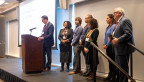
More than 300 Cornell employees and community members attended the seventh annual Inclusive Excellence Summit on March 24, gathering virtually from across the nation for a day of connection and reflection on the realities shaping campuses and communities today.
Centered on the theme “Protecting What Matters. Building What’s Next,” the event brought campus and community members together to consider how to move forward with intention and impact.
“We always try to craft a summit that speaks to the moment we’re living and working in,” said Erin Sember-Chase, DEI learning consultant for the Department of Inclusion and Belonging in the Division of Human Resources. “It’s meant to be a source of both information and inspiration, providing insights and approaches to navigate the challenges that are top of mind in our workplaces and communities. Our aim this year was to broaden our scope beyond Cornell, recognizing that no single institution can effectively or sustainably respond to today’s equity and inclusion challenges without evidence-based strategies and strong cross-sector partnerships.”
While participation was predominantly from New York state, attendees also joined from Colorado, Connecticut, Illinois, Missouri, North Carolina, Oklahoma, Pennsylvania, Texas and Virginia. The summit drew broad institutional diversity, including participants from 55 educational institutions, 19 nonprofit and community organizations and partners across the public and private sectors. Local organizations in attendance included Tompkins Whole Health, Taitem Engineering, Reflective Therapy, Family Reading Partnership, FLIC and Alternatives Federal Credit Union.
“This year’s summit created a space where higher education could learn from nonprofit innovation, where research could inform practice, where lived experiences could be shared, and where assumptions could be challenged,” said Sonia Rucker, associate vice president of inclusion and belonging. “This is the beauty and the benefit of creating and upholding diverse and inclusive spaces. Any time we can work to bring down barriers – either internally, or externally by bringing various organizations and voices together – we reveal the true depth and breadth of inclusion and belonging work.”
The day began with a panel on why DEI continues to matter in organizations, led by ILR School assistant professors James T. Carter, Sean Fath and Devon Proudfoot, followed by a presentation on navigating disagreement from Peter Loewen, the Harold Tanner Dean of the College of Arts and Sciences.
New this year, several teams across Cornell’s campus and the greater Ithaca area hosted watch parties to experience the summit together. Stella Hein, executive director of the Office of Access and Community Empowerment in the College of Agriculture and Life Sciences, organized one such gathering for her colleagues.
“I really appreciated the opportunity to come together to consider how the summit content resonates with us and our work,” Hein said. “I hope others were reminded that we are fortunate to have such a talented and inspiring community of practitioners here in Ithaca and at Cornell who are working to make this world and institution better for all. This collaborative spirit has always been what’s exceptional about Cornell.”
Other sessions focused on building engaged partnerships to improve access to employment and support healthier, more equitable communities, with presentations from members of the Ithaca community and Weill Cornell Medicine.
A session on strengthening community health and well-being connected directly to the work of Cornell’s Health Promoting Campus initiative, led by Julie Edwards, assistant vice president for student health and well-being, who attended the summit alongside colleagues from Cornell Health.
“Participating with my colleagues gave me a strong sense that we’re in this together,” Edwards said. “We were able to affirm what we were hearing and brainstorm meaningful ways to apply it in our work. The shared experience gave us valuable time to connect with one another between sessions and reflect on how we might improve or enhance our practices in the future.”
Throughout the summit, participants engaged in dialogue and explored strategies for navigating complex social dynamics, strengthening inclusive practices and building partnerships that expand equitable access and opportunity. By highlighting research, applied approaches and collaboration, the summit provided attendees with tools, insight and inspiration to help protect what matters and build what’s next in advancing inclusion and equity.
The Inclusive Excellence Summit is sponsored and organized by Cornell’s Department of Inclusion and Belonging in the Division of Human Resources.
Grace DePaull is communications assistant in the Department of Inclusion and Belonging in the Division of Human Resources.
Media Contact
Get Cornell news delivered right to your inbox.
Subscribe