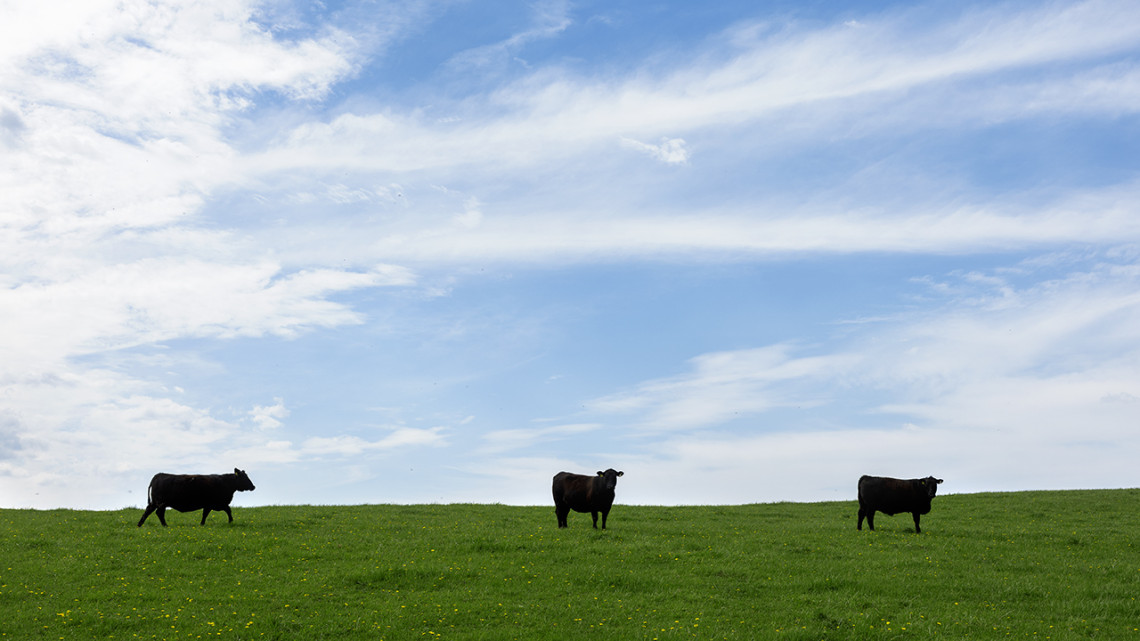
Cattle at Centerdale Farm in Black River, New York.
Northeast farmers could profit from grass-fed beef if they expand, join forces
By Caitlin Hayes, Cornell Chronicle
New York state and New England have optimal conditions for grass-fed beef production – with an abundance of pasturelands and forage – but higher production costs have made farmers wary of expanding operations.
In a new analysis, published in Agricultural Systems on March 25, researchers find that grass-fed beef can compete with grain-fed beef in the region, even given those higher costs and prices for consumers – particularly if operations are scaled up, either through larger farms or farm cooperatives, which could drop production costs and prices by 24%.

The study comes as the demand for grass-fed beef is on the rise, particularly in the region’s urban markets, where consumers want a healthier, more environmentally friendly alternative to grain-fed beef and are willing to pay higher prices for it.
“This study provides a comprehensive, supply-chain-wide evaluation based on first-hand data from farms and processors, which allows us to assess the real economic performance of grass-fed beef systems – making it different from previous studies,” said first author Houtian Ge, senior research associate in the Dyson School of Applied Economics and Management. “It’s very useful because we need to give farmers, investors and policymakers answers on the final performance of the product, and our conclusion is that generally grass-fed beef is viable and profitable in the region.”
Ge said there’s room to scale up operations in New York state and New England, with animals grazing on only 43% of available pastureland.
“Meat is one of the fastest-growing sectors, not only in terms of demand but also profitability,” added co-author Miguel I. Gómez, the Robert G. Tobin Professor of Food Marketing in the Dyson School, part of the Cornell SC Johnson College of Business. “The supply is not keeping up with the demand, which presents an opportunity for the region.”
Investing in domestic grass-fed beef production would also reduce reliance on imported beef – the bulk of grass-fed beef is currently shipped from Australia – and shift economic opportunity to local farmers and processors.
“Local food is healthy, environmentally friendly and also resilient,” Ge said. “We learned this lesson from the pandemic, when several slaughterhouses closed and the supply chain was broken – and prices rose sharply. A shorter supply chain is safer and enhances the security of our food supply.”
Gómez added that the rise in energy costs makes local food production more attractive. “With a regional food system, you have lower emissions, lower transportation costs, and all the value added stays within the region, with the farmers, the processors, distributors and retailers,” he said.

The study is part of a larger research program, funded by and in collaboration with the USDA, to explore the potential and barriers of expanding the U.S. grass-fed beef industry. In previous research, the team identified a need for more processing facilities and is now analyzing the emissions associated with production.
The researchers’ broad approach for this study incorporated and analyzed costs at every stage of production as well as processing and transport, with cost estimates based on actual survey data from 31 farms and production facilities across the region.
“We were in contact with almost all the grass-finishing farms in the Northeast, and we integrated data from production inside the farm to the product flow from production to consumption,” Ge said. “So the model was created from first-hand data, which makes it more realistic. We also went back to the stakeholders to confirm the model.”
The researchers modeled scenarios where the industry expanded operations and where they did not – in both projections, grass-fed beef remained competitive with grain-fed beef, given the demand and willingness of consumers to pay more for the product. But the scaled-up scenario would allow farmers and producers to dramatically lower production costs and prices for consumers.
Rather than growing the size of farms, Ge and Gómez suggest following the model of farm cooperatives, already prevalent in New York state and elsewhere in the region.
“Cooperative models have proven to be very successful in livestock sectors like dairy, and the government can provide support, information, the right incentives for farmers to cooperate, as they’ve done in that sector,” Gómez said.
The study is a boost to many stakeholders in New York and New England who are eager to grow, the researchers said.
“It’s one of the very exciting things about working on this – is that we talk to farmers, young investors, and they see a lot of potential,” Gómez said. “The sector as a whole can see this study as a proof of concept. Because if we are larger and more coordinated as a sector, we will benefit from being more efficient and a more reliable supply source for retailers, for restaurants and for consumers.”
Christian Peters M.S. ‘02, Ph.D. ‘07, from the USDA’s Agricultural Research Service, is a co-author.
Funding for the study was provided by the USDA.
Media Contact
Get Cornell news delivered right to your inbox.
Subscribe