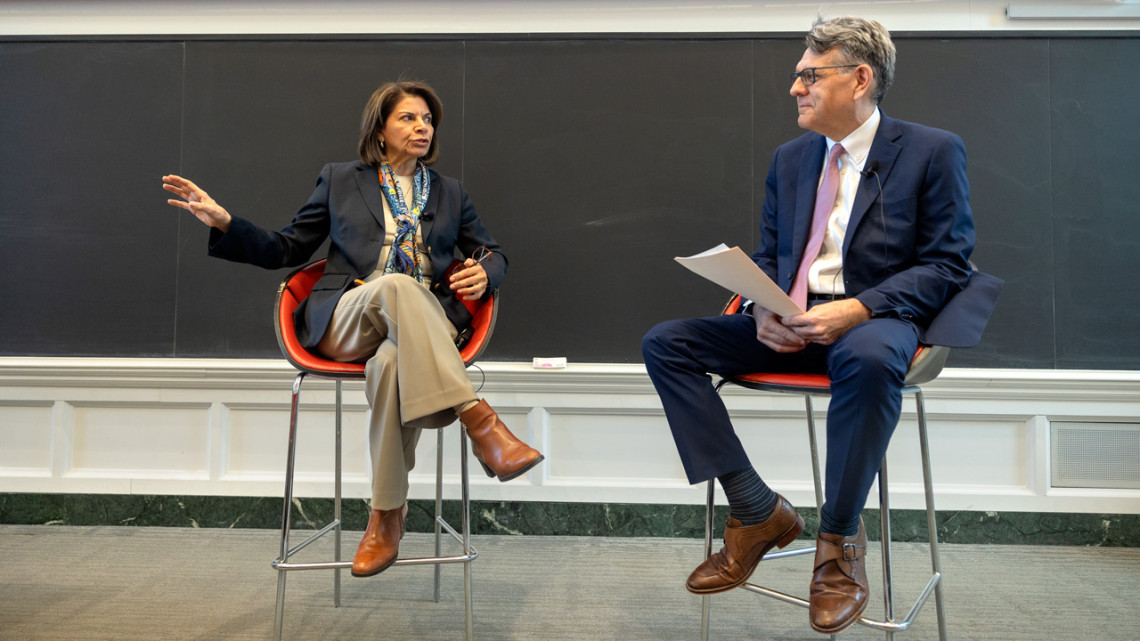
Laura Chinchilla, left, former president of Costa Rica, speaks with moderator and Cornell trustee Hernan Saenz III, MBA/MILR ’98, in a discussion of the role of democracy in a changing world.
Ex-Costa Rican president warns of ‘great reversal’ in democracy
By Giles Morris
Laura Chinchilla, the former president of Costa Rica, warned an audience of Cornell students that global democracy is undergoing a “great reversal,” citing rising authoritarianism, weakening elections and declining public trust in democratic institutions.
Chinchilla spoke April 10 in Warren Hall during “Democracy in a Changing World Order: Leadership and Lessons From President Laura Chinchilla,” hosted by the Cornell Brooks School’s Center on Global Democracy.
The discussion, moderated by Cornell trustee Hernán J.F. Saenz III, MBA/MILR ’98, was part of Chinchilla’s role as a 2025–26 John W. Nixon ’53 Distinguished Policy Fellow, a program that brings political leaders to Cornell to engage with students and faculty.
Chinchilla, the first woman elected president of Costa Rica, drew on findings from the V-Dem Institute’s Democracy Report 2026, which found that democratic conditions worldwide have declined to levels last seen in 1978.
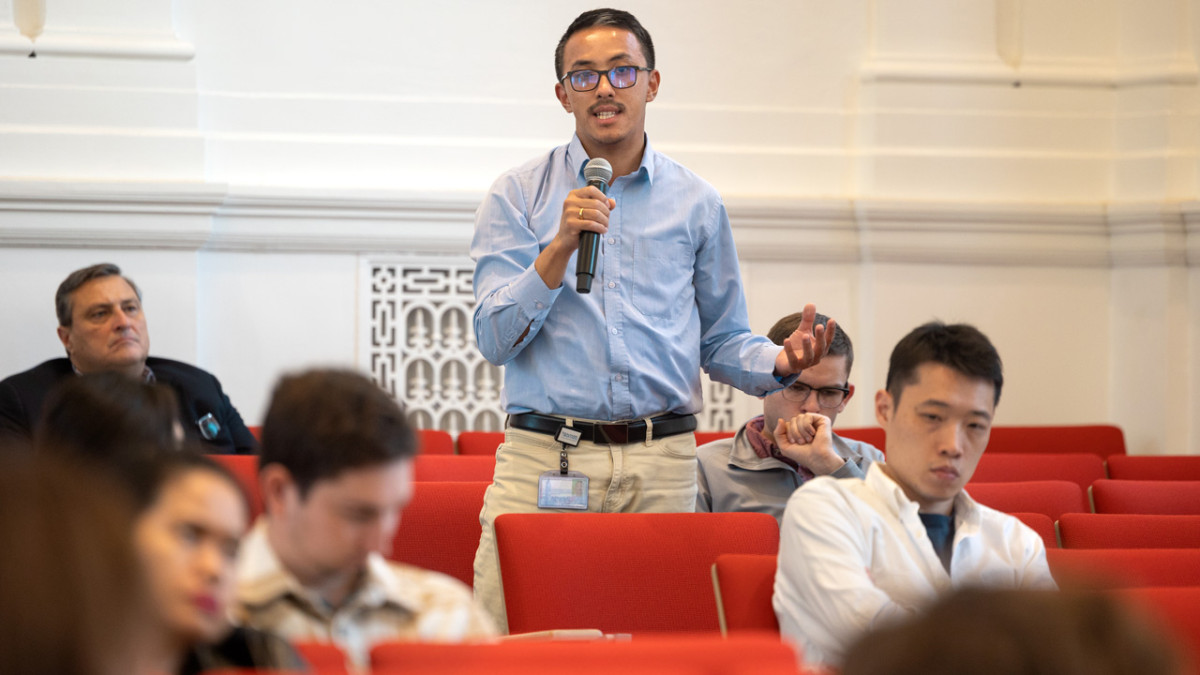
An audience member asks a question to Laura Chinchilla.
The report attributes the trend to worsening freedom of expression, declining election quality and overlapping global crises, including widening income inequality, organized crime, wars and disruptions to global trade.
“These are not isolated problems,” Chinchilla said. “The instrument and the institutions must change. We cannot continue to believe that minor adjustments and repairs to the existing systems will be enough. We need to implement major reforms.”
Chinchilla said democratic governments have failed to respond quickly and effectively to public concerns, creating space for authoritarian ideas to gain traction.
“Usually it is too late when people realize they are living in an authoritarian system,” she said. “In order for people not to wait until it’s too late, we have to make sure that democracy delivers in a more efficient and timely way the solutions that people require.”
A political scientist with a master’s degree in public policy from Georgetown University, Chinchilla served as Costa Rica’s president from 2010 to 2014. Before that, she held several positions in government, including minister of public security, minister of justice, congresswoman and vice president.
Since leaving office, Chinchilla has remained active in international affairs. She currently serves as co-chair of the Inter-American Dialogue and president of Club de Madrid, an organization of former democratic heads of state from around the world.
The event also featured a question-and-answer session with students, who asked about the decline of the middle class, the role of international law in modern conflicts and the responsibilities of citizens in democratic societies.
Saenz, a fellow Costa Rican who in addition to being a Cornell trustee serves as a senior visiting lecturer at the Cornell SC Johnson College of Business, emphasized that democracy depends on active civic engagement.
“Democracy requires a balance between rights and responsibilities,” Saenz said. “I observe bystanders and upstanders. You are either watching what is happening around you or you are standing up. I actually believe that if you are not standing up, you are not practicing the role of citizens.”
Chinchilla also reflected on the experience that inspired her to enter politics. At 19, she traveled through Central America while several countries in the region were engulfed in conflict.
“Traveling through Guatemala, Nicaragua, Honduras and El Salvador, countries which were at war, I took the decision that I would dedicate my life to work for my country because I didn’t want Costa Rica to follow the same path,” Chinchilla said.
She ended by urging students to recognize their obligations to their communities and democratic institutions.
“We are the result of many experiences,” Chinchilla said. “If we have been able to succeed, it is because there have been many people around us to help us succeed. This is why we cannot ignore our obligation.”
Giles Morris is assistant dean of communications and marketing for the Brooks School of Public Policy.
Media Contact
Get Cornell news delivered right to your inbox.
Subscribe