News directly from Cornell's colleges and centers
Teaching AI to operate particle accelerators with DOE grant
By Kate Blackwood
Georg Hoffstaetter de Torquat, professor of physics in the College of Arts and Sciences, is leading a $2.9 million Department of Energy grant project to support a bold venture: teaching artificial intelligence (AI) to operate particle accelerators, some of the most complex scientific machines on Earth.

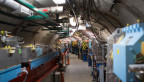
The Relativistic Heavy Ion Collider (RHIC), one of two particle accelerators at Brookhaven National Laboratory AI systems will be trained to operate using computer models.
Based at Brookhaven National Laboratory (BNL) on Long Island, the project will train AI systems on computer model “digital twins” of two hitherto human-run accelerators, BNL’s Relativistic Heavy Ion Collider (RHIC) and its planned successor, the Electron-Ion Collider (EIC).
“AI already helps scientists sift through enormous datasets after experiments are done. This project moves AI into an earlier, more active role: deciding how the experiment is run in the first place, in real time,” Hoffstaetter said. “This research is a step toward a future in which the world’s most complicated scientific instruments, like particle accelerators, telescopes, or fusion experiments are routinely operated by AI co-pilots or even AI pilots.”
Hoffstaetter said this project may be an early move toward a world in which AI can start to test its own physics “ideas.”
Read the full story on the College of Arts and Sciences website.
Media Contact
Get Cornell news delivered right to your inbox.
Subscribe