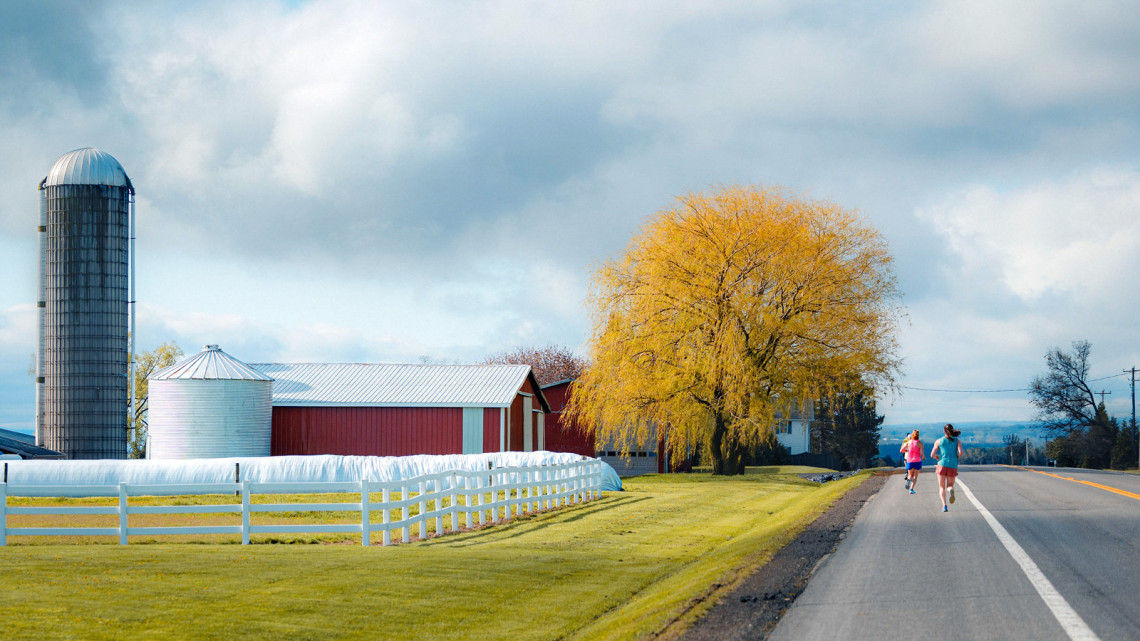
Runners travel through hilly, rural areas around Seneca Lake during the Seneca7 relay race April 26. Students in a Cornell Duffield College of Engineering class are designing a baton that could help race organizers track the competitors remotely.
Over hill and dale, students’ Internet of Things projects benefit Finger Lakes communities
By Holly Hartigan, Cornell Chronicle
Past fields, waterfalls and vineyards, down side roads and up main roads, 2,275 runners traverse 77.7 miles around Seneca Lake every spring as part of the Seneca7 relay race. Keeping track of them in areas with spotty cell phone service presents a challenge.
Students in the Introduction to the Internet of Things and Technology and Engagement class in the Cornell Duffield College of Engineering are working to address this challenge and others. Each semester, the class divides students into teams to develop low-cost solutions to real-world problems using networks of devices that can share data in areas without reliable internet or cellular access.
For Seneca7, a team of four students built a baton that can ping a nearby receiver with GPS positions. Eventually, each of the 325 teams of runners could carry one baton that they hand off for each of the Seneca7’s 21 legs.

Aaron King, a doctoral student in the field of psychology, passes a prototype of the baton off to Peter Frazier, the Eleanor and Howard Morgan Professor of operations research and information engineering in Duffield Engineering. Their relay team tested the baton as they competed in the Seneca7 race on April 26 and provided feedback to the student designers.
“We as race directors can’t be everywhere all the time, and it would be really helpful to know in real time, for a whole variety of reasons, where people are on the course,” said the race’s founder and volunteer coordinator Jackie Augustine.
The race, which starts and ends in Geneva, New York, not only draws thousands of visitors and business to the area every spring, it raises funds for local nonprofit organizations.
Augustine first connected with the Internet of Things class’ professor, Max Zhang, the Irving Porter Church Professor of Engineering in the Sibley School of Mechanical and Aerospace Engineering of Duffield Engineering, through her nonprofit, BluePrint Geneva, which she founded 10 years ago to address environmental and economic injustices in the region.
In 2025, Zhang’s students worked with BluePrint to start designing a system of stationary, ground-based sensors to measure air quality around the three nearby landfills, including Seneca Meadows Landfill, the largest in the state.
The sensors were easy to obtain and operate, but the data transmission posed a problem.
“The sensors require either cell service or a reliable, stable WiFi connection to transmit any of the data,” Augustine said. “So you could put a sensor out there, and if there’s a break in the cell or WiFi stream, you might lose a whole chunk of data.”
Student teams have worked on the stationary sensors for three semesters, passing the project off from group to group. This year, a second group of students started a project to develop a drone for BluePrint that can carry the sensors, providing more data and mobility.
The students built a quad-copter drone and programmed mission planning software intended to be easy for a volunteer to operate. By the end of the semester, they were preparing it for its first test flight.

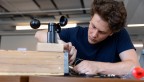
Alex Ilacqua, ’27, (left) a computer science major in the College of Arts and Sciences and the Cornell Ann S. Bowers College of Computing and Information Sciences, and Jeffrey Wang ’27, a mechanical engineering major in Duffield Engineering, work on their drone project during the Internet of Things and Technology and Engagement class.
“It’s supposed to be a relatively low-cost solution, which is the general trend with this class,” said Liam Bayne ’27, a mechanical engineering major on the drone team. “That presents challenges as we can’t just buy top-of-the-line components. We’ve had to make realistic compromises.”
“A lot of the systems that do similar data gathering are on the order of like $30-$40,000,” said drone team member Alex Ilacqua ’27, a computer science major in the College of Arts and Sciences and the Cornell Ann S. Bowers College of Computing and Information Sciences. “This is all in all, like a $2,000 system.”
Learning to work around problems and balance stakeholders’ needs while building a good product that serves its purpose well is part of the lesson and a core goal of training engaged engineers, said Zhang, who also serves as provost’s fellow for public engagement.
“A lot of real-world constraints and considerations are really hard to teach in the classroom,” Zhang said. “Bridging differences, cultural humility – those are important traits we want to our students to have.”
Alan Munschy ’27, a mechanical engineering major on the drone team, said if he were to build his own drone, he might build something high performance, but that might be too difficult for a BluePrint volunteer to fly.

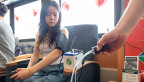
Duffield Engineering students Andrew D’Onofrio ’26 (left) and Jamison Taylor Jr. ’26 (center, holding the baton) discuss their tracking baton project with teammate and master’s student Kobe Phillips.
“When you’re working with a stakeholder, at the end of the day, what they want is the most important requirement,” he said. “That influenced how we designed the drone, in terms of emphasizing long flight time, but also being easy to fly, while also having all these sensors, which add additional weight. These are things that maybe are unideal in terms of designing a drone, but we have to work around them.”
On the race tracker team, the students found that sometimes the race staff and the runners’ needs were at odds. Organizers wanted lots of data, which would increase the size of the baton. Racers wanted something small and light.
Kobe Phillips, a master’s student in design technology and tracker team member, said they had long-distance runners try out their prototypes, eventually landing on a design that can fit in a small hand or be carried by a strap or a clip.
“That really helped shape our process,” he said. “The baton is a human interface, constantly held, constantly experienced, and we wanted to make the best out of that.”
The students will hand these projects off to the next semester’s teams to continue iterating, improving and testing, getting the air quality sensors hooked up on the drone and fine tuning the receivers that get signals from the racing baton.
Augustine at BluePrint said she appreciates the students’ iterative mentality.
“In the real world it rarely works out that you hit upon the perfect answer the first time,” she said. “I have faith in the students that we’re making a ton of progress.”
Media Contact
Get Cornell news delivered right to your inbox.
Subscribe