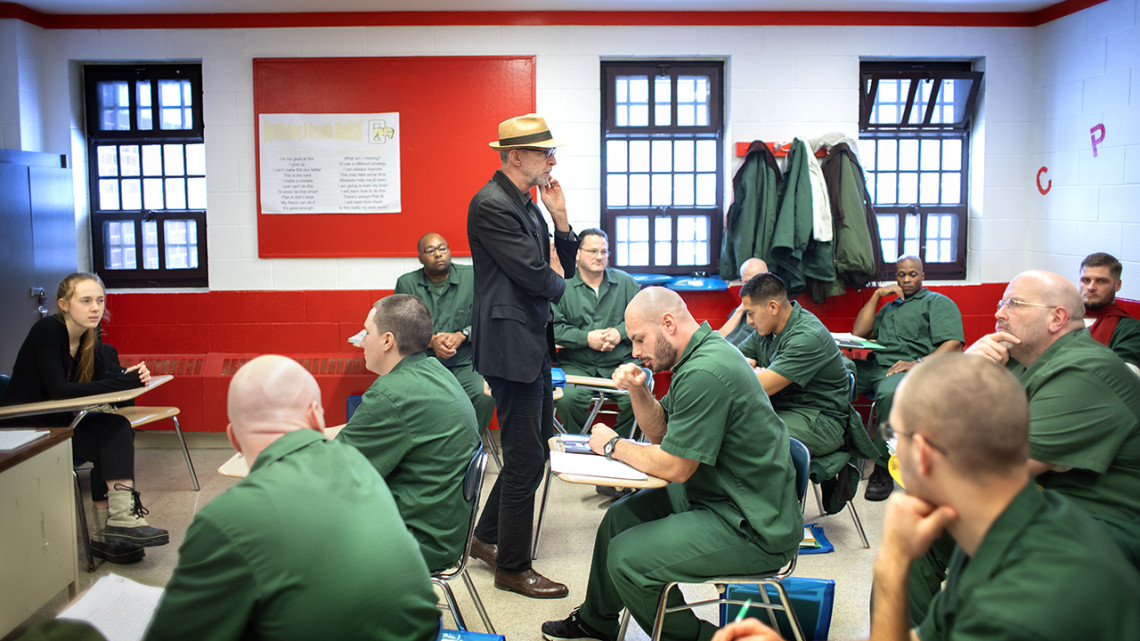
As part of the Cornell Prison Education Program, Joseph Margulies, professor of practice in the Department of Government in the College of Arts and Sciences, teaches students at Cayuga Correctional Facility in Moravia, New York, in 2020. Teaching assistant Hailey Shapiro ’22, left, looks on.
Prison education program wins $1.5M to create national research hub
By Susan Kelley, Cornell Chronicle
The Cornell Prison Education Program (CPEP) has launched two national initiatives to address the data and research challenges facing programs that provide higher education in prisons.
CPEP has created a national consortium for research on higher education in prisons, and enhanced its student-data tracking and management tool, which provides higher education in prison programs with a way to collect, organize and manage information about their students’ incarceration and parole status. CPEP will fund these initiatives with a three-year, $1.5 million grant from Ascendium Education Group, a nonprofit that focuses on postsecondary education for learners from low-income backgrounds.
“I’d like to see us contributing to a culture of research-informed progress for higher education in prison,” said Rob Scott, the Groos Family Director of CPEP. “Higher education is one of, if not the, major mode of reform that America is trying in prison. Thousands and thousands of people in prisons are being offered a pathway to college. It just beckons us to really pay attention to all the complexity that’s in there.”
CPEP’s Partnership for the Advancement of Prison Education Research (PAPER) aims to provide researchers studying prison higher education with shared resources, to promote collaboration, address key questions on data collection and research ethics, and strengthen strategic advocacy efforts on issues related to criminal justice.
CPEP launched PAPER April 8 with a research symposium in Cleveland, Ohio. More than 100 researchers attended.
Fruitful areas of future study include completion rates for prison ed programs, how education affects students’ workforce development after they’re released, and issues related to recidivism, Scott said.
“We’re seeing researchers speaking to each other and trying to help each other figure out how to do the best job we can with it,” he said.
CPEP also plans to strengthen and expand its Education Justice Tracker tool with an improved user experience and user interface. CPEP designed, built and maintains the tool, which supports higher education in prison programs by helping them access and manage crucial current information about their students’ and alumni’s status including transfers to other prisons and their parole status. Through the use of this system, providers of higher education in prison have greater visibility on the status of their students within the criminal legal system throughout their academic journey and beyond, enabling continuity and consistency in learning as well as improved reentry services.
Since CPEP launched the Education Justice Tracker in 2022, 14 higher education in prison programs throughout the country have signed on to use it. They include several SUNY campuses, which have the largest footprint in New York with higher education programs in 24 of New York’s 41 prisons.
Without the tool, higher education in prison programs often struggle with the onerous task to managing critical and timely data on their students.
Corrections departments around the country often transfer students to other prisons without notifying prison education programs, with potentially disastrous effects on the students’ education, though the New York State Department of Corrections and Community Supervision places administrative holds on students to minimize interruptions to their coursework, Scott said.
A transfer can immediately derail students’ education by removing them from a class and making it impossible for them to complete it. That can result in a failing grade, defaulting on the Pell grants that fund their education and making the students ineligible for future aid, Scott said.
“A tool like this can help higher ed in prison programs week by week, to make sure everyone’s in the right place,” he said. “Without a tool like this, there’s no other easy mechanism.”
The program is on schedule to double the number of users within the next few months, he added.
CPEP, part of the Office of the Vice Provost for Engagement and Land-Grant Affairs, operates in three correctional facilities in the region. Founded in 2001, it supports a regional collaboration that brings together Cornell faculty and graduate students who teach a college-level liberal arts curriculum to a select group of students.
Credits are applied toward an associate’s degree offered through a collaboration with SUNY Cayuga Community College. Advanced students may earn a Certificate in Liberal Arts from Cornell.
In 2027, Cornell will offer a bachelor of professional studies degree through Cayuga Correctional Facility, as well as academic reentry support services for alumni returning to their communities. Cornell will be the first Ivy League university to offer a degree to incarcerated students.
Editor's note: This story was revised after publication to reflect that the New York State Department of Corrections and Community Supervision places administrative holds on students in prison education programs to minimize disruption to their coursework.
Media Contact
Get Cornell news delivered right to your inbox.
Subscribe