News directly from Cornell's colleges and centers
Cornell CAT convenes researchers, industry to accelerate life sciences innovation
By Stephen D'Angelo
At a daylong event designed to promote academic-industry collaboration, Cornell’s Center for Advanced Technology (CAT) in Life Science Enterprise cast itself as both a funder of early-stage research and catalyst accelerating connections that move discoveries toward real-world impact.
Cornell’s CAT is one of 15 Centers for Advanced Technology that are funded by New York State through Empire State Development’s Division of Science, Technology and Innovation (NYSTAR).
“This is the first of a series of ‘CATalyzing’ events that we plan to do,” said Marcus Smolka, associate vice provost in the Cornell Research and Innovation. “We want to leverage the CAT to build a joint community that crosses the spectrum from New York State industry specialists, consultants and entrepreneurs to academic researchers, research developers and scientists in the lab who have interest in commercialization but don’t have much of an idea of how to do it.”

Smolka provides introductory comments.
Held on Cornell’s campus April 29, the event drew faculty, postdoctoral and graduate researchers, as well as entrepreneurs and industry partners from across the state.
Krystyn Van Vliet, vice president for innovation and external engagement strategy, framed the role of the program through the lens of chemistry: a catalyst reducing barriers, speeding up reactions and enabling transformation. “Lowering that activation energy is a daily function of our team and our office across Cornell,” she said. “It's getting connections between people, ideas, needs, and then the resources to carry out that work.”
That need is amplified by broader shifts in the research landscape. Win Thurlow, executive director of LifeSciencesNY, pointed to changing funding priorities as a growing challenge, but also an opportunity to accelerate university-industry partnerships. Programs like Cornell’s CAT and the broader NYSTAR Network help bridge that gap.
“CATs are designed to spur technology-based applied research and economic development here in New York by promoting collaboration,” he said. “The challenge for those of us in this room is to ensure that we're taking advantage of those incentives in a way that will make real progress.”
Iwijn De Vlaminck, a professor of biomedical engineering at Cornell, and Kate Rochlin, Ph.D. ’14, Chief Operating Officer at IN8bio, delivered keynote addresses reflecting on the path from academic discovery to real-world impact.

Rochlin, keynote speaker.
De Vlaminck, co-founder of Kanvas Biosciences and Romix Biosciences, shared how his research translated into these startups, while Rochlin spoke candidly about the challenges and resilience required to build companies from the ground up.
“Collaborative research is something that many more companies are doing, and universities through groups like this are so much more receptive to,” Rochlin said. “Having programs and initiatives where you can have access to core facilities, do collaborative work, access to students or postdocs or PIs who are interested in working with companies — that's so incredibly powerful because biotech funding is scarce now.”

CATalyzing audience.
For Cornell, those efforts are reflected in outcomes and scale. The university launched 20 technology-based companies last year, many in the life sciences, and maintains more than 500 active industry partnerships and nearly 1,000 technology licenses.
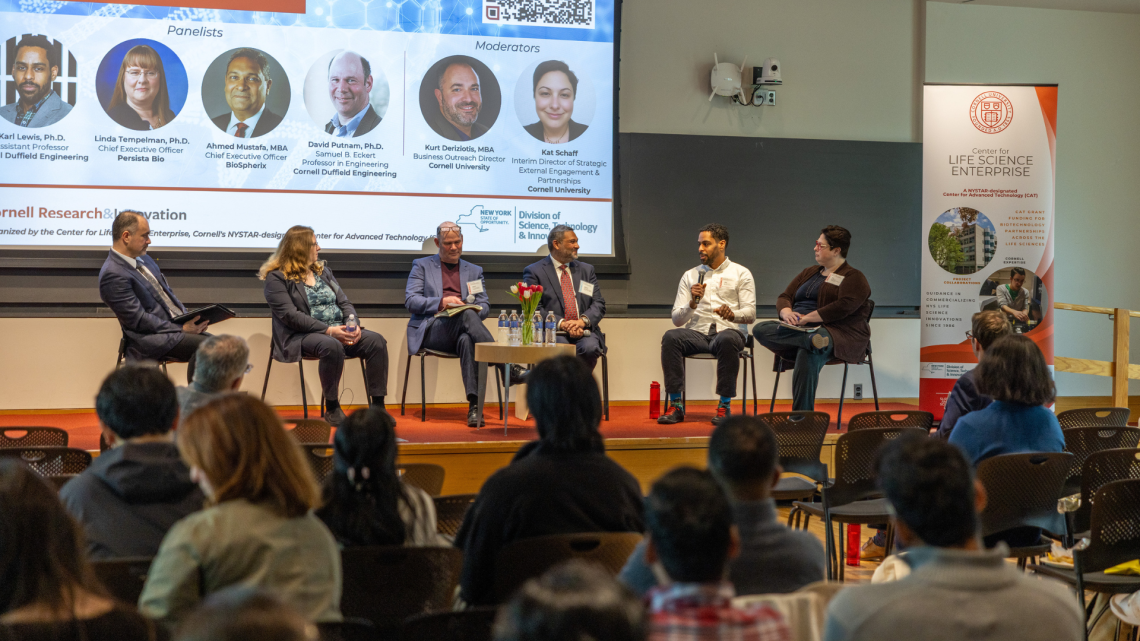
A panel discussion highlighted the practical realities of moving ideas from concept to company. Panelists included Karl Lewis, assistant professor in Cornell Engineering; David Putnam, the Samuel B. Eckert Professor of Engineering; Linda Tempelman, Ph.D., CEO of Persista Bio; and Syed Ahmed Mustafa, MBA, President and CEO of BioSpherix.
Mustafa emphasized the importance of building connections early and often and not attempting the process alone. “We need to increase the rate of those collisions in this state,” he said. “It's through those collisions that things happen, and this is why being here today is so important to me.”

The event wrapped with an industry, academic networking session.
A networking session at the close of the event gave attendees time to connect directly, explore potential collaborations and continue conversations sparked throughout the day.
“Our program serves Cornell and the New York State life science industry as a connector across disciplines and sectors, helping researchers find the expertise and resources needed to move forward,” said Kurt Deriziotis, director of business outreach for the CAT who planned and organized the event. “The primary way we do this is through our CAT grant offering.”
CAT Grants are competitive grants that provide funding to advance early-stage life science technologies toward commercialization. Structured as $75,000 awards to Cornell principal investigators, they are matched one-to-one by industry partners to support collaborative projects of up to $150,000.
Running two funding cycles each year, in the spring and fall, the next deadline for CAT project proposals is May 22, 2026.
Visit biotech.cornell.edu/cat for more information, to request a consultation, or to apply.
Stephen D'Angelo is the communications manager for biological systems at Cornell Research and Innovation.
Media Contact
Get Cornell news delivered right to your inbox.
Subscribe