Otherworldly thunder of Atlantic sturgeon inspires awe
By Caitlin Hayes, Cornell Chronicle
When a team of researchers recorded a low thundering underneath the surface of the Hudson River, they thought they were hearing the muffled rumble of trains.
A closer look, and listen, led to a much more interesting discovery: the thunder came from Atlantic sturgeon – an iconic and endangered species – spawning in the depths of the river.
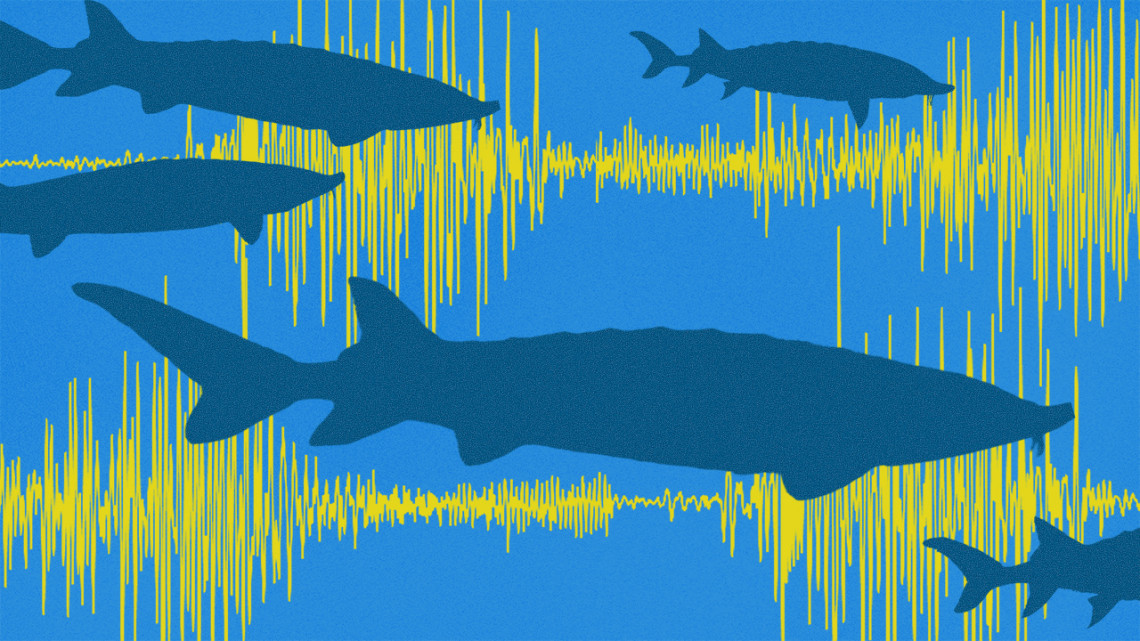
“It’s almost that you feel it more than you hear it,” said Maija Niemistö, science educator with the New York State Water Resources Institute (NYSWRI), a joint research center with Cornell and the New York State Department of Environmental Conservation (NYSDEC). “You can hear these chirps and squirts and bubbles underwater, but this is a different experience entirely. These are ancient fish, and the thunder – it’s almost like you’re brought back in time, because they’ve been making this sound, communicating with each other, for millions of years. It’s awe-inspiring.”
In a collaboration between the NYSWRI, NYSDEC, the Cornell Lab of Ornithology’s K. Lisa Yang Center for Conservation Bioacoustics, Cornell’s Department of Natural Resources and the Environment (DNRE), and others, the team has confirmed the thunder of the Atlantic sturgeon for the first time, publishing the study in Endangered Species Research in 2025. That study was conducted in a known sturgeon spawning ground; this spring, the team placed additional underwater recorders in areas of suspected spawning, some of which are not protected.
Researchers have documented the thundering of Atlantic sturgeon for the first time.
The group, including collaborators at NYSDEC’s Hudson River National Estuary Research Reserve (HRNERR) and Freshwater Fisheries Management and Research, made the discovery through a novel use of passive acoustic monitoring – placing hydrophones (underwater microphones) and passively recording over long periods – which has been regularly used in marine and terrestrial research but less so in freshwater applications. The noninvasive technique and the discovery give the NYSDEC another tool to help locate and understand the behavior of Atlantic sturgeon, a species that was decimated by overfishing in the 19th and 20th centuries and has not rebounded, even after nearly 30 years of protections.
Rebecca Cohen, postdoctoral researcher in the Cornell Lab, part of the College of Agriculture and Life Sciences (CALS), and a research lead on the project, said an estimated 6,000 Atlantic sturgeon came up the Hudson to spawn before commercial fishing’s heyday in the late 1800s – but now that number is less than 700.
“They’ve been an integral part of the ecosystem for millions of millions of years,” Cohen said. “Trying to support and hold on to this remnant population is the best bet for maintaining the Hudson River ecosystem that functions in the way we all benefit from.”
Meeting New York state needs
Even at numbers under 700, the Hudson River has the largest population of Atlantic sturgeon, with smaller populations found in various locations along the Atlantic coast. The fish, which can reach up to 14 feet and 800 pounds and live between 50 and 70 years, travel up the Hudson River from the ocean in the spring to spawn. Juveniles stay for three to five years, growing to about 1 meter in length, before they head back to sea. But the females then take a long time to mature – it could be up to 20 years before they return up the river to spawn for the first time.
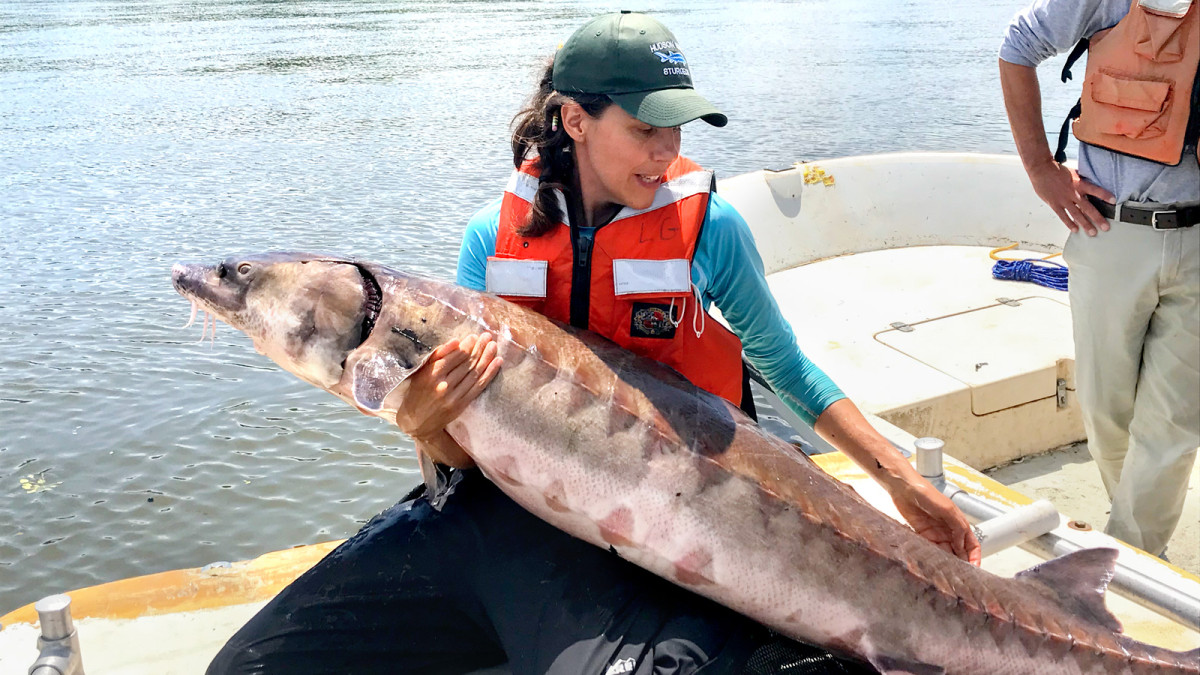
Maija Niemistö, science educator with the New York State Water Resources Institute, cradles an Atlantic sturgeon caught for tagging in the Hudson River, under National Marine Fisheries Service Research Permit #20340.
“That’s why they’re so susceptible to overfishing,” said co-author Amanda Higgs, a fisheries biologist with NYSDEC Hudson River Fisheries Unit and research support specialist in DNRE (CALS), who said fisheries targeted sturgeon for their caviar – 20% of a female’s substantial bodyweight could be eggs.
“A female was a lucrative catch,” Higgs said, “and so they got wiped out relatively quickly because they don’t have the ability to reproduce and replace themselves quickly.”
Protections were put in place in the late 1990s, and the last of the fisheries on the Hudson closed, but the Atlantic sturgeon still have not recovered – which makes identifying where and when they spawn, and protecting those areas, all the more important.
Now that researchers can track the sound of the thunder, which Cohen said is most likely caused by the thrashing of the males (and the resonance of their swim bladders) as they fertilize eggs, the team can use acoustic monitoring to locate and define new spawning grounds, so that the state can issue protections. Cohen said she also hopes the ongoing research, in combination with a long-standing state effort to tag and track sturgeon, will also help the state pinpoint the Atlantic sturgeon’s population size – essential information for conservation efforts. The use of bioacoustics could also inform studies on other endangered or invasive species of importance.
“This project hits on a really unique component of Cornell,” said senior author Aaron Rice, principal ecologist at the Yang Center. “We’re bringing Ithaca campus technology and applied research to New York state needs and combining that with the extensive expertise and survey work that’s already been done by NYSDEC.”
Rice said the team is sharing the research with other states as well. “We hope that what we’re doing can be repeated in Maine, in Delaware, in the Chesapeake. Having done this foundational work in the Hudson, we can increase the reach and have similar management impact on other sturgeon populations.”
Eavesdropping on an underwater world
Niemistö described the soundscape under the Hudson River as “almost alien,” a mysterious universe of sometimes familiar sounds made strange underwater.
It’s this otherworldliness that serves as a gateway for students and the public, she said.
Niemistö and education coordinator Christopher Bowser – both NYSWRI researchers stationed at HRNERR’s Norrie Point Environmental Center in Staatsburg, New York – have incorporated the bioacoustics research into their public-facing work with students of all ages, through class visits, new classroom materials and summer internships. Using recordings from the hydrophones, they’ve created an underwater sound tour of the Hudson River, where anyone can enter the “deep watery underworld,” Niemistö said, punctuated by the muffled sounds of trains and boats.
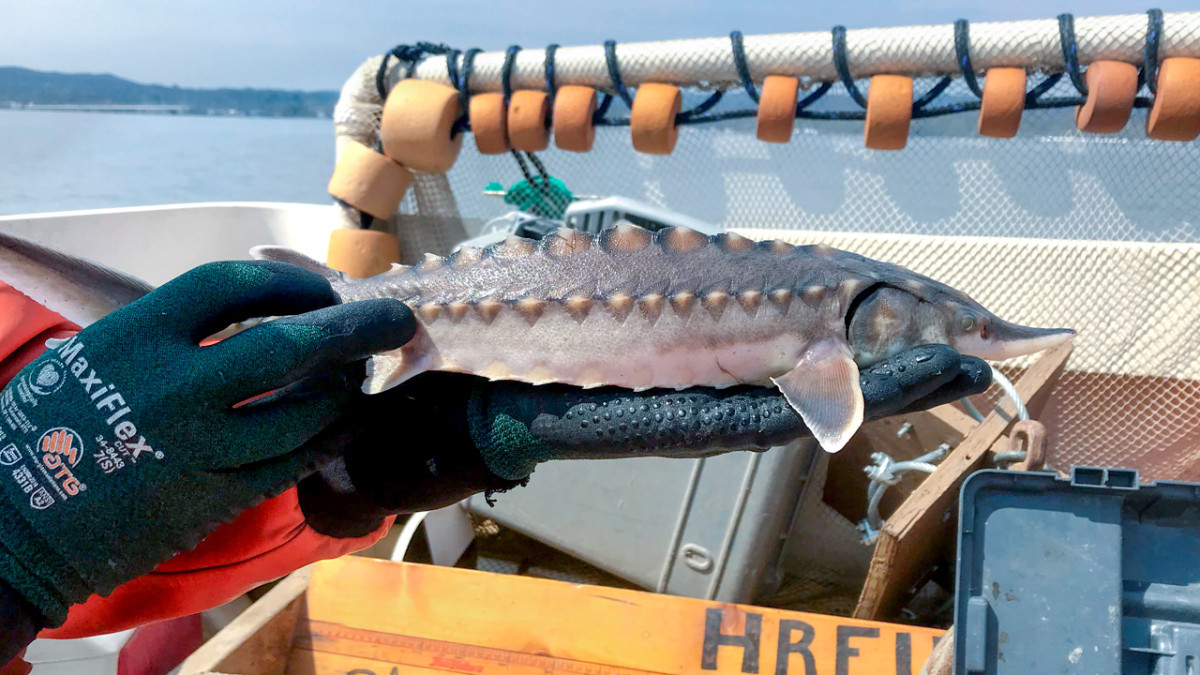
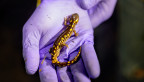
A baby sturgeon from the Hudson River, captured for research under National Marine Fisheries Service Research Permit #20340.
Rice said the range of deliverables from the project and the comradery has made it one of the most successful and enjoyable collaborations in his 20 years at Cornell, with partners each bringing essential skills and expertise. NYSDEC and Delaware State University have also offered logistical support; to deploy the hydrophones, the team often catches rides on NYSDEC research boats, where they can actually see Atlantic sturgeon – either captured for tagging or breaching out of the water.
“Everybody thinks they know the Hudson,” Rice said, “but then this giant, ancient fish comes out of it – it’s surreal.”
“You hold a fish like this that’s been around since the dinosaurs and can live 50 or 60 years, and you can feel a kind of wisdom,” Bowser said. “And maybe the thunder is a part of this. It’s great that we’re listening to it, but they’re not really talking to us. We’re eavesdropping on something much bigger.”
Additional co-authors and collaborators include Cornell researchers Alexander Flecker, professor of ecology and evolutionary biology (CALS) and Richard Pendleton, research support specialist (CALS); as well as Patrick Baker of the United States Military Academy at West Point; Matthew Breece of St. Mary’s College of Maryland; Dewayne Fox of Delaware State University; James Henne from the U.S. Fish and Wildlife Service; Suresh Sethi of Brooklyn College; and Shannon White from the U.S. Geological Survey at the Eastern Ecological Science Center.
Funding for the project comes from NYSWRI, HRNERR, and the National Oceanographic and Atmospheric Administration’s National Estuarine Research Reserve System Science Collaborative Program.
Media Contact
Get Cornell news delivered right to your inbox.
Subscribe