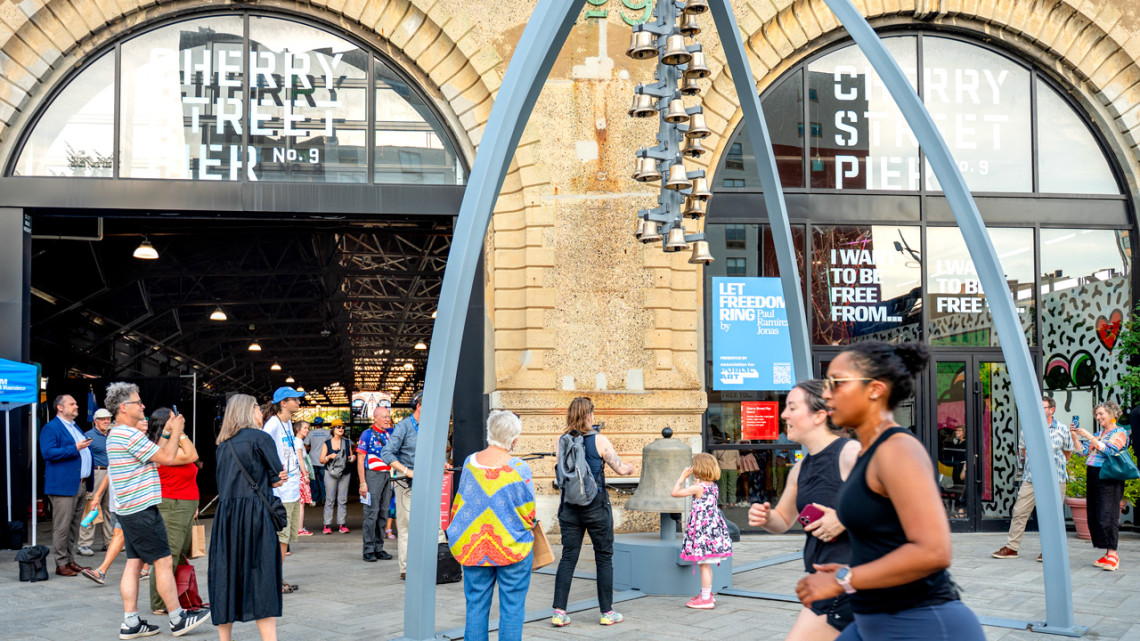
Following its 2023 debut on Washington’s National Mall, “Let Freedom Ring” opened June 4 on Philadelphia’s Cherry Street Pier, part of the city’s celebration of the signing of the Declaration of Independence there 250 years ago. Creator Paul Ramírez Jonas, seen at left in the striped shirt, captured the scene.
Near Liberty Bell, public art lets freedom ring for US at 250
By James Dean, Cornell Chronicle
Freedom to love, to think and to live without fear.
Those were among the first sentiments expressed by visitors to “Let Freedom Ring,” an installation designed by Paul Ramírez Jonas, chair of the Department of Art in the College of Architecture, Art and Planning, after its June 4 opening at Philadelphia’s Cherry Street Pier.
Part of the city’s celebration of the signing of the Declaration of Independence there 250 years ago, the interactive bell tower chimes the melody of “America (My Country, ’Tis of Thee)” – except for the final note.
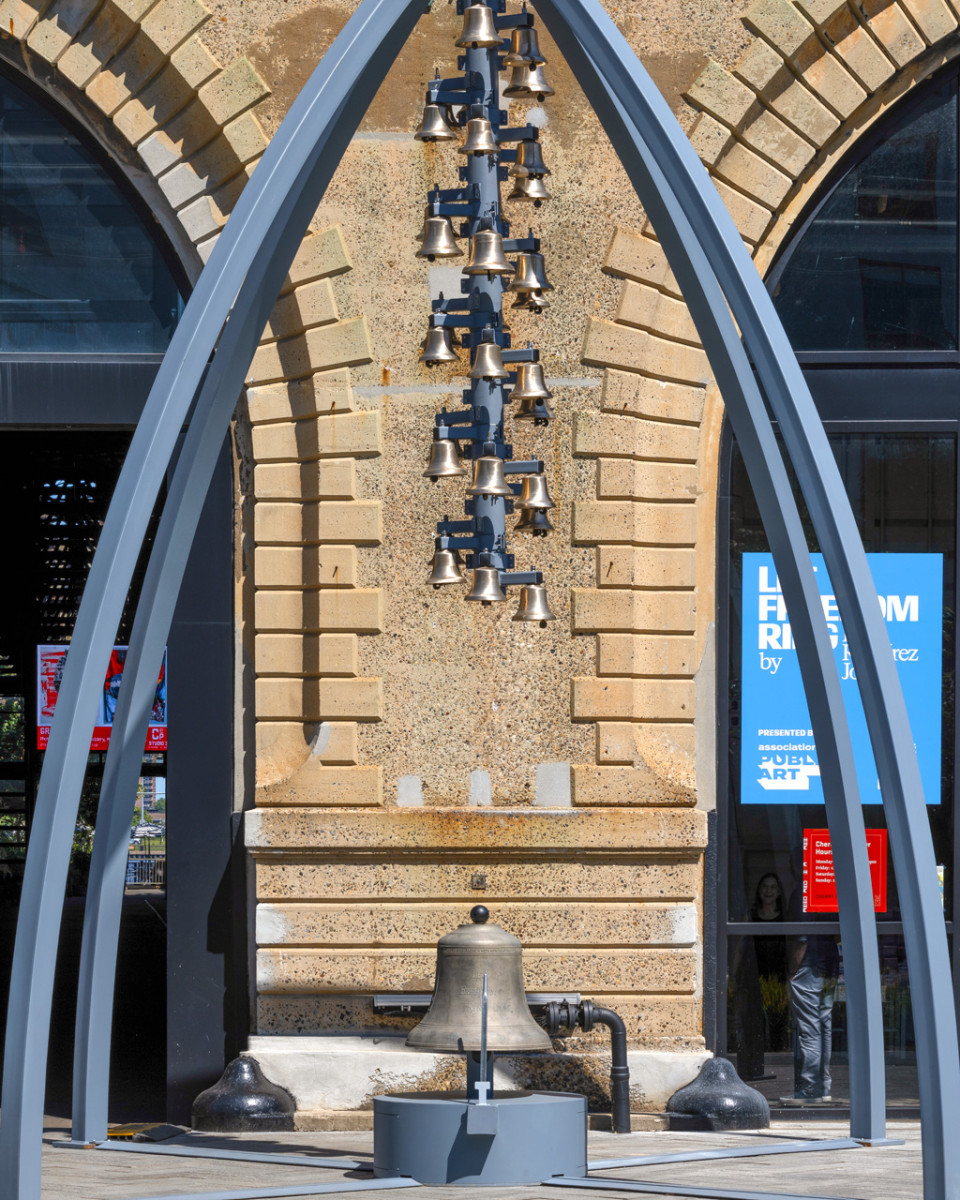
“Let Freedom Ring” features a pair of steel arches supporting a column lined with 32 small bronze bells that spiral toward a larger bell anchored to the ground. Participants complete the melody of “America (My Country, ’Tis of Thee).”
Participants complete the patriotic tune by pulling a lever to ring a 600-pound bronze bell at the tower’s base. They can also make rubbings of text engraved on the bell that invite them to reflect on what they want to be free to do, or what they want to be free from.
“I want them to see that this symbol can only really be activated if they’re engaged,” Ramírez Jonas said. “I want them to feel that they have a part to play, even if it seems small, but that it is an important part.”
“Let Freedom Ring” features a pair of steel arches supporting a column lined with 32 small bronze bells that spiral down toward the bigger bell anchored to the ground, playing notes in descending order. Ramírez Jonas designed the work for a 2023 exhibition on Washington’s National Mall that invited artists to reimagine public monuments. Now it’s situated less than a mile from the Liberty Bell and Independence Hall, where the Declaration of Independence and U.S. Constitution were debated and adopted.
The Association for Public Art, the exhibition’s sponsor in partnership with the Delaware River Waterfront Corp., says on its website that the piece is not a Liberty Bell replica “but a powerful reimagination and reactivation of our nation’s founding ideals. Ramírez Jonas offers a vision of a future where the bell of freedom rings for everyone, not just a select few – and his work of public art offers a physical platform on which to make this metaphor a reality.”
Ramírez Jonas said he’s long been interested in the concept of an unfinished melody, or of missing notes or words, as opportunities to reinterpret traditional texts and to encourage public participation. Bells, he said, are a kind of monument: Governments, churches, schools and factories have cast them as devices for gathering people and as symbols – like the Liberty Bell, which social justice movements have adopted over the years. They often carry inscriptions written in the first person, as if they are living objects.
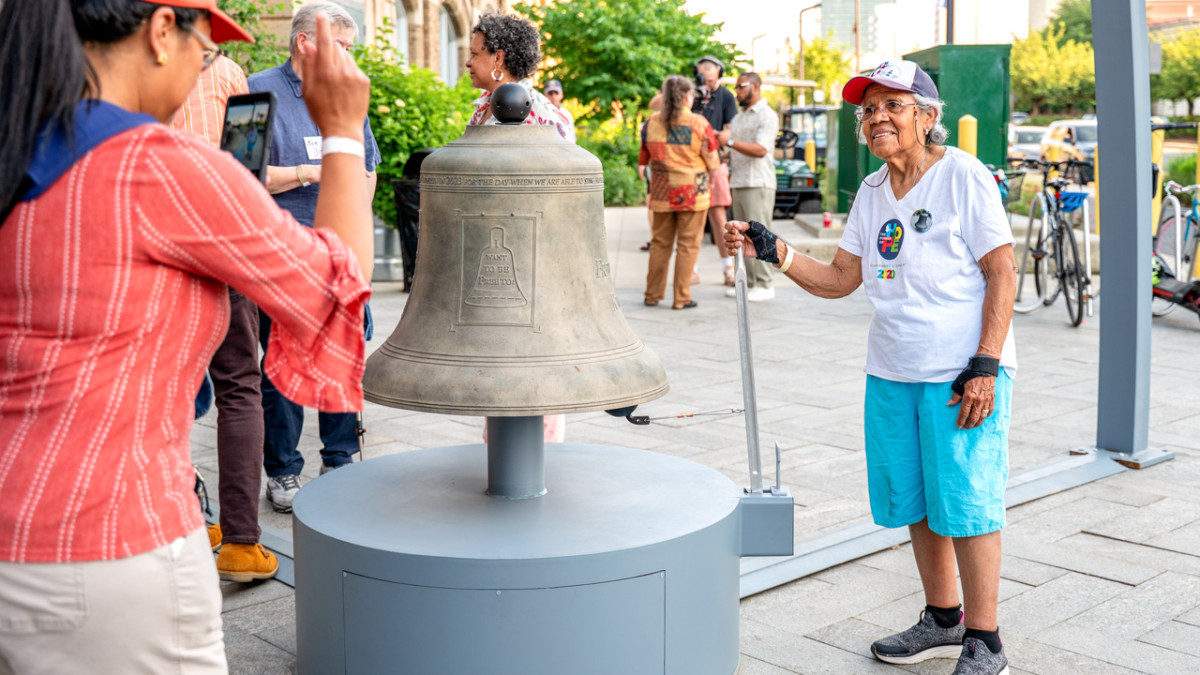
A visitor tolls the 600-pound bronze bell at the base of “Let Freedom Ring.” Inscriptions on the bell invite participants to declare what they want to be free to do, or free from.
The carillon’s rendition of “America” pays homage to Martin Luther King Jr.’s “I Have a Dream” speech, which adapted the lyrics, and to Black opera singer and Philadelphia native Marian Anderson, who modified the words during a famous 1939 performance at the Lincoln Memorial – singing “our country” instead of “my country,” and “we sing” instead of “I sing.” Singers representing the Marian Anderson Historical Society participated in the exhibition’s June 4 opening reception.
In the context of the nation’s 250th anniversary, Ramírez Jonas said he hopes the work sparks conversation about ideas of freedom that are contested in today’s polarized society.
“What is freedom to one group feels like oppression to the other,” he said. “I think the piece is being presented at the right time for people to think in a peaceful way about these differences.”
While inviting participants to articulate their aspirations for freedom, “Let Freedom Ring” also offers a physical experience: bell ringers hear and feel the song’s culminating note.
“There’s a component that goes beyond words,” Ramírez Jonas said.
As he was first envisioning the work, Ramírez Jonas worried it could be seen as too overtly patriotic – as unthinking patriotism. But by leaving the melody and definitions of what freedom is unfinished, he said, “Let Freedom Ring” creates space for participants to contribute to its meaning rather than imposing a point of view.
“I feel like that’s the work that needs to be done,” he said. “We can’t hear each other out if we don’t make opportunities for people to say what they really think in public.”
The Association for Public Art’s presentation of “Let Freedom Ring” runs through Sept. 27. Support is being provided by The Pew Center for Arts & Heritage and the Philadelphia Funder Collaborative for the Semiquincentennial.
Media Contact
Get Cornell news delivered right to your inbox.
Subscribe