News directly from Cornell's colleges and centers
How to train a magnet: Excitons as a new knob for magnetic control
By Kate Blackwood
Scientists can learn a lot about a quantum material by watching how it responds to light. In magnetic semiconductors, one especially useful messenger is the exciton: a pairing of a negatively charged electron and the positively charged “hole” it leaves behind.
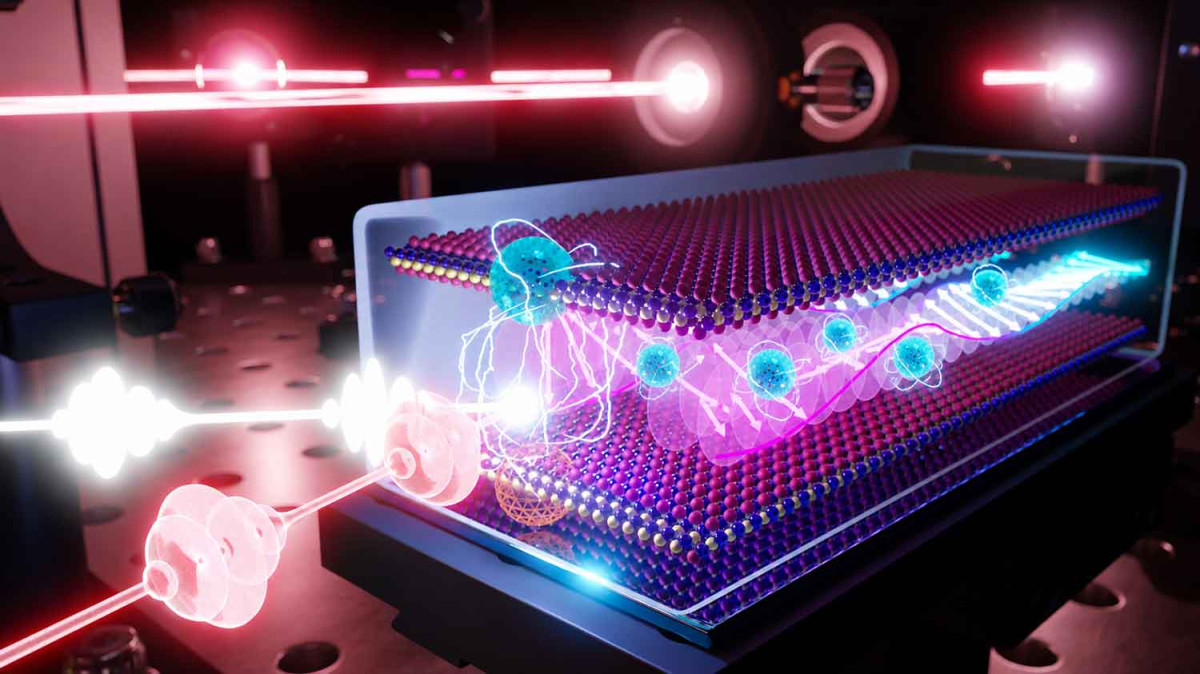
Schematic illustration of the magnon–exciton interaction
Until now, excitons in magnetic materials have mostly been used as reporters. They could reveal how spins were arranged or how magnetic waves moved through a material. But Cornell researchers have shown that excitons can do more than observe magnetism. They can actively steer it.
In “Excitonic Spin Torque in a Magnetic Semiconductor,” published June 15 in Nature Materials, Youn Jue (Eunice) Bae, assistant professor of chemistry and chemical biology in the College of Arts and Sciences, and colleagues report that excitons created by light can exert a spin torque in the two-dimensional magnetic semiconductor chromium sulfide bromide, or CrSBr. The finding establishes excitons as a new way to control magnetic motion with light.
“Excitons have been very useful for watching what spins are doing in magnetic materials,” Bae said. “What we show here is that excitons can also act back on the spins. They are not just spectators; they can help drive the magnetic motion.”
Read the full story on The College of Arts & Sciences website.
Media Contact
Get Cornell news delivered right to your inbox.
Subscribe