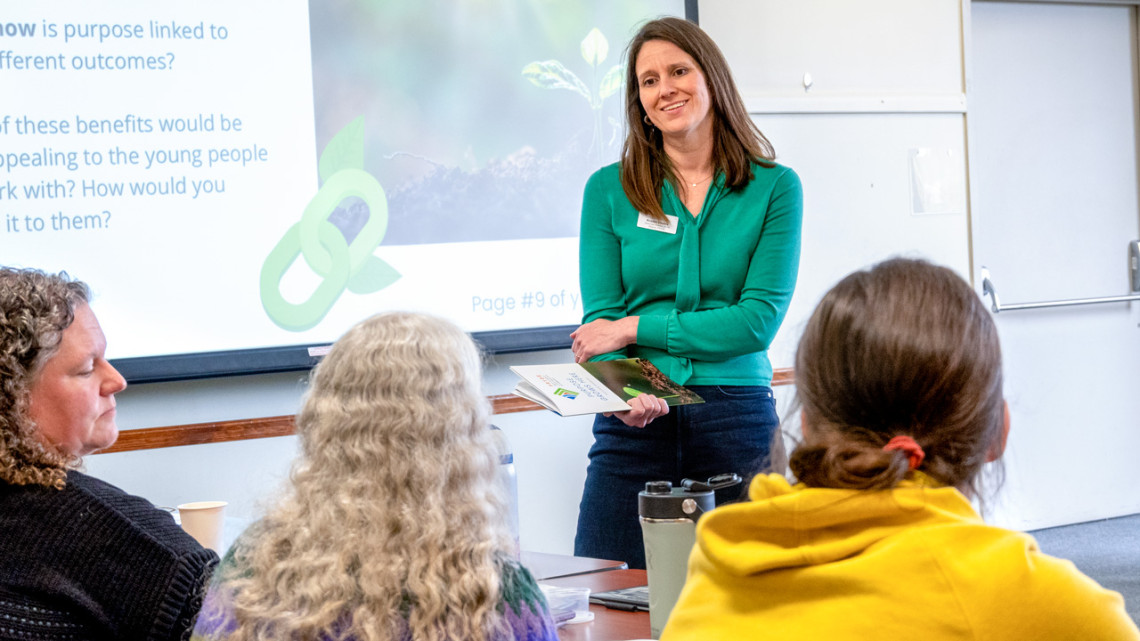
Kristen Elmore listens to participants sharing thoughts during the Purpose Grows Here Workshop at CCE-Tompkins.
Workshop turns research on youth purpose into action for educators
By Juan Vazquez-Leddon
Research has shown that youth have a greater sense of purpose than adults may realize, and a new workshop from the Program for Research on Youth Development and Engagement (PRYDE) at the Bronfenbrenner Center for Translational Research is helping youth educators understand how to foster that sense of purpose in the young people they serve.
Drawing on recent findings from purpose researchers, the “Purpose Grows Here” workshop translates those discoveries into lessons that educators can apply directly in their programs. It is offered to those who work with youth, including Cornell Cooperative Extension (CCE) county offices, county 4-H programs, K-12 educators and organizations serving youth, such as The Learning Web.
Participants start by defining purpose – a central, self-organizing aim, which is always out in front of you, leading you through life. This is different from a goal, which has an end point and can be accomplished.
“Distinguishing between the two is helpful,” said Kristen Elmore, PRYDE director. “It’s also important to understand that youth may not be able to articulate their purpose, but that doesn’t mean it’s not felt. Paying attention to moments when youth feel motivated and energized can offer a roadmap for designing programs that activate youth purpose that’s already present.”
During the session, participants look at survey data on when people perceive others to be most purposeful in life. Adults tend to believe this peaks during adulthood, but youth report feeling just as purposeful as adults.
“And this is key, because while adults may view youth in one light, they realize that youth have a different perception about themselves,” said Elmore. “Many youth are feeling a high sense of purpose and want adults to help cultivate or support it.”
The workshop examines why this matters for young people, how it’s measured, and the factors that help youth develop it. Exercises help educators identify how they can weave these lessons into their existing programming.
“The magic here is unlocking a way for educators to have discussions about this to deepen experiences where youth already feel this way,” said Elmore.
Those discussions can highlight the wide-ranging benefits of purpose, especially for well-being.
“The thing I found most interesting was how impactful a sense of purpose can be on physical health,” said Jorin Clougherty, a 4-H Rural Youth Services program educator for Danby who attended a recent session at CCE-Tompkins.
Research shows that a sense of purpose may help mitigate the risk of cognitive decline, stroke, and the effects of anxiety and depression. Particularly relevant for teens, it is also positively linked to interpersonal skills, the ability to handle stress, learning performance and financial behaviors.
“It makes a lot of sense, but seeing the numbers laid out was fascinating,” Clougherty said.
A key focus of the workshop is that all youth can have this. While environment – including family, community, socioeconomic status and gender identity – shapes how purpose develops, the capacity to cultivate it exists in everyone.
“We reject the notion that this is only available to high-achieving young people from privileged backgrounds,” said Casey Adrian, PRYDE assistant director. “Young people also don’t need to identify their exact purpose in life. If they can play a specific and integral role within their community, and perform challenging tasks alongside supportive adults, they can feel like their day-to-day actions are guided by something larger than themselves.”
To help educators put these ideas into practice, the workshop introduces the ARC model – agency, role clarity and challenge – developed by PRYDE and the Purpose Science and Innovation Exchange. Agency refers to one’s ability to make decisions that align with their goals and values; role-clarity means understanding one’s identity and place within a group or community; and challenge involves tasks or goals that stretch abilities and encourage growth.
Youth educators are also encouraged to apply the model not only to their programming, but to themselves.
“What motivates them to this profession? Why work with young people? We invite reflection on the ‘why’ of their work,” Elmore said, adding that these questions are discussed among participants.
That discussion and reflection resonated with Clougherty.
“I’m already trying to add purpose to my youth programs by incorporating goals, tasks and opportunities to talk about why we are doing the projects we do,” he said. “One of my programs has kids cleaning up a local park. It’s very natural to infuse that program with purpose.”
To hold a “Purpose Grows Here” workshop, contact Kristen Elmore at kce28@cornell.edu.
Juan Vazquez-Leddon is the communications director for the Bronfenbrenner Center for Translational Research.
Media Contact
Get Cornell news delivered right to your inbox.
Subscribe