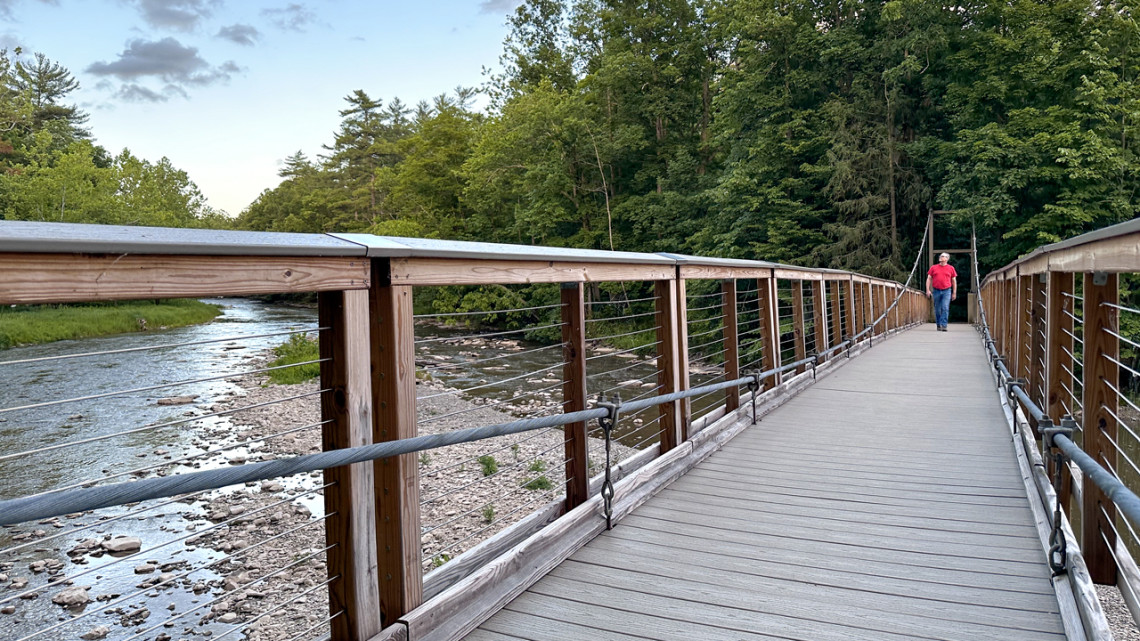
A pedestrian footbridge that crosses Fall Creek in an area of the Cornell Botanic Gardens known as Flat Rock was rebuilt by Cornell students in 2023.
Student-built bridges connect communities thanks to engineering course
By Diane Tessaglia-Hymes
Cornell adjunct professor Charlie Trautmann and his wife, Nancy, were walking the footbridge that crosses Fall Creek in an area of the Cornell Botanic Gardens known as Flat Rock. Noting how the bridge had fallen into disrepair, Nancy posed an innocent question, “Can’t you do something about this?”
That was the spark that spurred Trautmann, Ph.D. ’83, who holds dual appointments as an adjunct associate professor in the Cornell Duffield College of Engineering’s School of Civil and Environmental Engineering and in the Department of Psychology in the College of Arts and Sciences, to work with students on honing their engineering skills by designing and building community bridges. Completion of the fourth such bridge occurred June 14.
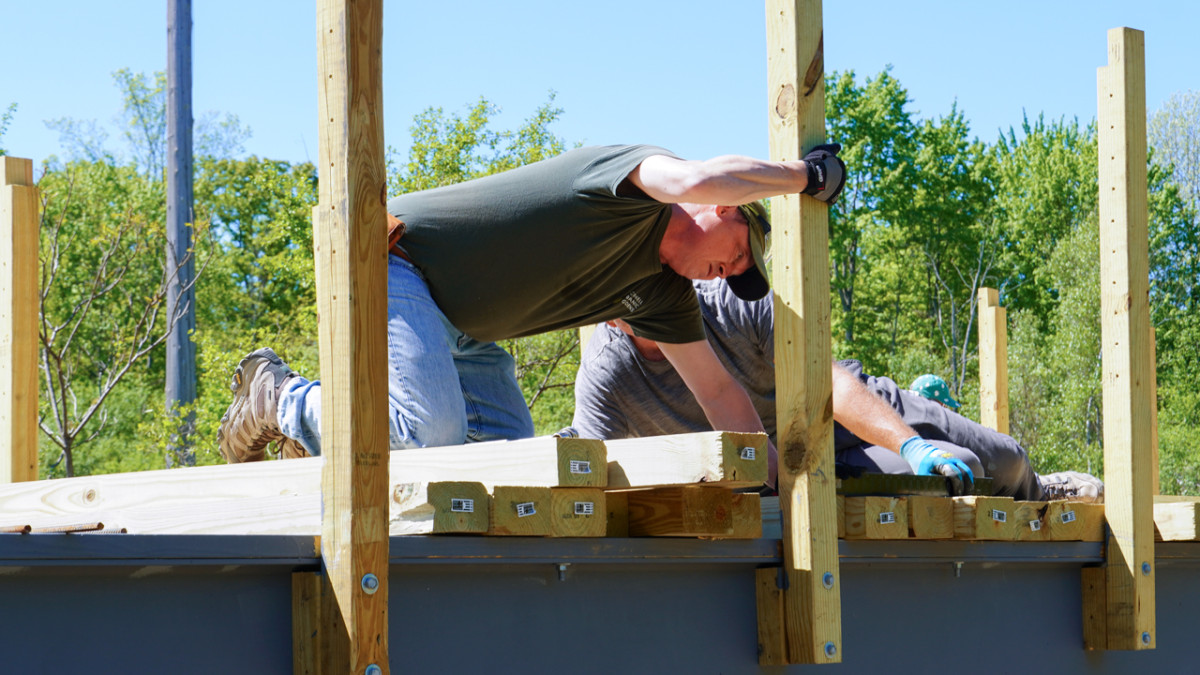
Todd Bittner, director of natural areas for Cornell Botanic Gardens, installs decking on the Dryden Rail Trail bridge designed by Cornell students. Bittner first recruited Charlie Trautmann, adjunct associate professor, and students to help with another bridge project, which led to the creation of the Engineering in the Community course.
After that auspicious walk across the Flat Rock footbridge, Trautmann began working with Todd Bittner, director of natural areas for Cornell Botanic Gardens, on repairs. Keeping the bridge open was critical, because it provides access to miles of trails along Fall Creek on the other side. But cost was a concern, and there was no dedicated funding for the project, making student involvement essential.
After more than two years of obtaining permits and six weeks of building, Trautmann and students with the Cornell Student Chapter of the American Society of Civil Engineers (ASCE) completed the 180-foot bridge in the spring of 2023.
Bittner reached out to Trautmann again in 2024, and they collaborated to build a new 45-foot truss bridge in the Monkey Run Natural Area along the Cayuga Trail, in the Town of Dryden. It was around then that Trautmann started thinking about creating a course so students could get credit for their work.
“Working on these as a service project of ASCE was great,” said Jackie Rohrbacher ’27, president of the Cornell Student Chapter of ASCE. “But Charlie recognized that we were doing a substantial amount of work on these projects, and he also wanted us to learn more about planning, organizing and permitting skills.”
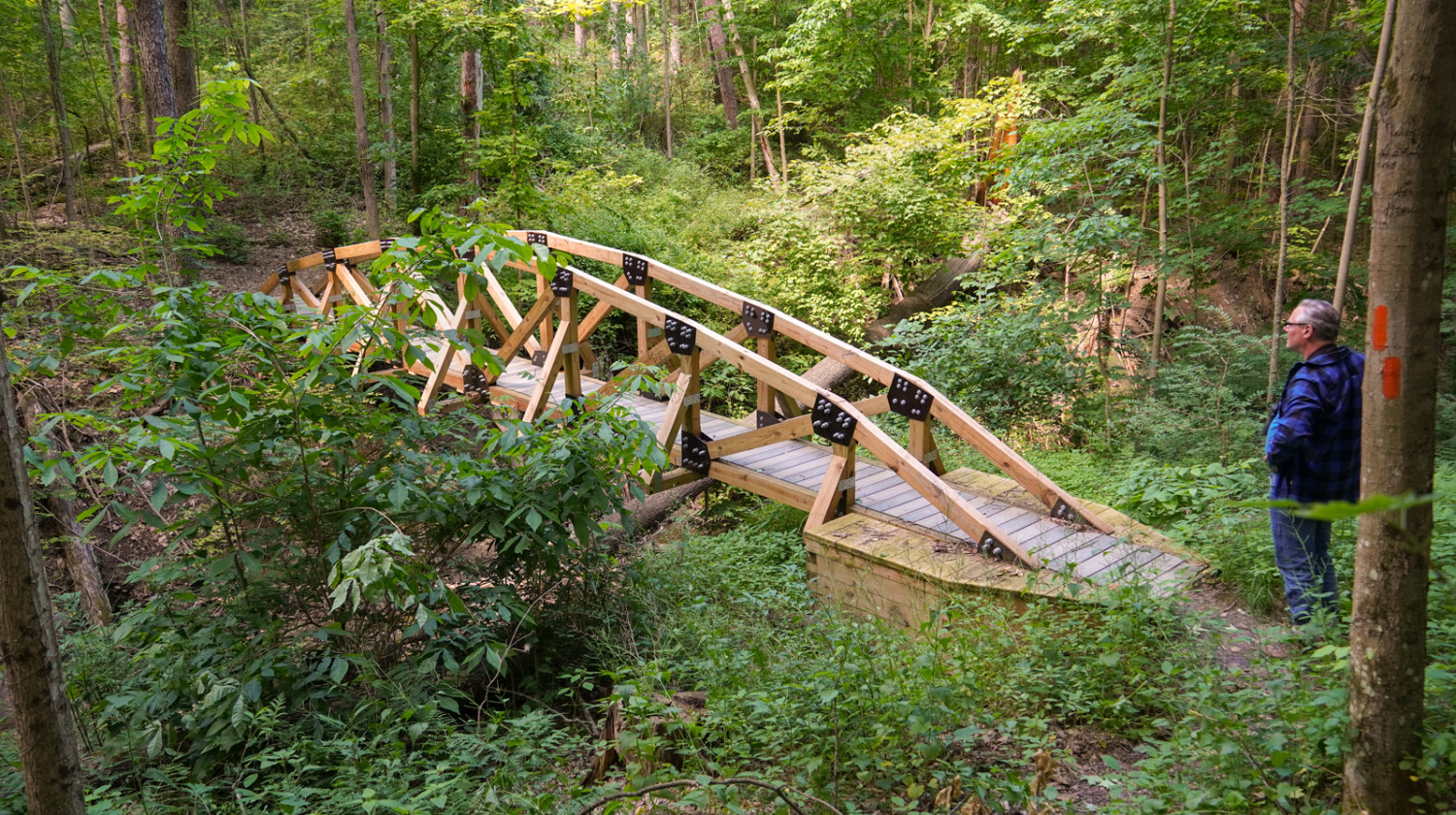
Cornell students built a 45-foot truss bridge in the Monkey Run Natural Area along the Cayuga Trail in the Town of Dryden.
The right skills for the job
Engineering in the Community (CEE 3090) debuted in the spring 2025 semester, offering students hands-on experience designing and building infrastructure that benefits local communities. The course was meant to teach students not only the skills to create infrastructure, but also the interpersonal skills needed to be successful in public projects.
“As an engineer, you will be called upon many times during your career to help your community with technical needs, such as advising a local government or non-profit organization,” Trautmann wrote in the course description. “This course will introduce you to that part of engineering in which hard and soft skills merge, where you are the expert to whom those in your community turn for help.”
That’s exactly what happened in the fall of 2024 when the Dryden Rail Trail Task Force turned to Trautmann and his students for help. As the group explored how to expand the trail east to Route 366, it encountered a major obstacle: A section of the trail had washed away, leaving a steep, impassable gap 16 feet deep and 45 feet wide.
The Dryden Rail Trail bridge thus became the first bridge to be designed by the students of the Engineering in the Community course.
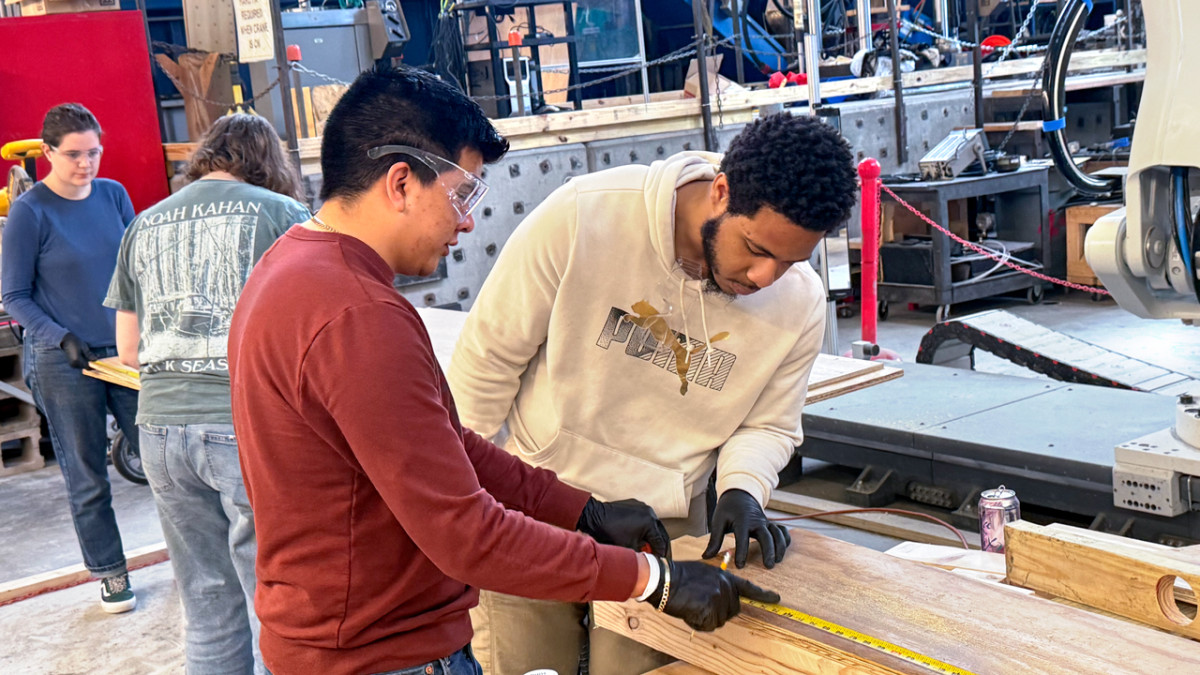
Students in the Engineering in the Community course get hands-on experience designing and building infrastructure that benefits local communities.
Eleven students worked on the bridge, learning about project management and teamwork during class time and building bridge components on weekends. The students drafted a site plan, completed the bridge design and finalized structural drawings. They also handled the extensive permitting process, working with the New York State Department of Environmental Conservation to secure wetland permits, to determine if endangered species were on the site, and obtaining permission to build the bridge from New York State Electric and Gas, the local utility that owns the land.
Students obtained cost estimates from steel suppliers, coordinated with the Dryden Department of Public Works for earthwork, and reported plans and progress to the Dryden Rail Trail Task Force.
“The best part of this project was the amount of learning that came from the design process itself,” said Ulises Balbuena Figueroa ’25, one of the two students responsible for designing the steel portion of the bridge. “Since we were responsible for developing the steel design from scratch, every design iteration taught us something new. As we refined the beam selection, bracing design and connection details, we gained a better understanding of steel design principles and how different design decisions affect the overall structure.”
Because of the time needed for obtaining permits, the project could not be completed in one semester. Most of the students who worked on this project graduated in 2025, leaving detailed drawings and notes for the next class about what had been done.
‘I was so proud’
This past spring, a new group of students resumed the work – reassembling the formwork, cutting and bending rebar, and prefabricating the guardrails. And while they waited for permits, the students took on a new project and spent the rest of the semester designing and building another bridge, this one for the new Water Tower Park in Interlaken, New York, around 18 miles north of Ithaca.
“This is the first public park in the village of Interlaken,” said Peter Garcia, president of the Interlaken Community Action Group. “The bridge is a key feature and will provide access to a natural area on the other side that will be the next chapter for the park.”
Following completion of the Water Tower Park bridge, the Dryden Department of Public Works and local volunteers worked together to complete the Dryden Rail Trail project, placing the final touches on the bridge June 14.
“So much of our schoolwork happens on paper or on a screen, and actually building something changes how you think about the work,” said Julius Pieper ’27, president-elect of the Cornell Student Chapter of ASCE. Pieper worked on both the Water Tower Park bridge and the Dryden Rail Trail bridge. “When we finished the Water Tower Park bridge, I was so proud of what our ASCE members accomplished together: making a real change for the community while applying skills from our coursework, both the technical side and the project management side.”
Trautmann said it was that kind of community-minded attitude that originally led him to believe that it wouldn’t be difficult to find students who would step up to the challenge.
“When I thought about rebuilding that first bridge, at Flat Rock, I thought, ‘I guess I should, because this bridge is important to the Cornell and local community, and it looks as if it’s not on anyone else’s radar,’” Trautmann said. “That’s been my approach all along: spearheading projects that might not otherwise get done.”
Diane Tessaglia-Hymes is a communications coordinator for Duffield Engineering.
Media Contact
Get Cornell news delivered right to your inbox.
Subscribe