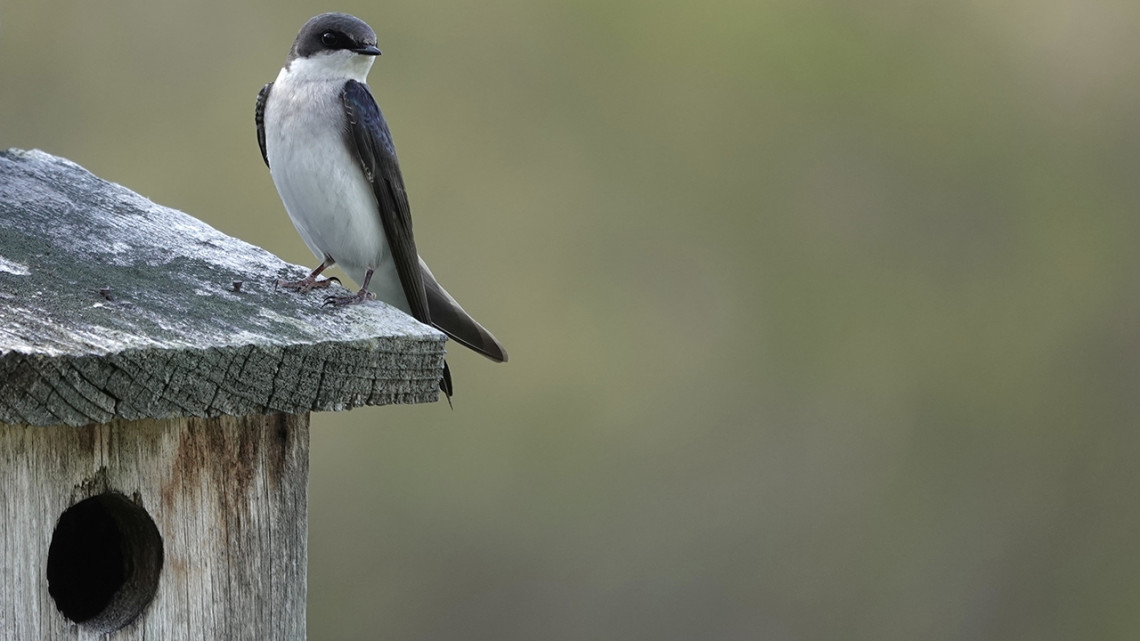
Tree swallow
Climate change leaves northern tree swallows most vulnerable
By Kathi Borgmann
Tree swallows in the northern U.S. and Canada face the greatest risk from climate change despite responding to temperature the same way as tree swallows in the southern U.S, according to a new study led by Cornell researchers that analyzed nearly 95,000 nests across five decades.
The findings, published July 7 in Proceedings of the National Academy of Sciences, reveal a critical timing squeeze for tree swallows in the northern half of the United States and Canada, putting them at risk.
Tree swallows are aerial insectivores, a group of birds that has experienced steep population declines across North America. As birds that eat flying insects, they serve as important indicators of ecosystem health and climate impacts.
The collaborative effort involved 28 research groups across North America, plus data collected by 40,000 people for participatory science programs including NestWatch, run by the Cornell Lab of Ornithology. The team analyzed tree swallow nesting records and temperature from 1966 to 2024 at 123 sites spanning Alaska to the southern United States, in one of the most comprehensive analyses of geographic climate sensitivity ever conducted for a wild bird species. The team also used data that birdwatchers shared with the Lab of Ornithology’s eBird program to estimate arrival time of swallows on the breeding grounds.
The research suggests that climate change vulnerability can arise not just from different sensitivities to warming, but from constraints on the ability to respond effectively. Northern populations face particularly difficult conditions, experiencing both greater warming and increased year-to-year temperature variability during the critical pre-breeding period. Combined with longer migration distances to get to their farther-north breeding grounds, these swallows may be in poorer condition when breeding starts.
Going into the study, researchers expected to find different sensitivities to temperatures across populations, based on previous European studies.
“I was sort of expecting to see that in tree swallows, but surprisingly, we found that across all the populations … they all responded to temperature the same way,” said Conor Taff, research associate in the Department of Ecology and Evolutionary Biology in the College of Agriculture and Life Sciences (CALS) and first author of the study.
“Temperature is similarly influencing breeding timing across the continental range,” said Maren Vitousek, associate professor of ecology and evolutionary biology in CALS and co-author of the study.
The result is that egg laying in tree swallows advanced nearly one day – in populations from north to south throughout their range – for every degree of warming, according to the study. However, this uniform response masks important geographic differences. In the north, temperatures tend to fluctuate more dramatically, with early warming periods followed by cold snaps.
“What we think may be happening,” Taff said, “is that those northern populations, even though they’re responding similarly to temperature, temperatures in the north have actually warmed the most, so the birds are breeding earlier and earlier, but they also are experiencing more variable weather and a shorter time period between migration arrival and when they start laying.”
The study found that three weeks prior to breeding, there’s a critical window when tree swallows are deciding when to breed, and the birds are in a high-stakes guessing game.
“If you lay eggs early, and it turns out to be a warm year, you have by far the highest reproductive success,” Vitousek said. “But if you lay eggs early and then it turns out to be a relatively cold year, then your reproductive success is much lower than if you had waited.”
That’s because cold weather events early in the season can impact both the development of young and the numbers of flying insects tree swallows rely on.
All of these stresses add up, Taff said, and could be behind the population declines noted in the study. Northern populations have experienced the steepest declines in breeding abundance over the past half-century, based on Breeding Bird Survey data, while southern populations have remained stable or increased.
“These northern populations may be kind of reaching the limits of their remaining flexibility to be able to adjust their timing of breeding,” Vitousek said. “They really seem to be near a kind of tipping point.”
By combining long-term monitoring data with participatory science records from NestWatch, the researchers detected patterns impossible to see in single-location studies.
“Collecting this kind of field data is really resource-intensive,” Taff said. “The more we can pull data together from all these different groups and then also link that with these participatory-science programs, I think they have a real power to scale up the kinds of questions that can be asked.”
The research was supported by the National Science Foundation; the Defense Advanced Research Project Agency; the U.S. Department of Agriculture; the Natural Sciences and Engineering Research Council of Canada; and other funding sources that enabled decades of long-term monitoring.
Kathi Borgmann is communications manager for the Cornell Lab of Ornithology.
Media Contact
Get Cornell news delivered right to your inbox.
Subscribe