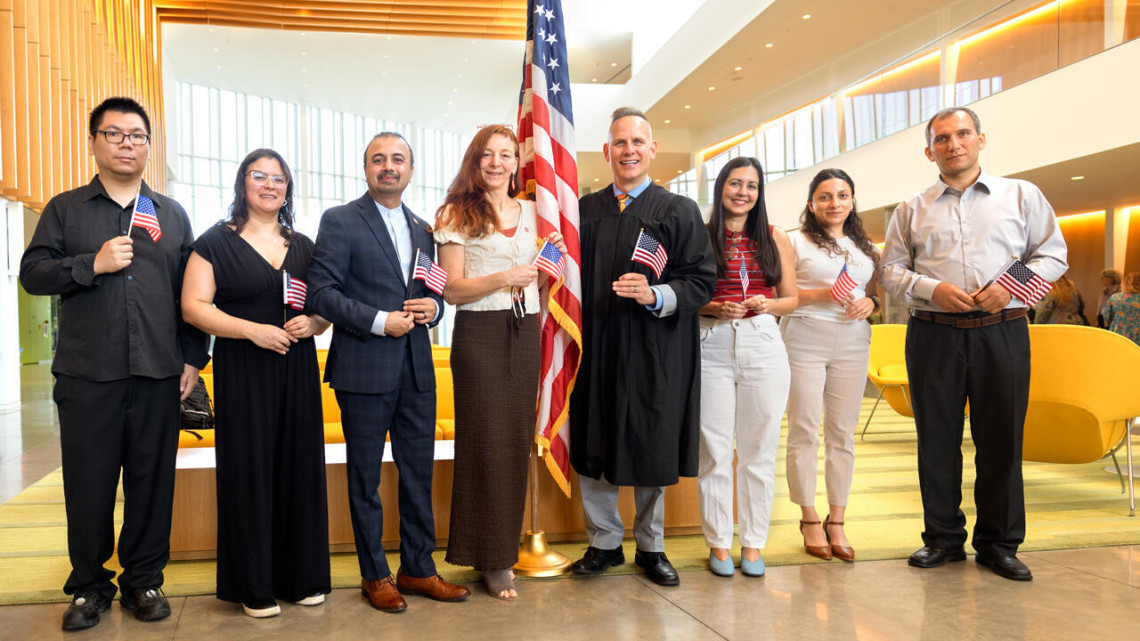
At center, Scott A. Miller ’90, J.D. ’95, acting New York State Supreme Court justice and Tompkins County court judge, celebrates with the eight immigrants who became U.S. citizens at a naturalization ceremony held July 23 at the College of Veterinary Medicine. Miller had presided over the ceremony.
‘Welcome home’: New Americans begin their journey as US citizens
By Susan Kelley, Cornell Chronicle
Vardan Khachatryan and Lilit Abrahamyan, his wife, did not plan to stay in the U.S. when they left Armenia in 2016 and moved to Virginia for his new position as a physics researcher. “It was not in our plan A or plan B,” Khachatryan said.
But that changed in 2018, when they moved to Ithaca.
He had been hired as a research associate at the Cornell Laboratory for Accelerator-based ScienceS and Education (CLASSE). “I loved working here,” he said. “Then we loved living here.”
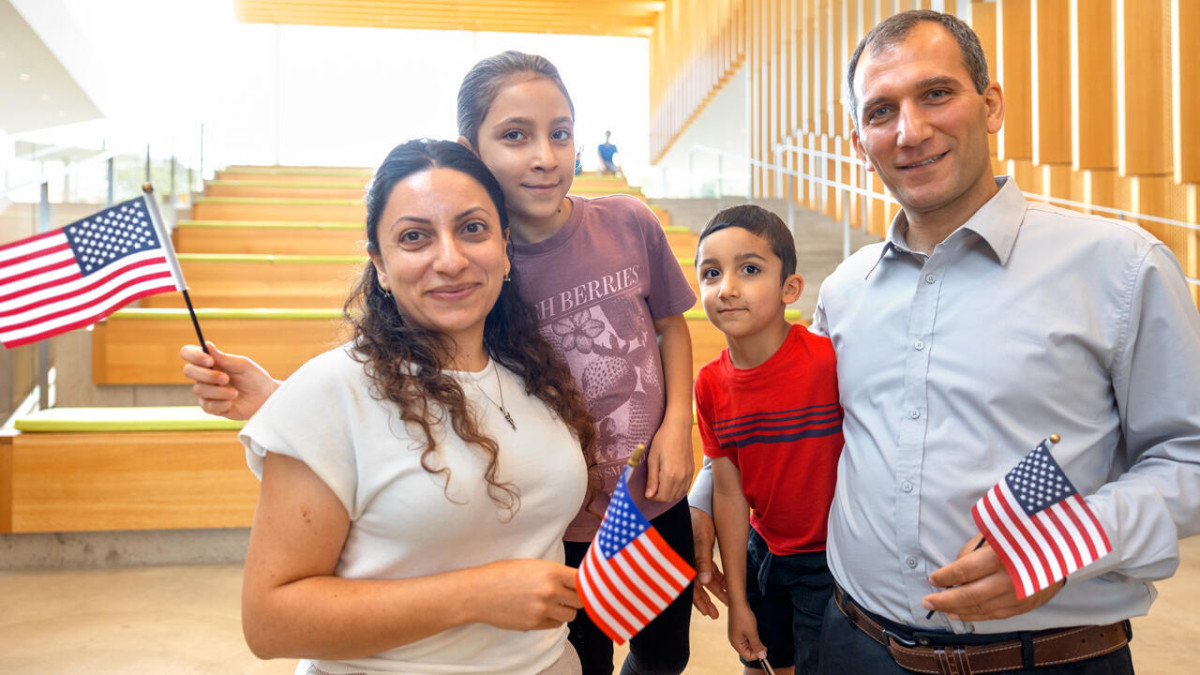
Lilit Abrahamyan (left) and her husband, Vardan Khachatryan (right), became U.S. citizens at a naturalization ceremony held July 23 at the College of Veterinary Medicine. Their two children are pictured between them. Khachatryan is a research associate at the Cornell Laboratory for Accelerator-based ScienceS and Education (CLASSE).
They had a son, in addition to their daughter, who was born in Virginia. They became involved in their children’s schools and more integrated into their community.
“We realized that this is already our country, and if we love our family’s life here, why not do the final step?” Khachatryan said.
He and Abrahamyan were two of eight people from six countries who became U.S. citizens at a naturalization ceremony, held July 23 at the College of Veterinary Medicine’s Yarnell Lecture Hall. The event was co-hosted by Tompkins County and Cornell’s Office of Community Relations.
Maureen Reynolds, Tompkins County clerk, officiated the event, with Scott A. Miller ’90, J.D. ’95, acting New York State Supreme Court justice and Tompkins County court judge, presiding.
The new citizens came from Armenia, China, Colombia, Germany, Italy and Pakistan.
Khachatryan and Abrahamyan said they were excited to become citizens – and glad that the long application process was over. “Today it is the end of that journey, and the beginning of another journey,” Khachatryan said. Abrahamyan was the first in line to register to vote at the event, assisted by members of the League of Women Voters.
As part of the ceremony, local musicians London McDaniels and Love Day Greene performed music including “In This Moment,” a song Greene wrote for the event, with the refrain “In this moment/I’m so proud of where I stand.”
Keynote speaker Avery August, Ph.D. ’94, Cornell’s deputy provost, said the new Americans were celebrating what he, too, did many years ago, when he became a U.S. citizen.
As a teenager in his home country of Belize, August did not want to become an American, he said. “I didn’t want to come to the U.S. I didn’t want to leave my friends. I didn’t want to leave my neighborhood, my culture,” he said.
But his mother had emigrated to the U.S. a few years before, had become a citizen and had secured green cards for him and his three siblings. Moving to the U.S., he was confused by the culture and the language, August said.
As he went to school, got a job, made friends and learned the cultural nuances, he began to participate in civil society. “I realized that I really cared about my neighbors, my community, my country – the U.S.,” he said. “And so I said, I should be fully part of this country.”
Citizenship has always meant more than the geography of where one lives. It is about expanding America’s revolutionary ideas: liberty, equality under the rule of law and the belief that every person has dignity and worth, August said.
Over time, the U.S. has widened the circle of citizenship, he said.
“The nation expanded rights and recognition to groups that it once excluded,” he said, quoting sources ranging from Abigail Adams, who encouraged her husband, John Adams, to “remember the ladies,” to Benjamin Franklin, and Frederick Douglass, who envisioned America united not by ancestry but by citizenship.
Successive generations have challenged barriers to citizenship based on race, ethnicity, national origin and religion, August said. “The definition of who belongs has expanded imperfectly but persistently towards the nation’s highest ideals,” he said.
Citizens inherit not only rights but also responsibilities, he said, and he encouraged the new Americans to participate in civic life. “Remember that democracy works best when we all show up. Show up to vote, show up to volunteer for your neighbors, for your community.”
That’s what Alejandra Rodriguez aims to do, now that she is a citizen.
Rogriguez, a biologist, moved from Colombia to Minnesota in 2022 for her husband’s work as a postdoctoral researcher. When he became a faculty member at SUNY Cortland in 2023, they moved to Cortland; they now live in Ithaca.
Rodriguez applied for citizenship specifically so she can vote and participate more fully in civic life, she said. As a citizen, she plans to protect others, she said, including immigrants, people of color and members of the LGBTQ community. “I have friends who are going through very rough times as I am, as an immigrant,” she said. “If I can do something, I would like to.”
Miller administered the oath of citizenship after an official from the U.S. Citizenship and Immigration Services read the petitioners’ names and asked Miller to grant a motion for their naturalization.
“Congratulations, my fellow Americans – and welcome home,” Miller said.
In his remarks, he noted that his mother’s family emigrated to America from Italy in the late 1880s. His father’s family escaped the pogroms of Russia to arrive in the U.S. in the early 1900s. His wife was born in South Korea, he said.
Americans are all born of immigrants, Miller said. “Those who have benefited from calling America home for many generations must remember: There is no ‘us’ and ‘them.’ There is only ‘we’ – ‘we the people.’”
Media Contact
Get Cornell news delivered right to your inbox.
Subscribe