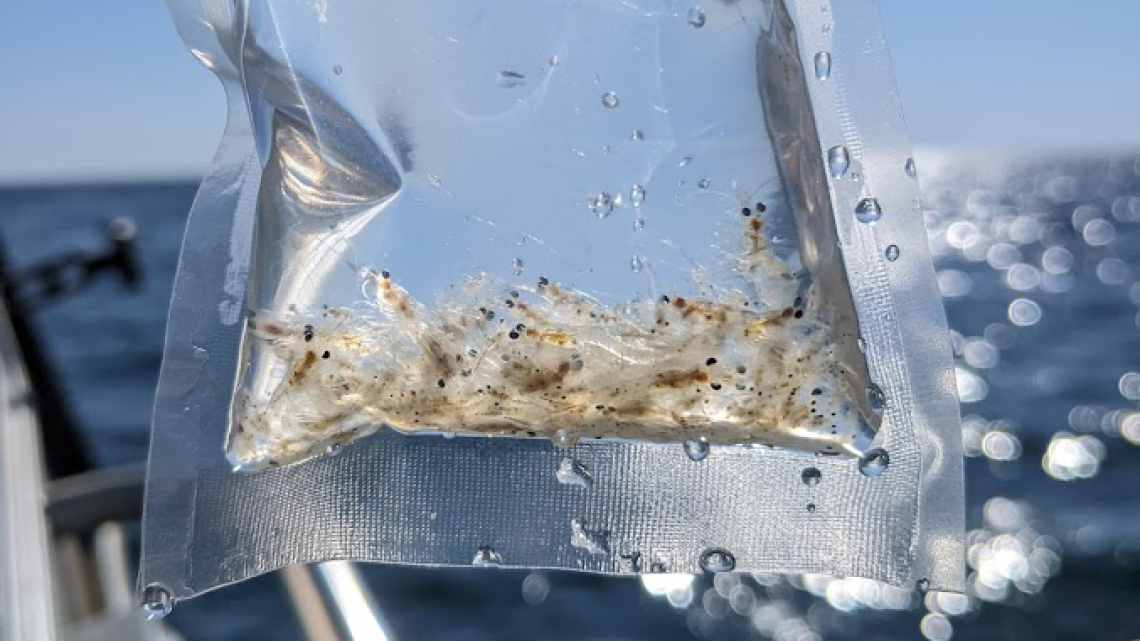
Kayden Nasworthy, a graduate student at Cornell University, holding a bag of collected mysids. A new New York Sea Grant-funded research project is evaluating long-term trends in mysid shrimp populations in Lake Ontario.
News directly from Cornell's colleges and centers
Cornell leads a Lake Ontario food web study in $1.5M Sea Grant research suite
By Marc Ducharme Sumayyah Uddin
Cornell University’s James Watkins and Kade Keranen are leading a nearly $240,000 study to examine the abundance of mysid, small, shrimp-like crustaceans that are critical links in Lake Ontario’s aquatic food web. The funding is part of New York Sea Grant’s (NYSG) latest suite of two year research projects — administered by NYSG and funded through the National Oceanographic and Atmospheric Administration (NOAA), Sea Grant’s federal parent agency.
Mysid shrimp have historically made up around 30% of the zooplankton in Lake Ontario, serving as both a predator for smaller zooplankton and a primary prey source for fish. However, recent decades show a deteriorating shrimp population in some lakes, which may potentially have negative impacts on the wider food web.
The investigators are using trawl-acoustic data from the past two decades to evaluate long-term trends in mysid shrimp population abundance. This will help researchers determine this zooplankton’s distribution, understand more about the factors impacting abundance, and explore potential avenues for future management.
“We are hoping to gain a better understanding of the processes driving mysid densities in Lake Ontario, and what may be different in Lake Ontario compared to other Great Lakes such as Lake Michigan with declining mysid populations,” said James Watkins, Interim Director of Cornell Biological Field Station and Senior Research Associate in Cornell’s Natural Resources and the Environment section. “Even small shrimp-like crustaceans are vitally important to the offshore Great Lakes food web, and so a better understanding of what is influencing mysid densities can inform how managers reintroduce native fish species such as cisco (Coregonus artedi) and bloater (Coregonus hoyi).”
This project is one of a group of seven studies totalling $1.5 million dollars being administered by NYSG to directly address multiple high-priority community, economic and environmental objectives. Other Great Lakes studies in the suite include one on lake trout, a key species possibly facing impacts from invasive mussels (SUNY College of Environmental Science and Forestry); and another on Pacific salmon, which represent Lake Ontario's most popular recreational fishery (SUNY Oswego). There are also four studies at Stony Brook University one each focusing on aquaculture and fisheries and another two zeroing in on the impacts of PFAS, a family of contaminants that negatively impact all living organisms, including humans.
For more information and to learn about the other six projects, read the complete NYSG press release.
Since 1971, New York Sea Grant, a cooperative program of Cornell University and the State University of New York, has been one of 34 university-based programs under the National Oceanic and Atmospheric Administration’s National Sea Grant College Program. The extension portion of NYSG’s programming is administered through Cornell Cooperative Extension.
Media Contact
Get Cornell news delivered right to your inbox.
Subscribe