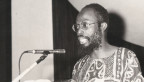
Locksley Edmondson, scholar of the African diaspora, dies at 92
By Kate Blackwood
Locksley Edmondson, professor of Africana Studies, emeritus in the College of Arts and Sciences (A&S), died Aug. 18 in Ithaca. He was 92.
A political scientist with specialties in international relations and race relations, Edmondson joined the Africana Studies and Research Center faculty as an assistant professor in 1983 and retired in 2017. An influential scholar of the African diaspora, he served as director of the Africana Studies and Research Center (ASRC) from 1991-96, developing the department and creating a model for Africana studies programs while contributing as a teacher and beloved community member.
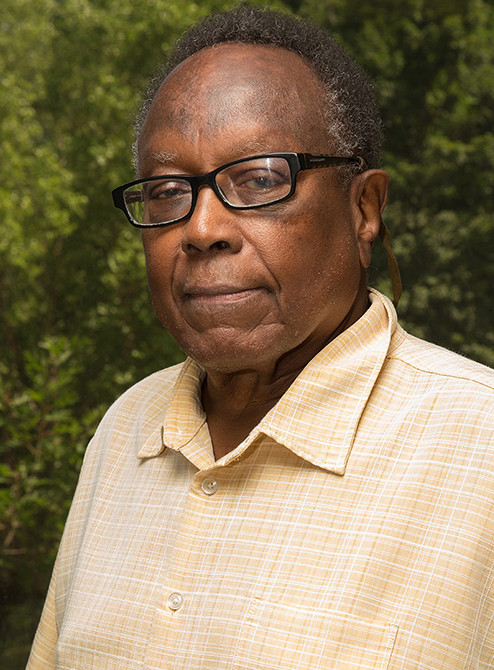
Locksley Edmondson
“He was one of the longstanding faculty members who welcomed me to Cornell when I arrived in 2008, a scholar whose contributions in Caribbean studies and Pan-Africanism established foundations in Africana studies,” said Riché Richardson, professor and chair in the ASRC (A&S). “As a director of the ASRC during the 1990s, Professor Edmondson made outstanding contributions as a leader on campus and helped pave the way for chairs who have since served in the role in the new millennium.”
He was a kind person and generous teacher, Richardson said, who delivered “brilliant lessons” in his lectures and told engaging stories, including ones about his beloved home country, Jamaica.
Born in 1934 in Jamaica, Edmondson earned a bachelor’s degree from the University of Birmingham in England and a masters’ degree and doctorate in political science from Queen’s University, Canada.
His teaching career included posts at the University of Waterloo, Canada; Makerere University, Uganda; the University of Denver; Southern Illinois University at Carbondale; and the University of the West Indies, where he was dean of social sciences.
He first taught at Cornell as an assistant professor in the government department in the early 1970s before joining the Africana studies faculty in 1983 as a full professor.
“Dr. Locksley Edmondson brought stature and stability to the Africana Studies and Research Center,” said Robert L. Harris Jr., professor of Africana studies, emeritus (A&S) “In part because of his education in England, Locksley was an exacting scholar who required excellence from his students, especially precision in their research and writing. Given that he had taught on three continents – Africa, Europe and North America – he brought cogent analyses to his courses on comparative politics.”
Jonathan D. Jansen, M.S. ’87, who arrived at Cornell from South Africa during the late Apartheid years there, said Edmondson had an enormous influence on his thinking and future.
“I attended his class on South Africa and discovered my country for the first time from a man who, as a matter of principle, had never set foot there,” said Jansen, Distinguished Professor of Education Studies at Stellenbosch University in South Africa. “I did not realize how the banning of books and my own fundamentalist faith had cut me off from knowledge of the atrocity of Apartheid until Locksley opened my mind to what was happening in and around me. He threw me into the deep end, getting me to debate a white South African student who was still steeped in Apartheid thinking. Both of us changed radically because of Locksley’s teachings and became good friends.”
N’Dri Thérèse Assié-Lumumba, professor of Africana studies, said Edmondson was lively and cheerful even when expressing strongly held convictions and engaging in vigorous debates, and his kindness and generosity were rooted in his commitment to freedom and justice.
“He was a global thinker and actor whose influence extended well beyond the university,” Assié-Lumumba said. “His work reflected a commitment to placing Africa and its diaspora at the center of global intellectual and historical conversations.”
“He treated Pan-Africanism as a serious field, demanding serious study, and he brought the same rigor to the classroom that he brought to his scholarship,” said Shannon K. Cohall ’14, L.L.M. ’25, president and CEO of the Cornell Black Alumni Association. “His work insisted on a truth that generations of us have carried into our own – that the Caribbean, the African continent and Black America are not separate stories, but one story told in different accents.”
Edmondson was active in several United Nations forums and agencies including the UN Economic Commission for Africa and the United Nations Educational, Scientific and Cultural Organization (UNESCO). He contributed to the UNESCO’s General History of Africa initiative.
He published widely and served in leadership roles with the New York African Studies Association, the African Studies Association of the West Indies, the Bureau of the International Congress of African Studies and the Caribbean Studies Association, of which he was a founding member. He was active with academic and charitable endeavors including in Haiti, Burkina Faso, Nigeria and South Africa.
Edmondson received the Distinguished Africanist Award from the New York African Studies Association in 2013. He was honored in 2017 with a symposium at Cornell, “Pan-African Connections.”
He is survived by his wife, Elizabeth; his children Georgette, Belinda, Magnus and Alisha; five grandchildren and one great-grandchild; and four sisters and three brothers.
Kate Blackwood is a writer for the College of Arts and Sciences.
Media Contact
Get Cornell news delivered right to your inbox.
Subscribe