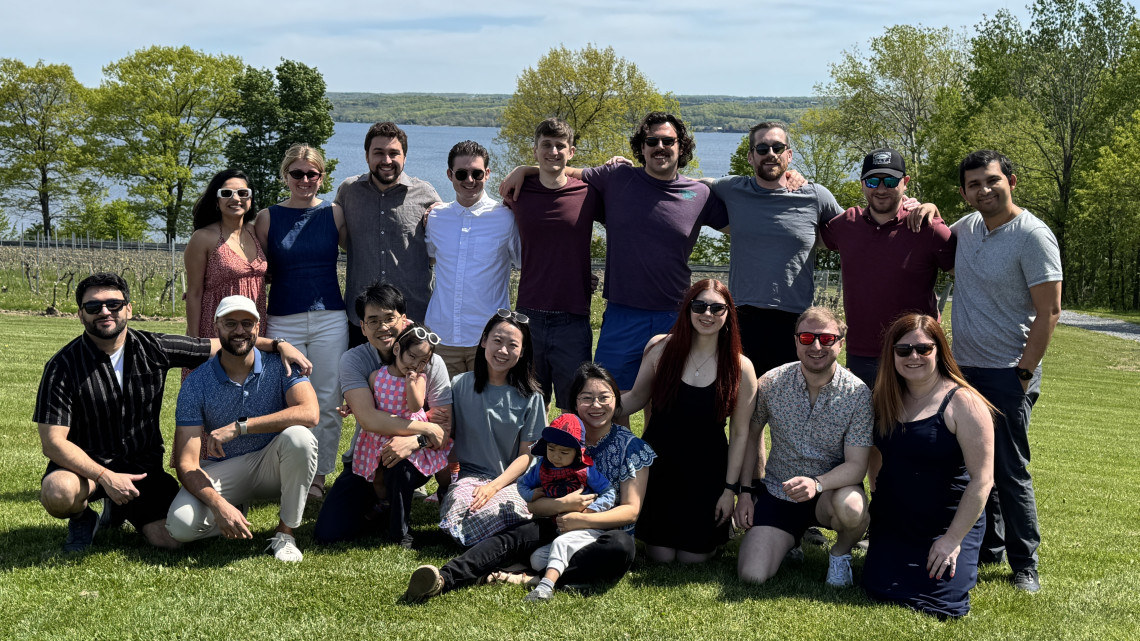
Alumni from Cornell's 2016 cohort of biomedical engineering Master of Engineering program returned to Ithaca during for their 10-year reunion.
News directly from Cornell's colleges and centers
Where can a biomedical M.Eng. take you? Just ask the Class of 2016
By Kathryn Henion
When members of Cornell University’s 2016 cohort of biomedical engineering Master of Engineering (M.Eng.) alumni returned to campus for their 10-year reunion, they gathered alongside the next generation of students at the program’s annual M.Eng. Industry Day – a fitting setting for a group whose careers have taken them in different directions, and a reminder that there is no single career path after a Cornell biomedical engineering M.Eng.
Over the past decade, program graduates have become leaders in medical devices and pharmaceuticals, founded companies, moved into consulting, robotics, bioinformatics, project management and sales, and advanced across startups, multinational corporations and research organizations.
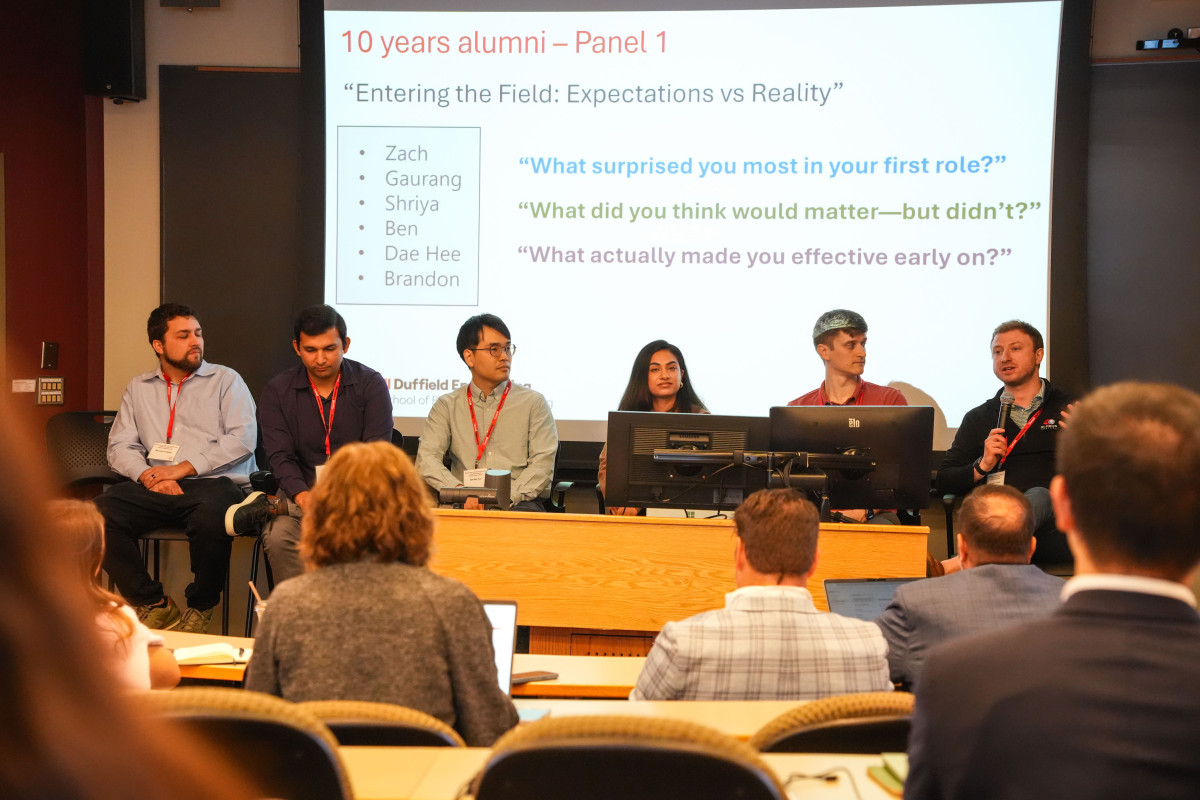
Biomedical engineering M.Eng. alumni present as part of an Industry Day panel.
The reunion gave graduating students a firsthand look at where a Cornell biomedical engineering degree can lead over the course of a decade. The alumni served on career panels, mentored current students, connected with industry partners and watched students present their capstone projects that define the culmination of the M.Eng. experience, while also reconnecting with classmates who remain an important part of their professional and personal lives.
“This program is different,” said Rikhabh “Ricky” Jain, M.Eng. ’16, now an associate director of external manufacturing operations at Merck. “It’s great for making connections.”
Jain recalled receiving his first job opportunity after meeting a Merck representative who visited campus during the program. Ten years later, he is still with the company, having advanced through multiple roles in manufacturing and operations leadership.
Jain wasn’t alone. Many alumni described careers shaped less by carefully mapped plans than by recognizing opportunities as they emerged.
Diana Rudz, M.Eng. ’16, is one example. Now a product development manager at Medtronic, she said her career did not unfold the way she originally expected. After starting in manufacturing engineering, she navigated company acquisitions, facility closures and changing roles before eventually moving into product development leadership.
“The goal you start with isn’t always the one you end up pursuing,” said Rudz. “You might achieve that initial goal and realize, ‘Based on that experience, I'm going to change direction.’”
As careers evolved, so did the value of the relationships alumni built during their year at Cornell.
“We’ve all stayed in contact throughout our careers,” Rudz said. “People got jobs or interview recommendations by staying in touch with each other, and that’s a really valuable part of this program.”
Gaurang Dimri, M.Eng. ’16, now working in medical device and database applications after roles in surgical robotics and critical care, remembered classmates celebrating with him after he became a U.S. citizen during the program.
“They held a big America party for me,” Dimri said during the panel. “I look back on that memory as one of the most important of my life.”

From left: Dae Hee Yun, M.Eng. ’16 with his wife and daughter; and Crystal Shuo Shan, M.Eng. ’16, and Gaurang Dimri, M.Eng. ’16, with their child.
Dimri also met his wife, fellow Cornell biomedical engineering M.Eng. alumna Crystal Shuo Shan, M.Eng. ’16, during the program. Shan later worked in industry research and development before pursuing doctoral research in bioinformatics.
Ten years later, those same graduates have applied their engineering foundation in remarkably different ways.
Kelsey Boissoneau, M.Eng. ’16, moved from research and development into project management and now helps lead new product development at Boston Scientific. Benjamin Solaski, M.Eng. ’16, built a career spanning consulting, sales, program management and orthopedic device product management, encouraging students to remain open to opportunities beyond traditional engineering roles.
Others found opportunities beyond engineering’s traditional boundaries. Joe Maher, M.Eng. ’16, moved from Johnson & Johnson into technology sales focused on life sciences companies. Sid Joshi, M.Eng. ’16, combined an M.Eng. with an MBA before pursuing entrepreneurship and consulting. Zachary Woods, M.Eng. ’16, joined a small health IT startup after graduation and helped grow the company over the past decade.
Emily Christie, M.Eng. ’16, found a path into biologics and pharmaceutical research without pursuing a Ph.D. After beginning at Regeneron, she joined Cue Biopharma, where she has spent nearly eight years helping advance a drug candidate from early research toward potential regulatory submission.
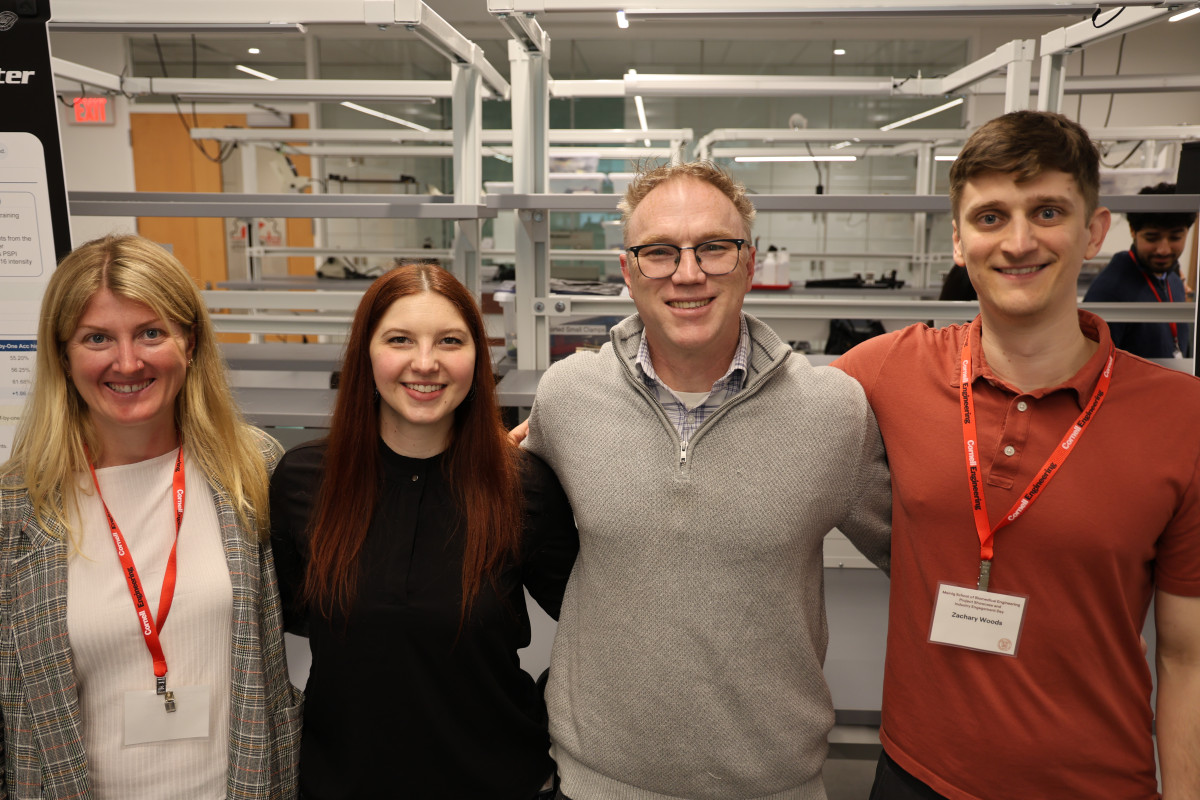
From left: Emily Christie, M.Eng. '16, Diana Rudz, M.Eng. '16, professor Jonathan Butcher, and Zachary Woods, M.Eng. '16.
Michelle Walther, M.Eng. ‘16, who has spent nearly a decade at BD across multiple divisions and locations, returned to campus under a mentorship role for students attending Industry Day. Through her role at BD, Walther has served as a project advisor, directly involved in the yearlong innovation process, giving her a firsthand view of how students apply the same skills she developed as an M.Eng. student: working across disciplines, adapting to challenges and translating ideas into solutions.
“[The M.Eng.] allowed me to take on independent work quicker than others in my field and operate more consistently with cross-functional groups, where each member has a different degree, vision and perspective,” Walther said.
Dae Hee Yun, M.Eng. ’16, now a senior full-stack engineer at LifeCanvas Technologies after doctoral work in neuroscience and research instrumentation, told graduating students that “your skills to learn new things” will become one of the most transferable parts of their degree.
Industry Day gave the Class of 2016 alums the chance to watch today’s students reach the same milestone they had celebrated a decade earlier. Their careers have taken many different directions, but returning to mentor students, reconnect with classmates and celebrate the next generation of innovators reflected the sense of community that has remained one of the program’s most enduring strengths.
Media Contact
Get Cornell news delivered right to your inbox.
Subscribe