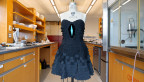
Dyed wool a sustainable water purification alternative
By Tom Fleischman, Cornell Chronicle
Scientists project that by 2050, nearly half the global urban population will not have enough potable water – a 50% increase since 2016. New and sustainable methods for desalination are needed, and Cornell researchers have one potential solution – in part inspired by the bird of paradise.
Employing a method of water distillation that harnesses sunlight by heating a body of water’s surface, a group led by Larissa Shepherd, M.S. ’13, Ph.D. ’17, assistant professor in the Department of Human Centered Design, in the College of Human Ecology (CHE), have proven the feasibility of using polydopamine-dyed and ultrablack wool as a low-cost, renewable water-purification method.
“The idea is to use natural materials and use them in a way that will allow areas that don’t necessarily have a lot of infrastructure to be able to generate clean water from salt water,” Shepherd said. “Wool is biodegradable, and we don’t have to worry about microplastics and other things that won’t degrade.”
Kyuin Park, M.S. ’23, Ph.D. ’26, formerly of Shepherd’s Responsive Apparel Design (RAD) Lab, is lead author of “Polydopamine-Wool Textiles for Sustainable Interfacial Solar Vapor Generation,” which published Sept. 6 in Advanced Science.
Co-authors include lab member Hansadi Jayamaha, Ph.D. ’26, and Lenan Zhang, assistant professor in the Sibley School of Mechanical and Aerospace Engineering, in the Cornell Duffield College of Engineering, whose lab helped with solar simulation and analysis.
Polydopamine (PDA) is a polymer inspired by melanin, a protein found in mussels. PDA has strong chemical bonding properties and absorbs near-infrared light, converting it into heat. The RAD Lab’s dyeing of wool with polydopamine, along with an additional step of plasma etching to create nanofibrils that trap light, last year created an ultrablack material – mimicking the striking deep black of the magnificent riflebird, a bird of paradise – that was the darkest fabric on record.
For this work, the researchers employed interfacial solar vapor generation (ISVG), a relatively new method for evaporation and desalination. In ISVG, specialized materials are partially submerged and heated via sunlight; they heat the top surface of the water while absorbing it and convert it into vapor.
The material captures the vast majority of the salt, and the vapor is converted back into potable water. For ISVG, a material must resist salt fouling; the researchers achieved 10 hours of continuous operation without salt accumulation.
Park and the team dyed three different wool architectures and tested their evaporation and vaporization capabilities in three distinct configurations, using a solar simulator: horizontal (parallel to the water surface); one-sided vertical; and two-sided vertical, with mirrors positioned at the back side of the material to achieve illumination on both sides.
The group found that ultrablack-dyed wool in the two-sided vertical ISVG set-up captured 2.43 kilograms of water per square meter of fabric per hour, while PDA-only wool recorded 2.21 kg absorption. Both rates are nearly twice that of traditional horizontal, two-dimensional evaporation systems.
Salt content in the captured water, Shepherd said, was well below the World Health Organization’s standard for drinking water.
Shepherd said that PDA’s efficiency is such that it might not be worth going through the extra step of plasma etching to achieve ultrablack. But over the course of a year or more, she said, getting the extra evaporation potential from ultrablack might be preferrable. “It’s a pretty drastic difference going from a regular generic black textile to our PDA dyed wool, and the ultrablack is a small step up from that,” she said.
Future studies, Shepherd said, will test the dyed-wool technology on both rain and waste water, along with enhanced water-collection designs.
Other contributors included Mia Bressler ’28, an environmental engineering major; Jintong Gao, a postdoctoral researcher from the Zhang Lab; and Yipu Wang, doctoral student in mechanical engineering and member of the Zhang Lab.
This work made use of the Cornell Center for Materials Research, and the Human Centered Design shared instrumentation facility. Funding support came from the National Science Foundation, the Cornell Atkinson Center for Sustainability and the AATCC Foundation.
Media Contact
Get Cornell news delivered right to your inbox.
Subscribe