‘Rooted in Reciprocity’: Indigenous students share stories of how plants fuel connection
By Holly Hartigan, Cornell Chronicle
Through plants and personal stories, a new student-led exhibit at Cornell Botanic Gardens explores the concept of reciprocity: that people live because the natural world lives.
The students, representing Indigenous cultures from across the Americas, recorded personal anecdotes about how plants support their well-being and connection to community. They include tales of a family heirloom made of sweetgrass, the strawberry’s benefits to the body and spirit, and passing seeds down through generations.
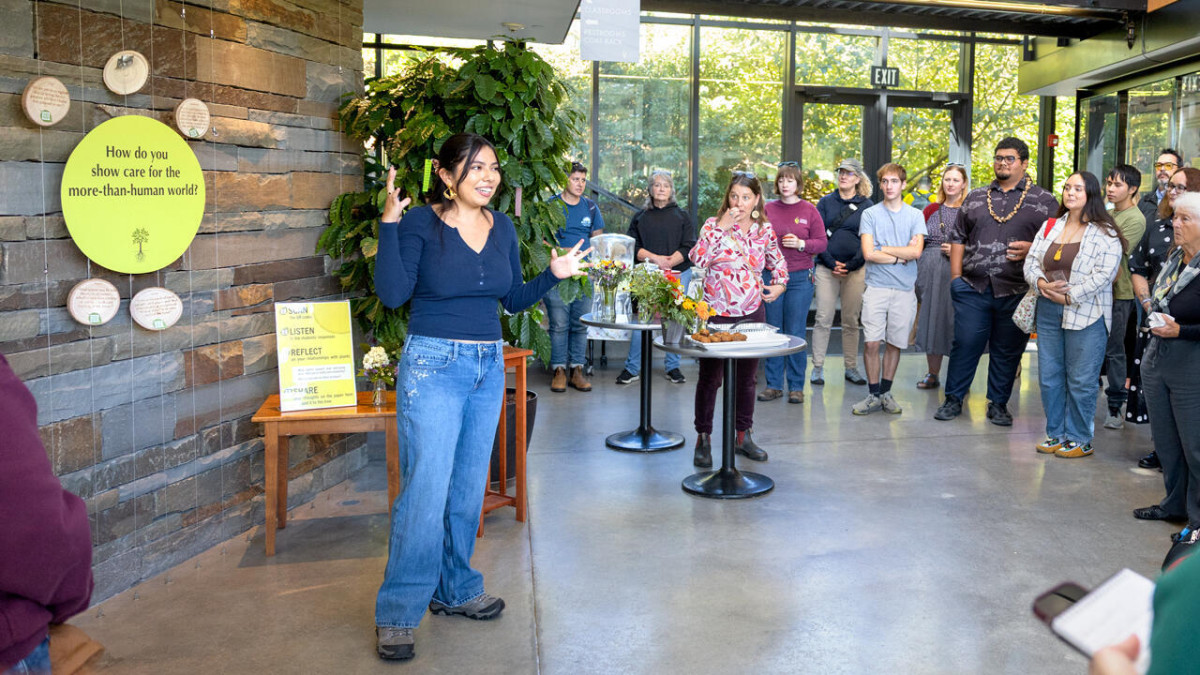
Shania Flores ’28, a student interpretation assistant with the botanic gardens, speaks in front of the Rooted in Reciprocity exhibit at an opening celebration Oct. 3.
Their stories, collectively titled Rooted in Reciprocity, are part of the botanic gardens’ Cultivating Hope: Plants and Indigenous Knowledge exhibit, which also features displays of plants that are deeply connected to Indigenous communities. They include white pine, whose clusters of five needles represent the union of the original five nations of the Haudenosaunee, and elderberry, used to treat fever and skin problems and as a dye. The exhibit runs through the end of 2027.
“We wanted people to see examples of Indigenous students thriving on this campus while continuing to be very close and true to their cultures and to who they are,” said Shania Flores ’28, a student interpretation assistant with the botanic gardens who worked with other students and staff to craft the storytelling project and select new plants for garden beds outside the Nevin Welcome Center and in the nearby Pounder Vegetable Garden.
Visitors can access the story collection inside the welcome center from QR codes printed on crosscut sections of wood hanging on a lobby wall.
Flores, an environment and sustainability major in the College of Agriculture and Life Sciences (CALS), contributed stories from her own family, who are members of the Kichwa from the Andean region of South America.
Plants not only serve to bond Indigenous communities together through food, medicine and ritual, Flores said. They have helped the Indigenous Cornell community build bonds with each other as they learn about and embrace each other’s traditions.
“We’re all very different,” Flores said, “but we have these threads that connect us and this care and these relationships that really bond us together.”
Students will harvest the marigolds currently blooming in the garden for the Day of the Dead, on Nov. 1, which they will celebrate together.
“There are plants here that have very deep connections to us,” Flores said, “and being far away from home right now, you want that comfort.”
Paige Peters ’27, a plant science major in CALS and a member of the Saginaw Chippewa Indian Tribe of Michigan, helped develop the exhibit from its earliest stages and recorded her own story of a barrette woven from sweetgrass that her family has passed down for generations. Now, sweetgrass grows in a circular garden outside the welcome center along with the three other sacred medicines: cedar, tobacco and sage.

Visitors can see new plantings that are deeply connected to Indigenous communities in the Pounder Vegetable Garden and the gardens outside the Nevin Welcome Center as part of the Cultivating Hope exhibit.
“I have had sweetgrass braids and other sweetgrass items, but I’ve never been able to identify it outside on my own,” she said during a presentation to celebrate the project on Oct. 3. “Having sweetgrass planted out in the garden – it’s such a privilege to be able to establish connections in that way. So yes, we’re talking about our past and our current connections, but this is also creating future connections.”
The exhibit is a collaboration between botanic gardens staff and Indigenous staff, students and faculty, including Sarah Buffet, admissions counselor in the American Indian and Indigenous Studies Program (CALS) and Karim-Aly Kassam, professor of natural resources and of American Indian and Indigenous studies. The organizers plan to add more stories from students as well as other members of the community.
Sarah Fiorello, interpretation coordinator at the botanic gardens who guided the exhibit’s development, said organizers hope to inspire people to reflect on their own reciprocal relationships with nature. Visitors can contribute personal stories by writing them on colorful tags to hang on trees near the story wall.
“That’s a way for us to be able to make connections with people we might not even meet through reminding each other that we are all in a relationship of mutual care with all beings,” she said.
Media Contact
Get Cornell news delivered right to your inbox.
Subscribe