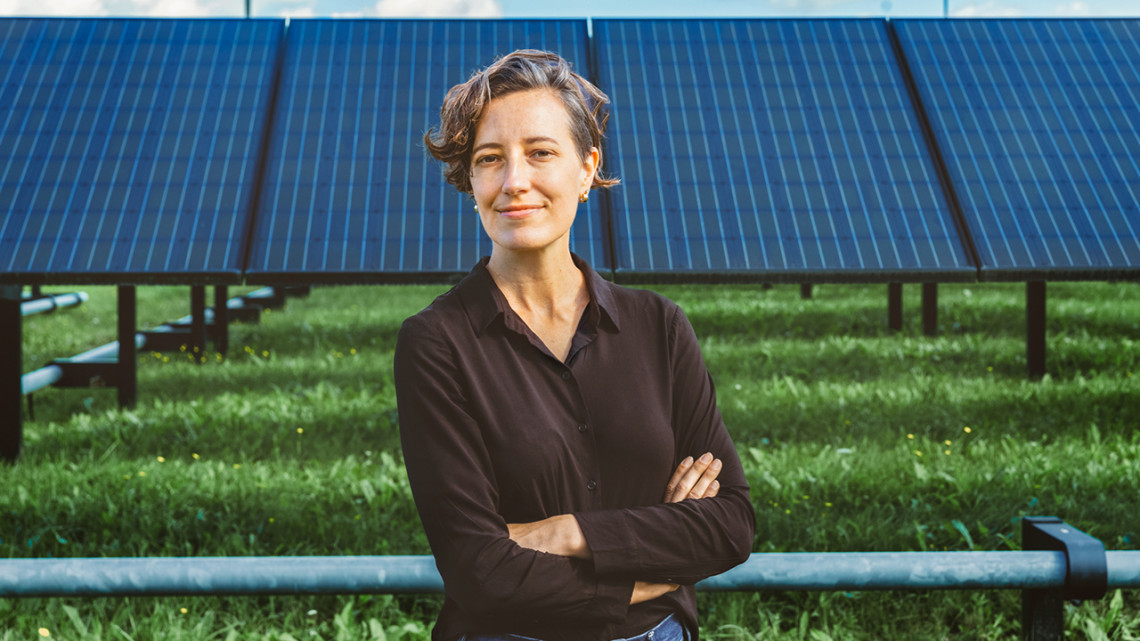
Holly Jean Buck, Ph.D. ’17, has been awarded a MacArthur Foundation “genius grant.”
Sociologist alumna who studies climate change wins MacArthur Fellowship
By Beth Saulnier
When the MacArthur Foundation scheduled a call with sociologist Holly Jean Buck, Ph.D. ’17, she assumed that the nonprofit wanted her thoughts on where it should direct funding for research on mitigating climate change – one of her areas of expertise.
“It was actually the third call with funders I had scheduled that day, just randomly,” she recalls. “I wasn’t expecting that they would notify me that I was a fellow. That was really a big surprise.”

And of course, the honor she’d garnered isn’t just any fellowship: Colloquially known as the “genius grant,” it’s given to notables in a wide range of fields – and has no application process, relying instead on a confidential nomination system.
Buck is one of this year’s 20 recipients of the fellowship, which carries an unrestricted $800,000 award. Other 2026 honorees include artists and writers, a forensic anthropologist, a poet, a labor economist, and a choreographer.
An associate professor in the Department of Environment and Sustainability at the University at Buffalo, Buck does research in such areas as climate change, environmental policy, and public participation in emerging technologies, particularly in rural areas.
“Buck is setting forth a compelling vision for what is needed to launch a successful energy and climate transition and to support rural innovation, while remaining attentive to social realities and justice,” the foundation wrote on its website, noting that she “cuts through heated rhetoric to focus on communities and just and equitable implementation of solutions to our planetary climate crisis.”
A doctoral alum in development sociology, Buck did interdisciplinary research during her time on the Hill, such as studying food systems and poverty reduction in East Africa. Her dissertation included work in the Arctic communities of Finnish Lapland, where she examined the role of public engagement in considering strategies for reflecting sunlight to cool the Earth.
Among her published works is the 2019 book “After Geoengineering: Climate Tragedy, Repair, and Restoration.” It explores whether the dystopian-seeming methods of manipulating the planet’s environment to counteract the effects of climate change may in fact have benefits – if thoughtfully deployed for the good of the populace rather than industrial interests.
In 2021, she published “Ending Fossil Fuels: Why Net Zero is Not Enough,” in which she argues that the focus on emissions accounting is a perilous distraction from the need to cease burning oil, coal and gas.
She’s currently at work on another book – she hopes the fellowship will allow her to devote time to it – on how rural communities are involved in shaping new technologies, from agriculture to semiconductors.
“It’s not surprising that MacArthur chose Holly for this award,” said Stephen Hilgartner ’78, B.A. ’83, Ph.D. ’88, the Frederick J. Whiton Professor of Science & Technology Studies in the College of Arts and Sciences and a member of Buck’s doctoral committee.
“She is extremely smart and creative,” he said. “She has an impressive feel for the social aspects of science and technology, and her work on environmental politics and policy is incisive and provocative. Her writing is clear and precise, and she’s skilled at interacting with academic and lay audiences.”
Buck has done extensive work with the Intergovernmental Panel on Climate Change, a United Nations body devoted to assessing the science that could mitigate the global threat. Under a grant from the Sloan Foundation, she has also been studying how climate technologies and the transition away from fossil fuels are viewed in various regions of the U.S.
“We’ve been doing interviews, focus groups and surveys,” she said, “trying to understand how people are thinking about the energy transition and about policies to achieve net-zero emissions, including what they see as the risks and benefits.”
And while she’s thrilled to receive the MacArthur, she admits that the award is bittersweet given the recent reversals in longstanding U.S. commitments to study and address the climate crisis.
“I’m grateful for the support, but philanthropic foundations funding this sort of work is just not scalable,” she said. “It really requires the federal government to fund things like satellites, instrumentation and personnel. The U.S. has built up leadership in this over the past several decades, and it’s painful to see that being swept away.”
Buck’s award is just the latest MacArthur Fellowship given to a Cornell alum or faculty member. Recent winners include two graduates of the university’s acclaimed master’s program in fiction writing: Manuel Muñoz, M.F.A. ’98, in 2023 and Ling Ma, M.F.A. ’16, in 2024.
Beth Saulnier is editor-in-chief of Cornellians.
Media Contact
Get Cornell news delivered right to your inbox.
Subscribe