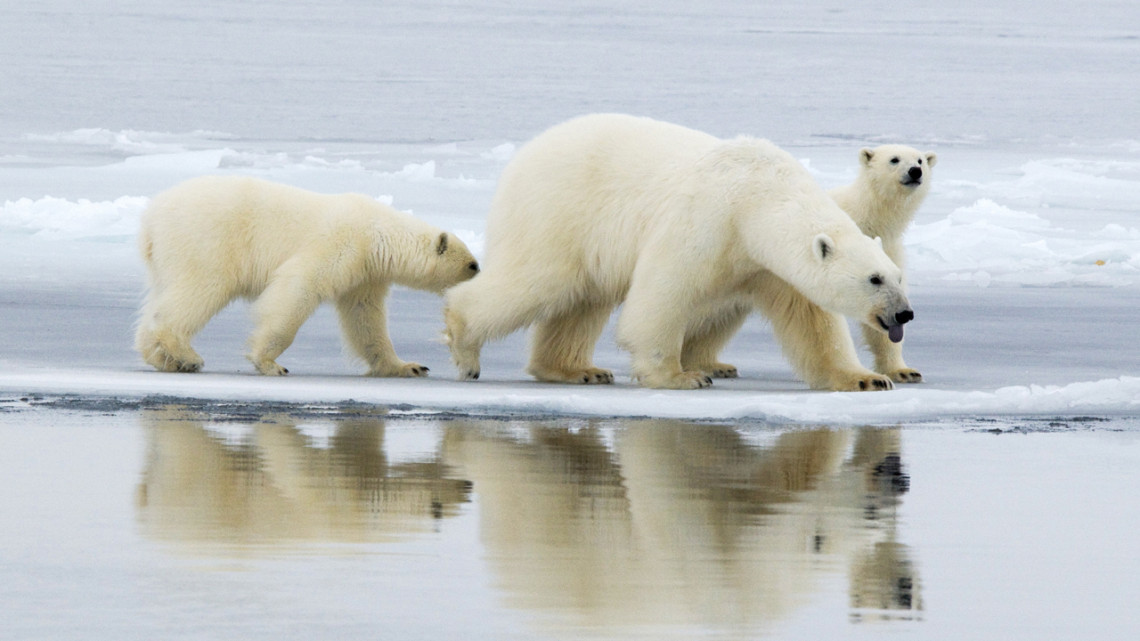
Mother polar bear and cubs in East Greenland.
Migratory birds spread avian influenza to Greenland’s polar bears
By Krishna Ramanujan, Cornell Chronicle
Migrating birds that breed in the Arctic are spreading avian influenza to polar bears in eastern Greenland, according to a new study that found evidence of infections in bear blood samples acquired from Greenland Inuit subsistence hunters.
The results suggest that such emerging viruses may pose risks to Arctic mammals.
The Arctic is warming at faster rates than much of the rest of the planet – in the western Arctic, four times the global rate. As a result, threatened polar bears that hunt on dwindling sea ice are being forced to search for food elsewhere, which has likely increased their odds of exposure to highly pathogenic avian influenza (HPAI).
“With climate change, we know that the bears are changing their diets, and they’re likely becoming exposed to many new pathogens on land that they could be naïve to, because they come from a life highly adapted to the ice,” said Kayla Buhler, a Cornell K. Lisa Yang Center for Wildlife Health Postdoctoral Fellowin the College of Veterinary Medicine. Buhler is first author of the study, published Oct. 13 in Emerging Infectious Diseases.
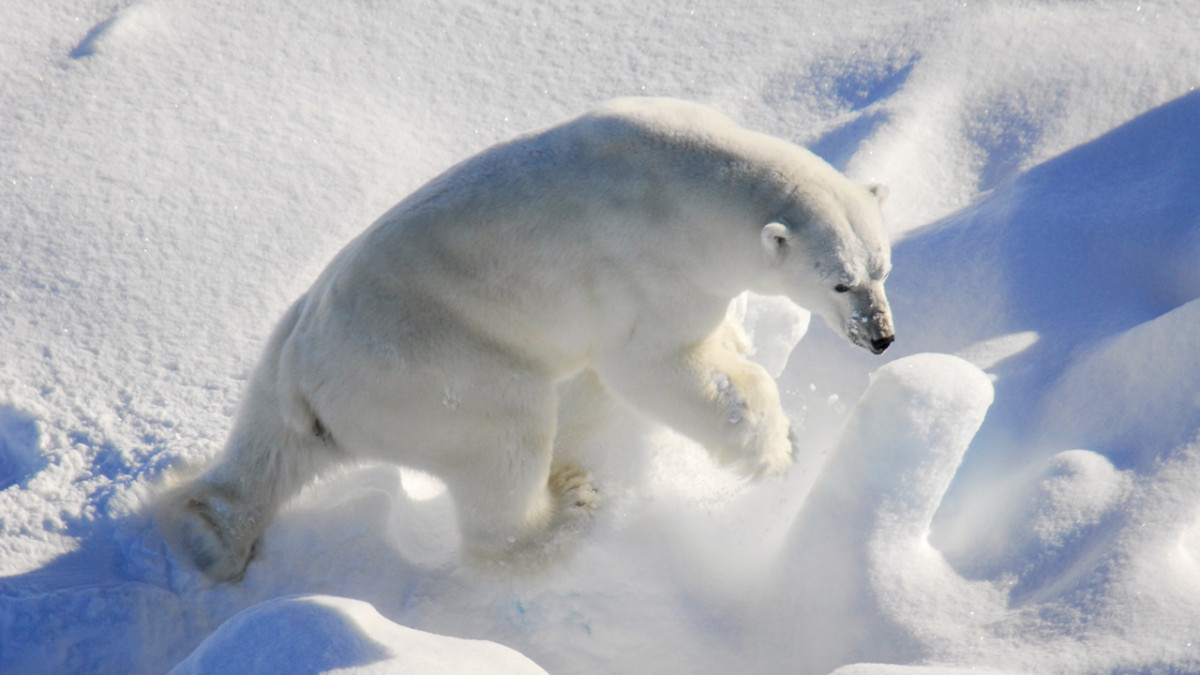
Polar Bear on East Greenland Pack Ice.
A wide range of global bird species migrate northward via East Atlantic and North American Atlantic flyways to breed in the Arctic and Greenland. There, they congregate in large colonies, creating a perfect hot spot for viral mixing and transmission. These birds include many species of shorebirds and waterfowl that are the main reservoirs of HPAI.
“It’s important for us to monitor what new pathogens are becoming established in polar bears because we don’t know how they’ll be affected,” said Buhler, who is also a researcher at the University of Inland Norway. “As populations become more and more stressed, diseases and pathogens could play a critical role in conservation efforts.”
The high exposure in polar bears creates additional questions about whether the HPAI viruses in Greenland contain mutations that make them more infectious to mammals and if HPAI could be transmitted from one polar bear to another.
Samples from polar bears in this study were collected during the subsistence hunts that occur around Scoresby Sound, also known as Ittoqqortoormiit in the Eastern Greenlandic dialect.
As ice recedes, polar bears are moving to land to search for new ways to meet their nutritional needs.
“On Svalbard, Norway, we see that polar bears are now taking down reindeer, which is something never seen before in the past. There and in many other parts of the Arctic, they are starting to raid bird colonies,” Buhler said.
Disease can spread when bears eat live and dead birds and eggs, or seals or other animals infected with HPAI. Polar bears with an active infection could potentially pass avian influenza to other bears when they congregate at hunting carcass sites and at dumpsters near human settlements.
In 2026, in Svalbard, scientists reported a young polar bear died from HPAI after eating an infected walrus. Another study in Svalbard detected H5N5 avian influenza virus in Arctic foxes in 2025 which scavenge and prey on birds and eggs. Both studies reported viruses with mutations suspected of making the virus more likely to infect mammals. And dead birds in Greenland have been found with strains of HPAI, including H5N1 and H5N5.
In the current paper, co-authors from Aarhus University, Denmark, acquired a total of 109 heart blood samples between 2016-25 from Inuit hunters, with whom they collaborate regularly. The government monitors the bears and provides annual quotas for subsistence hunting, which is a cultural right for Indigenous peoples.
In the lab, the blood plasma was separated out and the researchers tested for antibodies of influenza A, which detects exposure to HPAI and other influenza A viruses.
Out of the 10 years of samples, there was no evidence of any infection until 2024, when the scientistsdetected antibodies for influenza A in 21% of 14 bears. By 2025, the rate had gone up even more; they found antibodies in 43% of 14 bears. Further testing identified four positive bears with specific antibodies for HPAI viruses.
“We’re not detecting active infections; we’re detecting a prior infection that has been cleared by the animal,” Buhler said. “This is one of the first studies to show that bears can recover and do quite well after infection.”
The bears that were exposed to virus likely contracted it during the summer, while subsistence harvests took place the following spring. The hunters, who have extensive traditional knowledge of the bears, have not observed sick animals.
Co-authors include scientists across the circumpolar North, including Norway (University of Inland Norway), Denmark (Aarhus University) and Canada (University of Saskatchewan & National Microbiology Laboratory).
The research is supported by Denmark’s Environmental Protection Agency, the European Union Horizon Europe, the Morris Animal Foundation and the Cornell K. Lisa Yang Center for Wildlife Health.
Media Contact
Get Cornell news delivered right to your inbox.
Subscribe
