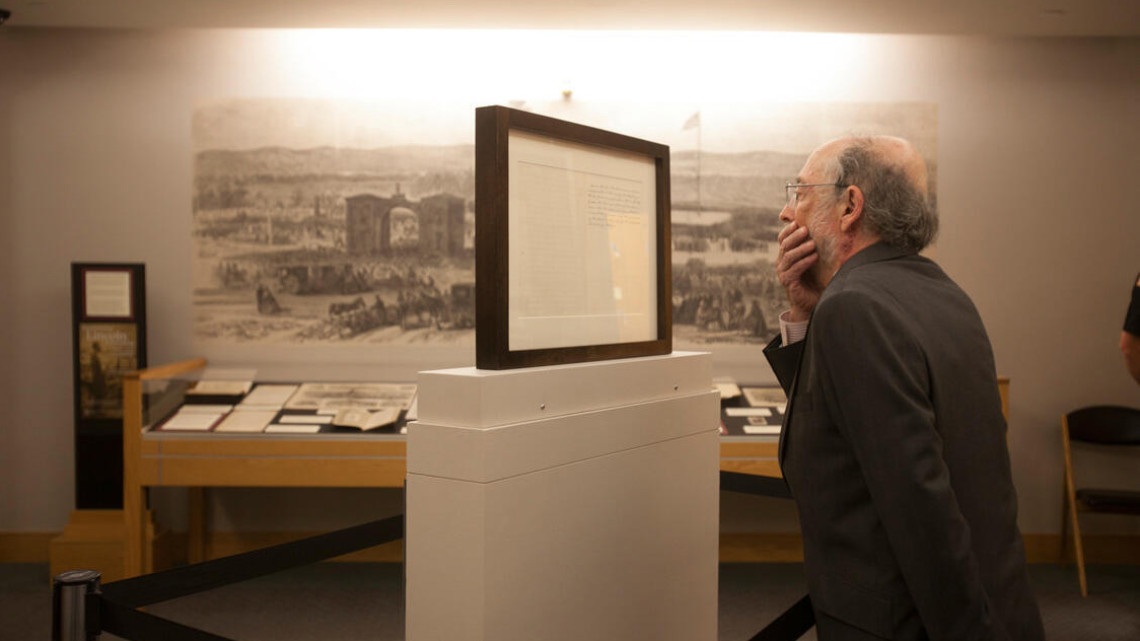
Gabor Boritt, Professor Emeritus of Civil War Studies and previous director of the Civil War Institute at Gettysburg College, examines Cornell’s copy of the Gettysburg Address in 2013.
Lincoln’s rare handwritten Gettysburg Address on view Nov. 19
By Laura Reiley, Cornell Chronicle
One of only five known copies of the Gettysburg Address written in Abraham Lincoln’s own hand will be on public view for one day, Nov. 19, exactly 163 years after the president delivered it, as Cornell University Library marks America’s 250th anniversary.
“Lincoln’s Words for America 250: A Viewing of the Gettysburg Address” runs from 10 a.m. to 7 p.m. in the Division of Rare and Manuscript Collections, Kroch Library, 2B48. The event is free and open to all. The last visitors will be admitted to the viewing line at 6:15 p.m.
Lincoln delivered the 272-word address on a battlefield near Gettysburg, Pennsylvania in 1863. The speech redefined the Civil War as a test of whether a nation “conceived in liberty, and dedicated to the proposition that all men are created equal,” could endure.
“Surrounded by the memory of thousands who had lost their lives, Lincoln honored those sacrifices while expressing confidence that the nation would prevail and endure,” said Elaine Westbrooks, Carl A. Kroch University Librarian. “He in brevity had this amazing way to convey deep, thoughtful words that inspire us.”
A copy made for a cause
Cornell’s manuscript exists because of a request from the most famous historian of his day, George Bancroft. On Feb. 23, 1864, Bancroft asked Lincoln at a White House reception for a handwritten copy of the speech. Bancroft’s stepson, Col. Alexander Bliss, was helping collect manuscripts for a lithographed volume of facsimiles, “Autographed Leaves of Our Country’s Authors.” It was to be sold at the Baltimore Sanitary Fair to aid soldiers, especially those ill in hospitals.
Lincoln agreed, but the first copy would not do. He had written on both sides of the paper, and the lithographic process required a blank reverse. After Lincoln’s secretary sent stationery of the right size, the president wrote a second copy shortly after March 7, 1864. That version was reproduced in the volume. It is now in the Lincoln Room at the White House.
The first copy, the one Cornell owns, stayed with the Bancroft family. The historian’s grandson, Wilder Bancroft, a Cornell professor of chemistry, inherited it and kept it in his home on campus. In 1929 he sold it to a New York dealer for $100,000. During the Depression it was resold for half that amount to a buyer in Indianapolis, and then to another Indianapolis resident, Mrs. Nicholas H. Noyes. In 1949 she presented it to Cornell as part of the Nicholas H. Noyes Collection of Historical Americana.
“Known as the Bancroft Copy, this artifact has been an historic touchstone for the campus since then,” said Katherine Reagan, the Ernest L. Stern ’56 Curator of Rare Books and Manuscripts and head of collections. “Seeing the document and Lincoln’s actual handwriting up close can be an unforgettable, deeply moving experience.”
Five copies, many questions
Only five manuscripts of the address in Lincoln’s handwriting are known. The Library of Congress holds the two earliest, which Lincoln gave to his private secretaries, John Nicolay and John Hay. The other three were written after Nov. 19 for charitable purposes: Cornell’s, the one now at the White House, and one made for Edward Everett, the orator who spoke before Lincoln at Gettysburg. Everett’s manuscript is at the Illinois State Historical Library in Springfield.
The copies are not identical, and scholars still debate which, if any, was the text Lincoln held at the cemetery dedication. The Nicolay copy lacks the phrase “under God,” for example, which appears in later versions. Historians also disagree about when and where Lincoln wrote the speech: in the weeks before the trip, on the train, or the night before, in Gettysburg.
Each of the five surviving copies has a unique history, told through its paper, format and wording, Reagan said.
“Cornell’s copy, for example, is the only one to survive with Lincoln’s original letter of transmittal,” she said. “This public display offers a rare opportunity to learn directly about the reality of how it was made and its distinct historical trajectory.”
What visitors should know
To protect the fragile materials, food and drink are not permitted in the viewing area. Heavy coats, bags, backpacks and other large items must be set aside before entering. A designated area will be available for belongings, but it is not locked or monitored.
The last time the library had public all-day viewings of the Gettysburg Address was in 2015. Those who cannot attend in person can explore “The Gettysburg Address,” an online exhibition curated by Reagan. It includes images of Lincoln’s letter and envelope to Bancroft, a transcript of Cornell’s copy and background on all five manuscripts.
Westbrooks says she hopes visitors leave with renewed appreciation for the importance of primary sources.
“There is a difference between reading a digitized version of a historic document and standing in front of the original artifact,” she said. “Seeing the document as it was created offers a more direct connection to history and underscores the value of making these resources accessible to our community.”
Media Contact
Get Cornell news delivered right to your inbox.
Subscribe