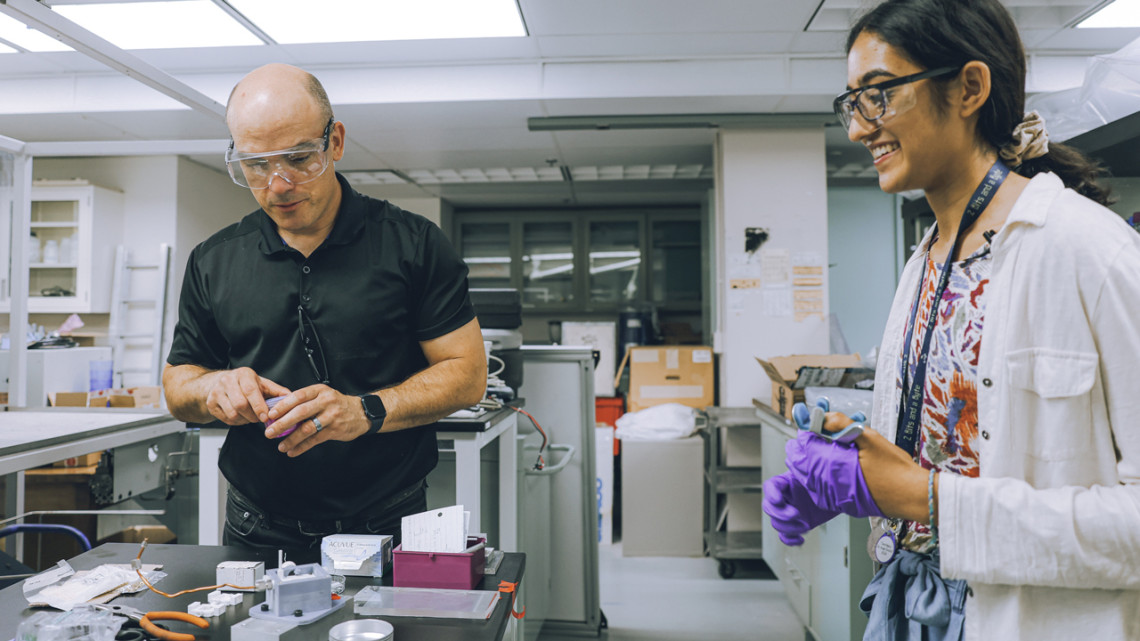
Tobias Hanrath, the Croll Professor in Engineering in Duffield Engineering, and Anjali Asthagiri ’28 explored how tiny semiconductor crystals called quantum dots arrange themselves into patterns.
Tigers, zebras, quantum dots: Nanoparticles assemble into patterns
By David Nutt, Cornell Chronicle
Forget about how the zebra got its stripes. For a group of Cornell engineers, an equally important question is: What drives the formation of such eye-catching patterns?
Rather than studying the animal kingdom, the researchers looked to tiny semiconductor crystals called quantum dots to understand how they arrange themselves into striking cascade structures in evaporating liquid. As a result, the researchers can now control the process, which could lead to engineering the next generation of optical and electronic devices from nanoscale building blocks.
The findings published Nov. 14 in Nature Communications. The study’s lead author is Jonathan Palumbo, M.S. ’25, a doctoral student in the Hanrath Energy Lab. Anjali Asthagiri ’28 is the co-author.
“One of the beautiful aspects of this paper is that you can have a film that has a lot of disorder and complexity and weird structures that haven’t been seen elsewhere, and most people would look at it and say, ‘Oh, there’s something weird going on there. Let’s make sure we avoid making the film like that,’” said Tobias Hanrath, the Croll Professor in Engineering in the Cornell Duffield College of Engineering and the paper’s senior author. “I think the interesting conceptual shift is if you embrace the complexity and approach it as ‘Ah, I wonder what’s actually happening there? What gives rise to that?’”
Quantum dots, which were recognized with the 2023 Nobel Prize in Chemistry, are inorganic semiconductor nanoparticles – each essentially a cluster of 1,000 atoms – that have strong light-absorbing properties. Their optical and electronic properties can change simply by varying the dots’ size and shape – capabilities that make them ideal building blocks for multilayered superlattices. Hanrath’s lab has previously paired quantum dots with microbes to create nano-biohybrid systems that can harvest sunlight to perform complex chemical transformations.
“When people want to take the quantum dot and make a superlattice, they want to make a perfect crystal that’s as big as possible, with no grain boundaries,” Palumbo said. “But instead, what this paper explores is if we grow our super crystal as small as we can, with a cluster of maybe 20 dots, what kind of patterns can that make? And how do we step between those perfect monolayers and then stranger, smaller systems?”
To do that, Palumbo and Asthagiri used a tiny syringe to deposit 10 nanoliter droplets of ethylene glycol containing quantum dots under a laser confocal microscope. The droplets – each roughly 1/100th of a raindrop – would evaporate and shrink, leaving behind what Palumbo described as “a snail tail of film, which we call the cascade of morphologies.”
“During the experiments, Jonathan and I would discuss why we may be seeing these cascades and the different underlying physics phenomena at play: solvent evaporation, convection, diffusion,” said Asthagiri, who was supported by an Engineering Undergraduate Research Grant for her work on the project. “That process enabled us to start building our intuition for how to come up with a computational model.”
Asthagiri developed the model and ran simulations for the ordering and packing of the quantum dots, which primarily formed tiles and ribbon patterns. The sequence of the cascades in the models matched that of the experiments. The researchers then set out to replicate the process using two forms of control: concentration and solvent volatility.
“If the solvent evaporates very, very slowly, you end up seeing a lot of different patterns form as you drive dots initially to the edge, forming a multilayer, and then going through the cascade of multilayer to monolayer to holes, to ribbons and tiles,” Palumbo said. “If you use a really fast evaporator, instead of the film having time to organize and order from highest to lowest concentration, you just quench into some average regime.”
While the physics behind the formations of quantum dots differs from other natural examples such as tiger or zebra stripes, visually they resemble one another. And once you notice the patterns, they become hard to miss.
“Anjali and I used to send each other pictures of the patterns we’d see everywhere that looked exactly like dots,” Palumbo said. “Like when the snow would fall and melt in Ithaca. You can see it on the macro scale, like with the new storms they’re finding on Saturn, all the way down to animals, drying evaporatives and soup.”
The research was supported by the National Science Foundation (NSF), the Cornell Presidential Life Science Fellowship and the Duffield Engineering Learning Initiatives Fellowship.
The researchers made use of the Cornell Center for Materials Research, which is supported by the NSF MRSEC program.
Media Contact
Get Cornell news delivered right to your inbox.
Subscribe
