Dr. Jarra Jagne, an expert on chickens, turkeys and game birds like pheasants, has a hand in nearly all aspects of New York state’s growing poultry industry.
New York’s only poultry veterinarian keeps birds healthy, industry thriving
By Susan Kelley, Cornell Chronicle
Dr. Jarra Jagne did not like the feel of the hen in her arms.
Jagne – the only board-certified poultry veterinarian in New York state – had suited up in biohazard coveralls, boot covers and gloves to check on the 12,000 chickens on David Weaver’s farm in Penn Yan, New York.
“It’s a little bit soft. I can move it. I shouldn’t be able to do that,” said Jagne, D.V.M. ’90, as she examined a hen’s keel bone, which runs vertically down its chest. “That tells me we probably need to look at the diet, and add more calcium or vitamin D3. Do you give them supplements, like oyster shells?”

Dr. Jarra Jagne, a professor of practice in the Department of Public and Ecosystem Health at the College of Veterinary Medicine, examines a chicken on the farm of David and Leanna Weaver in Penn Yan, New York.
As an expert on poultry species including chickens, turkeys and game birds like pheasant, Jagne, a professor of practice in the Department of Public and Ecosystem Health at the College of Veterinary Medicine, helps keep New York’s poultry healthy and the industry thriving. Weaver’s operation is one of 9,000 poultry farms in the state. In 2024, those farms raised 7.2 million chickens and brought in annual sales of $195 million. The statistics have been rising every year, Jagne said.
Her rare expertise – there are only 348 poultry veterinarians in the country – is especially crucial as formerly well-controlled diseases make a comeback in New York state.
Turkeys, for example, are now experiencing a resurgence of erysipelas, a bacterial disease that is fatal for them and can also infect people. Half of the cases in the last five years occurred in 2026, said Jagne, who leads CVM’s Avian Health program.
Meat from these birds is safe to eat, she said. But people such as butchers who handle turkeys can catch the disease, which can cause skin infections and sometimes a rare, life-threatening inflammation of the heart called endocarditis.
New York’s small poultry producers, defined as those who raise between 100 and 2,000 birds, are experiencing more diseases like erysipelas, pasteurella and yersinia because they tend not to vaccinate their poultry, Jagne said. Vaccination is expensive, because vaccine manufacturers only sell their products in large, more costly quantities, aimed at commercial growers.
Even so, she has been educating small producers around the state on the importance of vaccination. Weaver, who vaccinates his birds, has consulted with Jagne for 12 years. “It puts your mind at ease that you know you have somebody that you can go to for answers,” he said.
His chickens roam 30 acres of pasture, surrounded by rolling woodlands, fields and a vineyard. At full capacity, they produce 10,800 organic eggs per day. He says it’s easy to spot problems with his flock. Diagnosing those problems is not.
“I don’t know diseases that well, and because of all the other things that I do, I don’t have time to sit down and study them,” he said. “So, we go to somebody who knows chickens inside and out.”

David Weaver packs eggs from the 12,000 chickens he raises in Penn Yan, New York. They produce up to 10,800 eggs per day.
Jagne provides veterinary services for not only Weaver but also 25 other small producers in the Finger Lakes who sell their eggs to Kreher Family Farms, a fourth-generation farm and the state’s second-largest egg producer, based in Clarence, New York. The Kreher familly's farms and its partner farms together raise 2.8 million laying hens, which produce everything from conventional white eggs to pasture-raised organic eggs.
Partner farmers like Weaver diversify Kreher’s egg production and reduce the risk of disease, said Brian Kreher ’04, the company’s vice president of egg farms. He asks Jagne to speak to the partner farmers annually, to keep them up to date on disease, nutrition, health and management best practices.
“She has that breadth of knowledge, and that depth of knowledge, and she does a fantastic job of distilling that down to something that even someone like me, who went to school for marketing, can understand,” Kreher said. “And that’s a skill, because if you’re a scientist, it can be very easy to talk above people’s heads.”
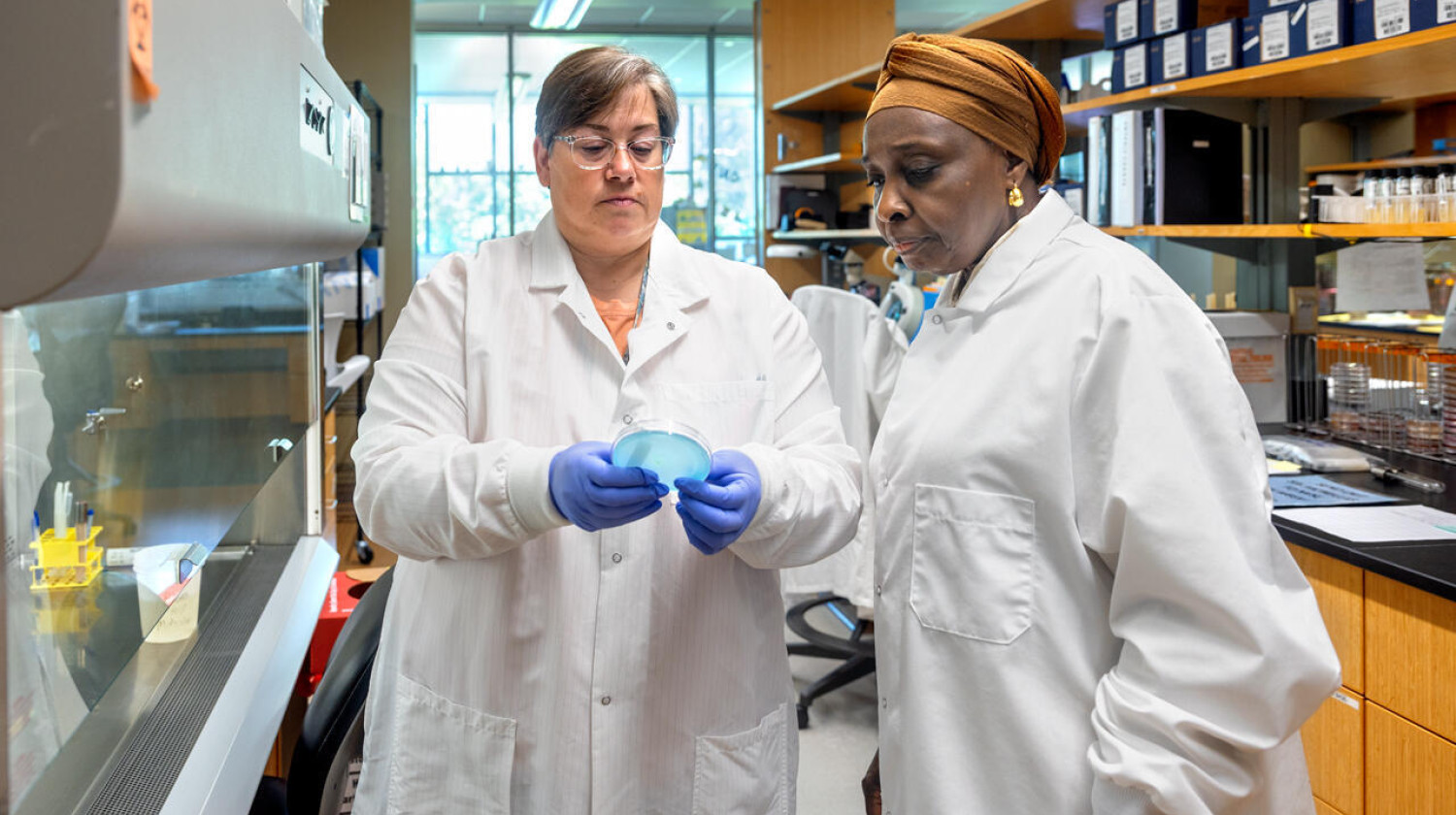
At right, Dr. Jarra Jagne, a professor of practice in the Department of Public and Ecosystem Health at the College of Veterinary Medicine, talks with Rebecca June Franklin-Guild, a supervisor at the bacteriology lab of the Animal Health Diagnostic Center.
Solving problems
Jagne never intended to specialize in poultry. As a child in her native Gambia, she lived in a city, but developed an appreciation for livestock when she traveled around the countryside in the summer with her father. An accountant, he provided payments to agents who bought peanut harvests from small farmers. Her parents recognized her love of animals and allowed her to have a pet cat – highly unusual in Gambia.
After high school, she worked for Gambia’s Department of Livestock Services. “I enjoyed going out to farms to help solve problems,” she said. “So, the next step was to get a degree in veterinary medicine.”

At center, Brian Kreher ’04, vice president of egg farms for Kreher Family Farms, in Clarence, New York, talks with Dr. Jarra Jagne, far right, and contract poultry farmer David Weaver, at left, on Weaver’s farm in Penn Yan, New York.
She moved to the U.S. and earned a B.S. at Colorado State University, where she intended to go to vet school. But Cornell offered a lower tuition. And the head of the Gambian veterinary service at the time had earned his D.V.M. at Cornell and encouraged her to attend. So she enrolled at CVM. Exposure to Cornell’s well-known poultry experts and researchers solidified her interest in poultry. “They’re very intelligent animals,” she said.
Jagne has seen a big increase in small producers in New York like Weaver, who are meeting market demand for pasture-raised and organic chicken and eggs, she said. They remind her of the smallholder farms she saw in Gambia.
“This is where we started from in the U.S. poultry industry: people having small backyard flocks just to feed the family, and selling the excess to others,” she said. “It’s coming back, and it’s consumer-driven. People are saying, ‘I want the old style. I want my eggs coming from these small farms.’ And it’s also providing jobs for a lot of people.”
Jagne said it’s important to her to build trust with poultry producers. “They have a commodity that is subject to diseases, and they can lose their livelihood if you give them the wrong advice,” she said. “So it’s a trust that you build upon, taking years and years of going to the farms, talking with them, solving their problems.”
While Jagne and David Weaver were off visiting the chicken pasture, Weaver’s wife, Leanna, said Jagne “is amazing.”
“She has a wealth of knowledge,” she said. “This lady really knows a whole lot, you know, and if we didn’t have someone like that, where would we go?”
“Completely connected”
Back at the veterinary college, Jagne put on her white lab coat and pushed through the double doors of the Animal Health Diagnostic Center (AHDC), where she helps anatomic pathologists diagnose the cause of illness and death of the 500 poultry specimens sent there annually from around the country.
Many of the calls and emails she fields at the AHDC’s Avian Health program are about poultry production and best practices. That’s because commercial chickens are the most vaccinated animals on Earth, Jagne said, and are well-protected against the most common illnesses.
That morning, she had received a call from a veterinarian at the Bronx Zoo, who needed to transfer two chickens to another location and wanted to know the best way to test them for salmonella.
When birds die from illnesses, the AHDC pathologists perform necropsies to diagnose causes, such as E. coli infections, which are common in broiler chickens, and Marek’s disease lymphomas commonly seen in older backyard chickens. Jagne consults with the pathologists on poultry necropsies and offers advice on further testing.
Necropsies usually reveal the cause of death, she said, such as overfeeding. That can cause fatty liver hemorrhagic syndrome, which causes birds to die suddenly without any signs of illness. When necropsies and tests are inconclusive, Jagne will visit the farm to investigate.

The chickens on David Weaver’s farm roam on 30 acres of pasture in Penn Yan.
This summer she got a call from a Tompkins County homeowner with a backyard flock who thought her five guinea fowl and six chickens had Northern fowl mites. Every time the owner entered the coop, she got tiny bites on her skin. She was prepared to cull the birds to stop the infestation, she told Jagne.
Jagne visited the flock to verify whether the flock had mites.
“My student and I examined every one of the birds, and none of them had mites,” Jagne said. But she noticed the owner had located the coop right up against woods and heavy vegetation. And it had been a rainy summer.
With that information, Jagne determined the owner was dealing with tiny midges in the brush, not mites. “Just talking to her on the phone, I never would have been able to solve her problem,” Jagne said.
She also helped Peter DeCloux, owner of Westwind Poultry Farms, a poultry hatchery in Ovid, New York, go antibiotic-free in 2004. Jagne has helped with many other issues over the years, said DeCloux, who supplies chicks to the commercial egg industry in New York and the eastern half of the U.S.
“I consider her a mentor,” he said. “I can ask her a question, and she will answer it, and frequently, I learn something new.”
As she talks with clients, she is always on the lookout for signs of highly pathogenic avian influenza – an extremely transmissible disease that can decimate entire flocks within hours. Jagne coordinates with New York State’s Department of Agriculture and Markets and the federal National Poultry Improvement Plan (NPIP) to keep avian influenza and other diseases like salmonella at bay through surveillance programs.
She also convenes the Avian Health Advisory Council every year, gathering industry experts, egg producers, pullet growers, broiler and duck producers, and staff at the Cornell Cooperative Extension’s Small Flocks program. And she serves on a federal and state committee that oversees the regulation of live bird markets, which are mostly in New York City.
These prevention efforts are crucial, Kreher said. Avian influenza, for example, would devastate not only his contractors like Weaver but also the state’s largest operations – including his own.
“For us, it means losing a premium supply and, more worrying, a biosecurity threat to the farms in the surrounding community. That’s exactly why our partnership with Cornell and Dr. Jagne is so important. Fast detection is everything,” Kreher said. “And while avian influenza dominates the headlines, there are other devastating diseases that don’t get the same federal support – egg drop syndrome, infectious coryza – which is another reason having Dr. Jagne and the Animal Health Diagnostic Center as partners is so valuable.”
Jagne has worked also with several farms and a commercial hatchery to train their staff on the NPIP biosecurity program, which requires biosecurity audits for farms with more than 3,000 birds. She has twice served on national committees that wrote biosecurity and audit guidelines.
The implications go beyond New York, DeCloux said, because diseases don’t recognize borders.
“This is not just a state gig. Jarra has to be in tune with the entire country and the world,” he said. “If it’s happening in the states south of us, it’s a direct threat. It’s a job that you have to stay completely connected to all the time, and she does.”
Media Contact
Adam Allington
Get Cornell news delivered right to your inbox.
Subscribe