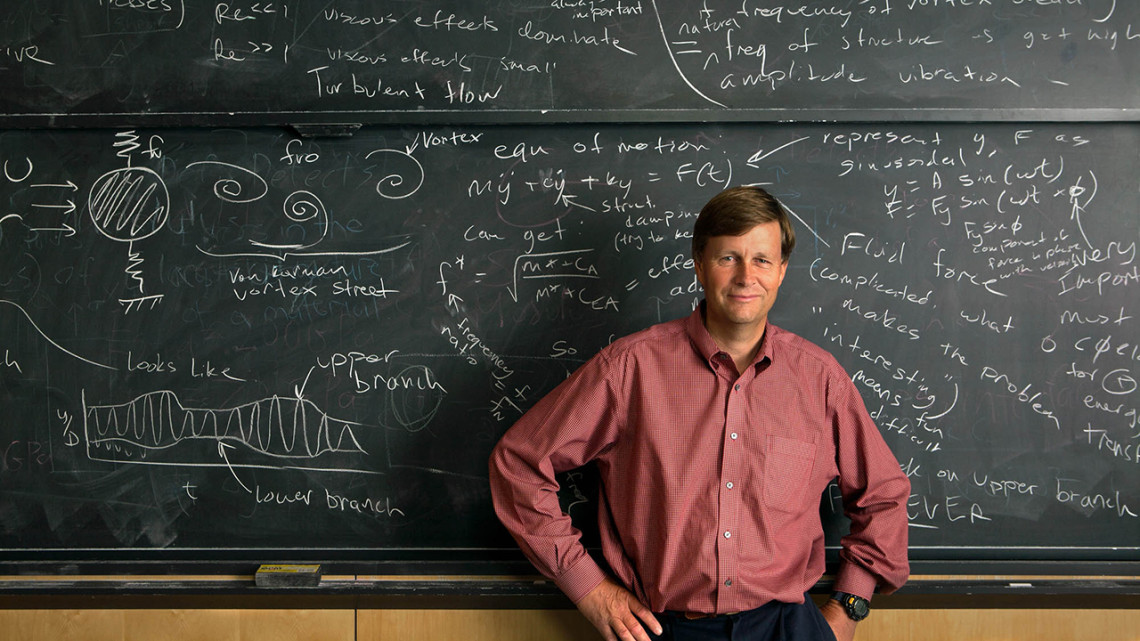
Charles H.K. “Chas” Williamson, the Willis H. Carrier Professor of Engineering Emeritus in Cornell’s Sibley School of Mechanical and Aerospace Engineering, died Nov. 11 at 70.
Charles ‘Chas’ Williamson, fluid dynamics expert, dies at 70
By Chris Dawson
Charles H.K. “Chas” Williamson, the Willis H. Carrier Professor of Engineering Emeritus in Cornell’s Sibley School of Mechanical and Aerospace Engineering, whose pioneering research in fluid dynamics earned international recognition and whose enthusiasm for teaching inspired generations of students, died Nov. 11 from complications of Parkinson’s disease. He was 70.
During his 36 years at Cornell, Williamson established himself as a leading researcher in vortex dynamics and fluid-structure interactions, studying how fluids move, how swirling flows develop and how those movements affect surrounding objects and structures. But for many of his students, his most lasting contribution was making complicated engineering concepts accessible, engaging and even entertaining.
Williamson was selected 19 times by Cornell’s Merrill Presidential Scholars as one of the professors who had most influenced their undergraduate education. The program recognizes graduating seniors for outstanding academic achievement and invites each to honor a Cornell faculty member who played a significant role in their intellectual development.
Williamson’s ability to connect with students was rooted in a teaching philosophy that emphasized curiosity, experimentation and enjoyment.
“If you have the attitude, ‘I can have fun with anything,’ students will be receptive. That’s my theory,” Williamson said during a 2007 faculty seminar on teaching. “Students come in thinking we’ll do just book stuff, but I’ve got all these little things waiting for them, with the theory behind it all.”
That attitude was evident in his fluid mechanics classes, where he used everything from enormous smoke rings and flying rolls of toilet paper to clips from the movie “Top Gun” to demonstrate the principles governing fluid motion. He delighted in surprising students with demonstrations that appeared spontaneous but were carefully designed to reveal the science behind every day phenomena.
Williamson earned his bachelor’s degree in naval architecture from the University of Southampton in England and his doctorate in fluid mechanics from the University of Cambridge in 1982. His early career included work on offshore engineering research and teaching mathematics and physics at a London high school. He later spent six years at the California Institute of Technology before joining Cornell’s faculty in 1990.
At Cornell, Williamson conducted influential research into the behavior of vortices and the forces they exert on objects. His work included studies of vortex-induced vibrations, aircraft wake vortices, instabilities in fluid flows and the interactions between waves and structures.
A fellow of the American Physical Society since 2003, Williamson was widely recognized for his experimental research. He received numerous honors for his scientific work, including eight awards in the American Physical Society’s Gallery of Fluid Motion competition, which recognizes compelling visual demonstrations of fluid behavior. He also helped establish an international conference series devoted to bluff-body flows and vortex-induced vibrations.
In 1999, Williamson received the Stephen H. Weiss Presidential Fellowship, Cornell’s highest teaching honor, and in 2006 was named New York State Professor of the Year by the Carnegie Foundation for the Advancement of Teaching and the Council for Advancement and Support of Education.
He also received the W.M. Keck Foundation Award for engineering teaching excellence in 1994, multiple Cornell engineering teaching awards and the Sibley School’s Shepherd Memorial Teaching Prize twice.
In October 2017, Cornell honored Williamson by naming the Fluid Dynamics Water Channel Laboratory in Upson Hall the Charles H.K. Williamson Lab. The dedication, supported by the Merrill Family Foundation and contributions from former students, was organized as a surprise.
At the ceremony, where attendees included longtime family friend and celebrity science educator Bill Nye ’77, then-Dean of Engineering Lance Collins praised Williamson as “an extraordinarily careful and extraordinarily creative experimentalist,” but suggested his contributions to teaching were even more remarkable.
“He brings passion to fluid mechanics like no one I’ve ever known,” Collins said.
During remarks at the surprise ceremony, Williamson’s son Philippe recalled that before examinations, his father sometimes remained on campus until midnight so students could stop by with last-minute questions.
“Really, the bottom line isn’t just about having great colleagues, but it’s the quality of the students,” Williamson said at the ceremony. “I’m telling you, that makes a complete difference.”
Outside the classroom and laboratory, Williamson was an accomplished sailor who competed and sailed recreationally for many years. He served as faculty adviser to the Cornell sailing team beginning in 1998, combining his professional understanding of fluid dynamics with a lifelong enthusiasm for the water.
“Chas leaves behind a tremendous legacy, not only through his scientific accomplishments but also through the countless students and colleagues whose lives and careers he touched,” said Nelly Andarawis-Puri, the S.C. Thomas Sze Director of the Sibley School. “He will be deeply missed by our school community.”
He is survived by his partner, Chantal Champagne, and his children, Nicolas, Emilie and Philippe.
Chris Dawson is a communications coordinator for Duffield Engineering.
Media Contact
Adam Allington
Get Cornell news delivered right to your inbox.
Subscribe