Biological weapons show promise in onion growers' long battle against a plague of maggots, Cornell researchers say
By Blaine Friedlander
The leading enemy of New York state's fall onion harvest is a fly with the Latin name, Delia antiqua. Onion growers just call its immature stage the onion maggot and for two decades it increasingly has been wreaking economic havoc in the state's onion fields.
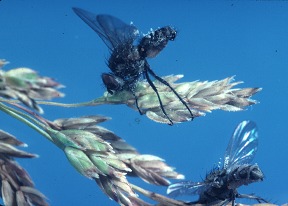
New York's 12,000 acres of commercial onion fields annually produce a crop with a value of between $50 million and $75 million. If a field gets infested with the maggot, between 20 percent and 90 percent of unprotected onion seedlings can be wiped out.
Until now the maggot has resisted attempts at control. But Cornell University agricultural researchers are reporting that two biological tools are showing promise in field tests against the onion maggot: a fungus called Beauveria bassiania and a bacterium known as Bacillus thuringiensis (Bt).
"The research is encouraging," says Charles J. Eckenrode Jr., professor of entomology and researcher at Cornell's New York State Agricultural Experiment Station in Geneva, N.Y. "We've had very good success in the laboratory and Jan van der Heide had good results in the field. Beauveria looks exciting, but we have to work out more details." Van der Heide is a Cornell Cooperative Extension (CCE) agent in Oswego County, N.Y.
Cornell laboratory experiments have shown that when Beauveria, commercially available as Mycotrol ES, made by Mycotech, is sprayed on seedlings, onion maggot damage is reduced to 8.1 percent from 30.3 percent in untreated plots. The researchers believe that this is the result of increased fly mortality and thus leaves fewer maggots on the seedlings. "We do have evidence that Beauveria kills flies, but this is indirect evidence," says van der Heide. The researchers first reported their findings in February at the New York State Vegetable Conference in Syracuse.
In a New York growing season, the onion maggot has three generations. The first is the most destructive because the young plants are very susceptible to maggot damage caused by larval feeding after emergence in late May to early June. Farmers' major line of defense has been soil insecticides, specifically an organophosphate that is applied in the seed furrow at planting. Pyrethroid insecticides are labeled for use on onions, and are sometimes used in an attempt to kill adult onion maggot flies later in the season. Unfortunately, these pyrethroid applications only kill a very small percentage of the flies, because most seek refuge from warm, dry conditions in weedy borders and hedge rows, and consequently spend little time on onion field seedlings.
Since 1996, as an alternative to organophospate, onion growers have received Environmental Protection Agency permission during each growing season to use seed pellets augmented with cyromazine, an insect-growth regulator.
In controlled field plots without soil insecticides, Beauveria wiped out the first generation of onion maggots, limiting seasonal damage to between 2 and 10 percent, the point at which the maggots become only a minor nuisance, the Cornell researchers say.
"We still have to learn how to use Beauveria, and when to use it, thus enabling the growers to reduce their dependence on more conventional pesticides," says Eckenrode. "New control approaches such as Bt and Beauveria are urgently needed, so we must continue to invest significant amounts of research and time and attention on the ones that show promise."
Eckenrode says that Beauveria fungi occur naturally and are believed not to affect humans. Flies killed by these fungi can readily be found in homes and gardens each year. "By taking one of nature's epidemics against flies, and using it commercially, we hope to speed up the process," Eckenrode says.
In New York, onions are grown very intensively in a highly organic, peat-type soil, known in the industry as muck. This usually requires a yearly grower investment of $3,000 to $3,500 an acre before harvest. The muck soil holds water well and allows the onion bulbs to expand. Even in this favorable environment, plant nutrients must be added at strategic times, and a wide array of pests -- including the onion maggot -- plant diseases and weeds must be controlled.
Cornell researchers recommend that growers rotate out of onions, if they can. One possibility for rotation is sorghum sudan grass. Planting it not only breaks the maggot's life cycle, but reduces the nematode population in the muck soil. The grass roots also aerate the ground, allowing increased onion harvests in subsequent growing seasons.
Laboratory and field work discussed here were conducted by Eckenrode and van der Heide; Mary-Lou Hessney, entomologist at the Geneva Experiment Station; Kathleen Hahn, CCE researcher in Oswego County; Mark Ramos, USDA Agricultural Research Service; and John Dunsmoor, an onion grower in Oswego.
Media Contact
Get Cornell news delivered right to your inbox.
Subscribe