New book looks at political uses of grief -- from the public mourning of Princess Diana to the AIDS quilt
By Linda Myers
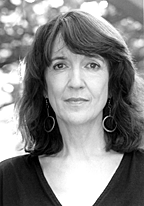
The outpouring of emotion following Princess Diana's untimely death shows, better than any other recent event, how the way we publicly mourn has changed, says Cornell University faculty member Gail Holst-Warhaft.
In her new book, The Cue for Passion: Grief and Its Political Uses (Harvard University Press, 2000), Holst-Warhaft writes: "In our age, we have seen an increasing manipulation of grief by the media, by professional counselors of the bereaved, by the creators of a spate of monuments and museums designed as sites for communal mourning. What effect has this had on the way people mourn?"
The book is a multiyear undertaking by the author, an adjunct associate professor of classics and comparative literature at Cornell who was drawn to the subject by personal as well as professional reasons. She comments that political and religious authorities have been alert to the dangerously powerful effects of communal expressions of grief and have tried to control and channel mourning rites since ancient times. "Figures of authority have recognized that this is the site where emotions can be fired and revolutions sparked," she writes. "Because it arouses passion, grief can always be manipulated for political ends. It may be positively harnessed as a means to effect political change" -- as with the mothers of the Plaza de Mayo in Argentina protesting the disappearance of their children -- "and it may be callously prolonged and exacerbated" -- as with the U.S. government's attempt to turn defeat into victory by charging that there are still remains of American soldiers in Vietnam.
Holst-Warhaft looks at the public rituals of grief for a range of diverse groups, taking note of "the men in paper tiaras at a funeral of an AIDS victim, the list of names without rank on a blank wall, the silent women wearing the diapers of their dead children, the piles of shoes and spectacles" on display at Auschwitz.
The book begins and ends with Hamlet and Electra -- two literary models for dangerous mourners -- and looks at wailing women and other assigned mourners in different cultures, bawdy Celtic mourning rituals frowned on by the Catholic church, the power of the AIDS quilt, the bones of the buried and the controversy over the Vietnam War memorial.
For a review copy of the book, contact the publisher, at http://www.hup.harvard.edu.
Media Contact
Get Cornell news delivered right to your inbox.
Subscribe