Cornell's instruments in Cayuga Lake will help scientists, students and the public monitor water quality – and sailing conditions
By Roger Segelken
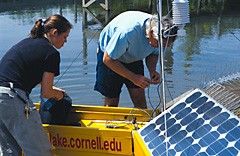
Kristi Kull, a Cornell Class of '01 engineering graduate, and Del Nordman of Apprise Technologies prepare RUSS for installation in Cayuga Lake.
RUSS (for Remote Underwater Sampling Station) is the instrument package installed June 6 in Cayuga Lake, near the Cornell University campus. And the web site, which is run by the Cornell Center for the Environment (CfE), is where scientists, students and the general public can find water-quality data and meteorological information that is relayed, within minutes, from the solar-powered station moored in 80 feet of water some 2,000 feet offshore.
The main purpose of RUSS is to collect such details as lake-water temperature and turbidity (murkiness due to suspended sediment) and biological activity (based on measurements of chlorophyll in phytoplankton), says Edwin Cowen, assistant professor in Cornell's Department of Civil and Environmental Engineering and one of the leaders in the project. The device gauges water quality by remotely controlling the buoyancy of an instrumented probe that descends to make measurements, one meter at a time to a depth of 25 meters, repeating the process up to six times a day. Onboard computers start the data processing before the information is relayed to other computers at the CfE for further analyses.
The lake-monitoring effort is a joint project of CfE together with Cowen and N-elson Hairston Jr., a Cornell professor of ecology and evolutionary biology, who notes a unique feature of the project – its usefulness to the general public as well as to research scientists. After an initial phase when primarily raw data will be displayed as it is collected, outreach specialists at CfE will begin in early fall to provide more user-friendly information and interpretation of the data. Above the water line, Cornell's RUSS is a bright yellow, Y-shaped device that is labeled with the Cornell web address and name of the manufacturer, Apprise Technologies Inc. of Duluth, Minn. It is covered with antennas, weather instruments and photovoltaic solar panels. Arrays of prongs on the panels are designed to discourage birds from roosting, and lighted orange floats are intended to keep boaters from approaching too closely.
Costs of the $150,000 water-monitoring project, including approximately $65,000 for RUSS, are covered by a gift from an anonymous donor, the result of a development effort led by Theodore Hullar, former CfE director, and Leonard Weinstein, an environmental researcher at Boyce Thompson Institute, as well as funds from Cornell University.
According to Gene Hartquist, CfE web administrator, the lake-monitoring web site will link to other RUSS sites around the country, allowing researchers and students to monitor a variety of lake environments without getting their toes wet. The web page features meteorological information from Cornell's RUSS – including air temperature and relative humidity, sunlight and wind speed and direction – updated every five minutes, while the water quality data will be updated every four hours. Hartquist said he will keep several pages of the web site "plain and simple" so that the current weather data can easily be accessed with palm-sized mobile computers.
And therein lies temptation, predicts Cowen. "People at work will be able to check wind conditions on the lake, cancel their afternoon appointments and go sailing," Cowen hints, "although you didn't hear that from me. I don't even own a boat or a sailboard."
Rather, the environmental engineer plans to use water-quality data from RUSS to develop mathematical models of sediment transport and mixing in lakes. Nevertheless, he won't have to spend every summer minute hunched over a computer in Cornell's Hollister Hall. RUSS is due for some equipment upgrades over the next few months to increase its abilities to measure turbulent mixing and currents in the lake -- offering the perfect opportunity to abandon the office and get back on the water.
Other related websites:
- School of Civil and Environmental Engineering: http://www.cee.cornell.edu/
- How RUSS works: http://lakeaccess.org/russ/
Media Contact
Get Cornell news delivered right to your inbox.
Subscribe