'Hotel Rwanda' hero offers lessons to halt future genocides
By Linda Myers
ITHACA, N.Y. -- The hotel in Kigali, Rwanda, where Paul Rusesabagina sheltered 1,200 people in 1994 has the picturesque name Des Mille Collines -- French for 1,000 hills.
It also is a description of the once beautiful countryside of Rwanda, which sadly has not recovered from the brutal machete murders by Hutu militias of a million Rwandese Tutsis in 100 days just 11 years ago -- the fastest genocide in history. Said Rusesabagina of the devastation: "Every place smelled" of rotting corpses "and all you could hear were the sounds of dogs eating the bodies."
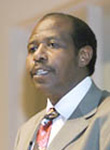
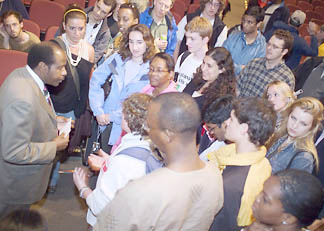
His story is told in the Academy Award-nominated film "Hotel Rwanda," and he was heralded as a hero when he spoke in Cornell University's Alice Statler Auditorium April 20, with a standing ovation from the crowd. But Rusesabagina insisted that he was merely "a normal person who tried to remain who he was -- a hotel manager" -- during the slaughter. Still, "ordinary people can do a lot of things," he told the audience. With the hotel an island surrounded by "a sea of fighting," he found the courage to stay put to ensure the safety of the many refugees under his protection as "guests" at the hotel.
When he was offered safe passage for himself, his Tutsi wife and children, he said: "'I'm sorry but I cannot leave these people here because if I leave and they are killed I could never live with myself.'" When a handful of U.N. troops failed to offer minimal protection, Rusesabagina "phoned the whole world," but no one came. Eventually he managed to negotiate with militia leaders and bought enough time for most refugees to be evacuated.
Seeing a film made about his experience was "a kind of therapy for me," said Rusesabagina. "When the 1994 genocide happened and nobody seemed to be willing to listen to me, I was angry, bitter." When the movie came and the world finally heard his message, "I took it as a kind of achievement." While some of the details are changed for dramatic effect, the basic story remains the same, he said.
As background to the conflict, Rusesabagina related that Rwanda was a colony of Germany from the 1800s until 1923, when the United Nations made the country a protectorate of Belgium, following Germany's defeat in World War I. "Divide and conquer" was the strategy that both countries used to rule Rwanda, said Rusesabagina, exploiting small differences in facial features and skin coloring among the native populace to create a privileged minority, the Tutsis, and an underclass majority, the Hutus. Following independence from Belgium in 1959, jealousies and resentments boiled up periodically, with power changing hands several times, culminating in the 1994 genocide.
The problems have not gone away. "There is a saying in Rwanda that translates, roughly, as 'the dancers have changed but the music stays the same,'" Rusesabagina said. The murderers still have not been brought to justice, and the country has received no international support to rebuild itself -- unlike Germany following World War II, he noted.
What can people do to help -- in Rwanda and places like Congo, Burundi and Darfur today? "To influence leaders is always the best idea," said Rusesabagina, who sees the film as "a message" to the world to prevent future genocides. He recommended halting the sale of arms to Sudan and imposing an embargo on Sudanese oil, whose profits are being used to arm militias. He also called for post-conflict humanitarian support: "All of these conflicts leave behind a lot of orphans who need food, shelter, care and women who have been raped who need medical and psychological care," he said. A foundation he started raises money for such efforts.
His talk, a benefit to aid the Genocide Intervention Fund, was sponsored by STARS, a campus group that tries to raise awareness among students about the Holocaust and genocides.
Media Contact
Get Cornell news delivered right to your inbox.
Subscribe