Tsunamis, ancient fires and criminal trials featured at undergraduate research forum
By Thomas Oberst
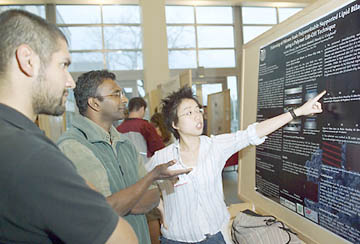
ITHACA, N.Y. -- How do children influence their parents' eating habits? Can a polymer be used to deactivate chemical warfare agents? What are the differences in how jurors process information in criminal trials? Can ancient charcoal from the fires of the Mayans cast new light on the civilization's timeline?
Ask Cornell University undergraduates. About 100 of them conducted and presented their original research on these and other topics at the 20th Annual Undergraduate Research Forum April 20, sponsored by the Cornell Undergraduate Research Board (CURB).
It is not easy to steal the spotlight from the research of faculty and graduate students at Cornell. But with a combined display of 70 posters and 25 oral presentations that filled the open spaces and alcoves of the 970,000-cubic-foot grand atrium in Duffield Hall, Cornell's undergraduates did just that -- even if only for a short while.
"CURB is a student-run organization dedicated to promoting, publicizing, coordinating and celebrating undergraduate research," said CURB's president Gali Porat, ILR '05, of Philadelphia.
CURB's main event is the annual spring forum, which gives undergraduates a chance to publicly present the findings of their research over the past year.
This year's forum kicked off with a keynote address by Philip Liu, professor of civil and environmental engineering, who spoke about the recent tsunami in Southeast Asia. A world-renowned tsunami expert who has helped develop warning systems for countries surrounding the Pacific Ocean, Liu also mentioned the importance of undergraduate research. "Getting involved in undergraduate research motivates students more for their courses, gives them a better understanding of why certain courses need to be taken and can be a determining factor on an application if they choose to enter advanced studies," he said.
Karen Gunderson, HumEc '05 and a human biology, health and society major from Lake George, N.Y., studied how children influence their parents' eating habits. She administered questionnaires to 161 parents who visited a pediatrician's office in upstate New York to ask about changes in their eating habits after having children. Her results show that as parents they generally eat more vegetables, fruits and wheat and increase their frequency of eating breakfast while consuming fewer junk foods, desserts, fast food, beef and alcohol than they did before having children.
"Children's health -- and parents' health -- is influenced by nutrition," observed Gunderson. "Understanding how children influence their parents' eating habits can lead to better counseling of parents on their food decisions."
Gunderson, who became interested in child nutrition as a youth camp counselor and while shadowing pediatricians, is planning a career as a physician assistant.
Larissa Paschyn, A&S '07, of Parma, Ohio, who is considering a major in archaeology, has been studying ancient charcoal remains of the Mayan empire from Oaxaca, Mexico. In both a poster and an oral presentation, Paschyn explained how fluctuations of fire activity and inactivity may reveal that the settlement patterns of the Mayans were earlier than experts had previously estimated.
"I originally wanted to study ice cores and how rings on the cores can determine the age of a site. However, when no one in the department was focusing on that, I was directed toward an archaeologist performing soil tests in Mexico," recalled Paschyn.
Among the many other eye-catching posters was one by Justin Gunnell, HumEc '05, of Staten Island, N.Y., which depicted the differences in information processing among jurors in criminal trials. Gunnell, a policy analysis and management major, became fascinated with the topic after taking a course on psychology and the legal system. He plans to attend Brooklyn Law School in the fall.
Porat, who spent a great deal of energy preparing for and running the forum, still found time to submit her own research on alcohol abuse in the college setting.
"CURB has really made some strides this year," she asserted. In addition to this spring's forum having the highest number of submissions in the event's history, CURB has held more meetings and informational sessions and events throughout the year. CURB also created an informational booklet this year called "Research 101," designed to help undergraduate students get started in research.
Said Porat, "We want to help undergrads find their niche at Cornell -- academically, professionally and personally."
Thomas Oberst is a student intern with the Cornell News Service.
Media Contact
Get Cornell news delivered right to your inbox.
Subscribe