University celebrates 'most distinguished professor ever to serve at Cornell' with a building in his honor
By Lauren Gold
There are so many things to say about Hans Bethe. One of the most important is that his name will live on with a West Campus building that is to be named for him.
"He was great and good man," said physicist Freeman Dyson of the Institute for Advanced Study, Princeton, N.J. "A great teacher, great scientist, wise counselor and faithful friend."
On Sunday afternoon, Sept. 18, some of Bethe's closest colleagues and protégés delivered tributes to Bethe before a full house at Statler Auditorium. The event, "Celebrating an Exemplary Life," drew hundreds of admirers from the Cornell community and beyond.
They came to remember the man Dyson once characterized, in a letter to his family, as "large and clumsy, with an exceptionally muddy pair of shoes." They spoke of his wide-ranging and extraordinary accomplishments -- his Nobel Prize-winning paper explaining the process that powers the stars; his leadership as head of the theoretical division at the Los Alamos National Laboratory during the Manhattan Project; his essential contributions to the field of quantum electrodynamics; and his tireless dedication to making the world safer.
Setting the tone, Cornell University President Hunter R. Rawlings began the event by announcing that West Campus House Three, a building planned for the West Campus Residential Initiative project, will become the Hans Bethe House. A ceremony dedicating the building will be held following its completion next spring.
"Hans Bethe was the most distinguished professor ever to serve at Cornell University," said Rawlings. "He controlled the entire field of physics in his head. He defied conventional wisdom that physics is a young person's sport. And he also changed the way physics and much of contemporary science is done."
"He was a man of principle and integrity," said Rawlings. "Cornell will keep his example forever before the world."
Each speaker following Rawlings noted the sides of Bethe they knew best.
Kurt Gottfried, Cornell professor emeritus of physics, spoke of his mentor's unparalleled 70-plus-year scientific career. "His intellectual output was on a scale which would have been thought impossible -- had he not existed," Gottfried said. "But Bethe achieved respect and esteem not explicable by his contributions to physics alone."
Much of that respect came from his strong sense of duty to his adopted country. Bethe came to the United States in 1935, after Hitler's racial laws barred him from work in Germany, and said he immediately felt at home here.
"The U.S. offered a social and intellectual atmosphere unique and different than anything he had been part of before," said Bethe's son, Henry. "He loved it. He felt a great sense of obligation to it." Bethe's stand against nuclear proliferation was largely responsible for President John F. Kennedy's signing of the 1963 Limited Test Ban Treaty outlawing atmospheric tests. Even after Bethe's 1975 retirement from teaching, he continued to advocate strongly for nuclear disarmament.
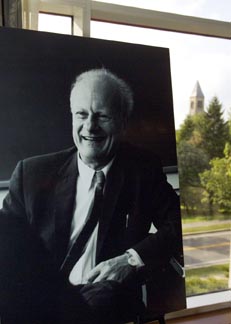
Bethe also loved Cornell.
Dale Corson, Cornell president emeritus and former physics department chair, spoke of Bethe's leadership during the chaotic summer of 1969, when students seized Willard Straight Hall and announced, over the radio, that Cornell had only a few remaining hours of existence.
"I felt strongly that this should not be so," Bethe said later. In the weeks following the radio announcement, he set an example for colleagues by participating in campuswide meetings and writing a paper on "The Academic Responsibility of the Faculty." That Cornell survived through that turbulent time, said Corson, was in part due to those efforts.
"It was a long way from neutrinos and supernovae … but for this place and that time, that paper was more important than any of the others," said Corson. "I've always been very grateful to Hans for that."
The speakers remembered Bethe's joyful enthusiasm for new knowledge, and his ability to teach and guide each of his students individually -- with just the right touch.
Many also noted Bethe's distress, in his final years of life, at the current tone of national politics.
"He felt very sad that at a time when there should have been more scientists and intellectuals getting involved, there were less," said Cornell astrophysicist Edwin Salpeter, who -- like Corson and many others -- chose a career at Cornell based on Bethe's presence here. "I am hoping that our junior colleagues will speak out."
And finally, said Bethe's colleagues, any fitting tribute is also necessarily a tribute to his wife, Rose.
"[Bethe's] habit was to talk with Rose about the larger dimensions of his work," said Rawlings; Bethe relied on her insight, commitment and unflagging support.
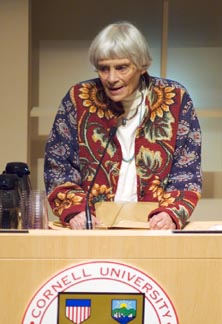
Rose Bethe spoke briefly. "He would have loved to hear it all," she said, "because he liked to be praised. But I think he knew that Cornell appreciated him."
For her words, and for her life, the audience stood and applauded.
At a reception after the ceremony, Cornell seniors Ben Hsu, Will Regan, Andrew Schwarzkopf and Nabil Iqbal wondered at a life so amazing, and so full.
The four were among dozens of younger attendees who never got to meet Hans Bethe. They came to show their respect, and to be inspired and to learn from his example.
And when they receive their degrees in physics next May, perhaps they will consider Bethe's own words, replayed to the eminent physicists and just-starting-out students who filled the auditorium:
"It has been a very interesting life, and most satisfactory. So I recommend to all the young people to do likewise."
Media Contact
Get Cornell news delivered right to your inbox.
Subscribe