Hospitality executives and professors discuss leadership at annual roundtable
By Linda Myers
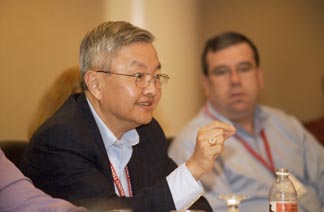
Every organization seeks it, but what, exactly, is leadership and can it be measured? Eighteen prominent hospitality executives, 12 faculty members at Cornell University's School of Hotel Administration and academics from other institutions offered answers but didn't always agree with one another during the 2005 Leadership Roundtable, held Sept. 7 and 8 in the Statler Hotel.
"Leadership is innately immeasurable. It's an art, not a science," said Rob Schiller, president and chief operating officer of Armor Holdings during Thursday morning's discussion. "The only measurable is continuous improvement. The only tool is personality profiling assessments that match up [individuals'] strengths and weaknesses."
But Cathy Enz, the Schaeneman Professor of Innovation and Dynamic Management at the Hotel School, pointed to a competencies model she and colleagues developed based on a survey of senior-level lodging executives. The officials identified eight overarching factors senior staff must have for organizational success. Key among them were: critical thinking, industry knowledge, self-management and strategic positioning.
"To have a successful enterprise, you've got to make the individuals in it successful," said Lee Pillsbury, co-chairman and CEO of Thayer Lodging. "It isn't about sacrificing; it's doing things that support a way for that person to be successful."
Bob Wright, co-founder of the Wright Institute for Lifelong Learning, disagreed, instead advocating for moving out people who aren't committed to doing their best to achieve an organization's goals or are ill-suited to their assignments.
Several participants took issue with his response.
"I would struggle with that," said Mark Lomanno, president of Smith Travel Research.
And Ted Teng, former president and chief operating officer of Wyndham International, said: "We limit ourselves when we say, 'Be your best.' What is a defined best? The human being behind that is unlimited."
As a leader, "you know what the mountaintop ought to look like," said John Simons, former president and CEO of Swift and Co., but it's important to "give your people the ability to make their own choices."
But, said Roger Mayer, professor of management at the University of Akron,"if your stock prices falls because of [Hurricane] Katrina, you're likely to be looked at as an ineffective leader by Wall Street, no matter how good a job you're doing."
Countered Schiller, "Public markets are punitive when they go down, but it doesn't mean you're a bad leader. It means you have an opportunity to be a good leader. What are you going to do with it?"
Roundtable topics were: "What Is Leadership and Can It Be Measured" and "Building and Sustaining Trust in Leadership," led by Hotel School Associate Professor Tony Simons; "Creating a Context for Leadership: Developing and Retaining Leadership Talent" and "Leadership for Excellent Service," led by Hotel School Assistant Professor Kate Walsh.
"The roundtables are a wonderful opportunity for hospitality industry managers and executives, Hotel School faculty and other researchers to learn from one another," said Gary Thompson, professor and executive director of the Hotel School's Center for Hospitality Research, which sponsored the forum.
The series, begun four years ago, includes hospitality law, human resources and marketing roundtables and a hospitality design roundtable Oct. 5-6. Being planned are roundtables on real estate, food safety and cruise lines. For information, see http://www.hotelschool.cornell.edu/chr/news/roundtables.html.
Media Contact
Get Cornell news delivered right to your inbox.
Subscribe