90-year-old alumna Esther Bondareff travels to Cornell to give her name to new Raptor Program facility
By Jeannie Griffith
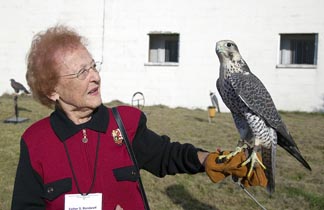
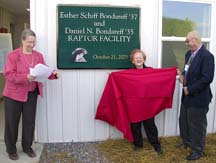
Injured and endangered raptors have a new place to roost at Cornell University: the Esther Schiff Bondareff '37 and Daniel N. Bondareff '35 Raptor Facility. The new home of the Cornell Raptor Program was dedicated Oct. 21.
The facility was named to honor the 90th birthday of one of the university's most beloved volunteers, Esther Bondareff, as well as her late husband, Dan, also a Cornell volunteer.
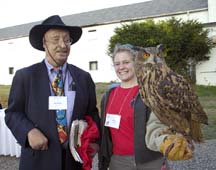
Bondareff made the trip from West Palm Beach, Fla., to attend the ceremony, as did her longtime friend Jay Hyman '55, DVM '57, who helped raise the $250,000 needed to name the facility in her honor. As guests arrived at the Game Farm Road site, they were greeted by student and alumni volunteers holding an assortment of bright-eyed raptors, including a pint-sized American kestrel, a rare Eurasian eagle owl, a gyrfalcon/peregrine falcon cross and an imposingly self-possessed golden eagle. The birds on display, some injured in the wild and some captive-bred, are all permanent residents used for demonstration purposes as part of the program's active school-outreach component.
Although the Cornell Raptor Program was not formally established until 1993, program director John Parks, professor of animal science, has led raptor conservation efforts at Cornell since the mid-1980s, following the successful restoration of the once-endangered peregrine falcon, with programs to breed three other species of concern -- the northern goshawk, sharp-shinned hawk and red-shouldered hawk. The program was housed in the Behavioral Ecology Lab, better known as the Hawk Barn, at Sapsucker Woods until 2001, when that building was razed to make way for the expansion of the Lab of Ornithology.
The move to interim quarters reduced the program's capacity to house rehabilitation cases from about 20 per year to just a few over a three-year period. The new facility -- a 4,000-square-foot pole barn with 19 fiberglass-paneled aviaries, each 10 feet wide, 16 feet long and 12 to 16 feet high -- will provide sanctuary for many more injured birds. Parks supervised the design and construction of the building.
Parks has spent years building the program, raising funds and devoting his Saturdays to teaching students about various raptor species and providing training in their care and handling in exchange for volunteer labor. About 30 students currently volunteer with the program, as do several Cornell staff members.
At the dedication, Susan Henry, the Ronald P. Lynch Dean of Agriculture and Life Sciences, presented Bondareff with a Cornell Sheep Program blanket to protect her against the October chill. Henry drew laughs when she suggested that the energetic Bondareff, who cleans cages weekly as a volunteer at Miami's Dreher Park Zoo, would be welcome to come back during summers to help take care of the raptors.
As Henry noted, Bondareff has been extensively involved with Cornell for decades. A foremost benefactor and a life trustee, she has been recognized with the Frank H.T. Rhodes Exemplary Service Award and the College of Agriculture and Life Sciences (CALS) Outstanding Alumni Award. She has served on campaign committees for CALS, Athletics and Mann Library chaired Reunion for the Class of 1937, and provided leadership for many alumni events. She was the first female president of the Cornell Club of Washington, and she and Hyman have teamed up many times to host Cornell alumni events in Florida. Recalling her first introduction to the work of the Cornell Raptor Program, which came from Parks in the form of complicated scientific literature, Bondareff quipped, "I finally decided that he was interested in sex -- but it was all for the birds."
Parks responded by announcing that the facility's orange-eyed Eurasian eagle owl has been renamed Jay in recognition of Hyman's dedication to the program. And the golden eagle will henceforth be known as Esther.
Media Contact
Get Cornell news delivered right to your inbox.
Subscribe