CU in the City: Courting the Big Apple
By Brenda Tobias
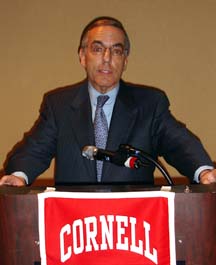
NEW YORK -- "New York City is where the Hotel School's variety of education is practiced at the highest level," according to the school's incoming dean, Michael Johnson. As evidence, almost 600 Hotel School alumni, students and faculty filled the Bryant Park Grille for the annual Hotel Society Reception Nov. 14.
Nestled in between the New York Public Library and an ice rink, the Grille teemed with New York City's networkers and nibblers, catching up and reminiscing late into the night. Virginia Mariani-Kitt '82 enthused that "It's like having a reunion, but in your own backyard."
The New York City chapter of the Cornell Hotel Society (CHS) was sponsoring its 80th annual reception. A silent auction was held during the reception to benefit the chapter's scholarship fund. Under avant-garde wall hangings and twinkling tiny lights, celebrity restaurateurs, vintners, hoteliers, faculty, executives and students gained audible momentum as they circulated. Johnson mused, "What I've learned so far is that as multidimensional as New York City is, so are its connections to the Hotel School. Cornell's multidimensional connections also were evident at the New York City branch of the School of Industrial and Labor Relations, when the president of Israel's National Labor Court, Stephen J. Adler, ILR '62, kicked off the new Labor and Employment Law Program with ILR Dean Harry Katz at a breakfast forum Nov. 30, attended by union and management lawyers and federal officials.
The newly formed Labor and Employment Law Program at ILR Extension, headed by Esta R. Bigler, ILR '70, will study, educate and partner with stakeholders to impact policies that affect people's lives both here and abroad. Adler compared freedom of association in Israel, the United States and the European Union, explaining that Israel's labor court is more powerful than the U.S. National Labor Relations Board (NLRB), which is an administrative agency.

Adler noted the egalitarian composition of the National Labor Court and how it benefits workers, while the NLRB is composed of lawyers. The Israeli labor court includes laymen to keep the judgments practical -- "to make a connection between what's happening in the workplace and the legal judgment. This is a big advantage to labor," explained Adler. Expanding on this theme, Bigler posited: "Work is a central focus of most people's lives. Few recognize the role law plays in regulating every aspect of the workplace."
The role of law in the workplace was also the subject when Mark Belnick '68 addressed a Cornell Entrepreneur Network (CEN) audience Oct. 25. Belnick, the former general counsel for Tyco International, who in July 2004 was acquitted of charges of misappropriating corporate funds, told an audience of 100 of his journey from Cornell U-Hall corridor president to standing trial in New York State Supreme Court on 14 felony indictments.
In 2002 Belnick went from being a witness for the prosecution of two other top Tyco executives to being charged with stealing millions of dollars from Tyco in the form of unauthorized bonuses and loans and failing to disclose the payments. If convicted, Belnick probably would have faced a lengthy prison term.
"There are no minimum security facilities for white-collar offenders in New York state," explained Belnick. For two years (between indictment and trial) the threat of 25 years in prison was his constant companion. "How did I cope?" he asked the audience. "The four 'F's: food, fearless lawyers, faith and family." The team of lawyers, led by Cornellians, obtained his acquittal on all charges after a trial lasting more than two months.
The Metro N.Y. Regional Office (708 Third Ave.) and CEN, a national business network for alumni affiliated with Cornell's Entrepreneurship and Personal Enterprise Program (EPE), sponsored Belnick's talk, "When the Tables Turn in Business and Law."
From topsy-turvy to the Big Top: NewYork-Presbyterian/Weill Cornell Medical Center was the sponsor and the Children's Blood Foundation (CBF) sent in the clowns to raise money for CBF Nov. 12. Proceeds from a night at the Big Apple Circus benefited children with blood diseases and cancer. Under a circus tent at the Lincoln Center plaza, jugglers, clowns and aerialists mesmerized cotton candy eaters. CBF supports research and fellowship training program in the Division of Pediatric Hematology and Oncology at the medical center. The Division of Pediatric Hematology and Oncology cares for children and families afflicted with childhood blood disorders and cancers. The division is led by Dr. Patricia J. Giardina and consists of six nationally and internationally renowned clinical faculty members and three basic scientists working with a staff of administrators, nurses, social workers, genetic counselors, technicians and postdoctoral fellows.
Brenda Tobias '97 is director of Cornell-New York City relations and is on assignment in New York City, reporting on Cornell's many connections and collaborations in the Big Apple. The CU in the City column appears monthly. To suggest an item for coverage, e-mail Tobias at NYC@cornell.edu.
Media Contact
Get Cornell news delivered right to your inbox.
Subscribe