A sculpture grows in Collegetown
By George Lowery
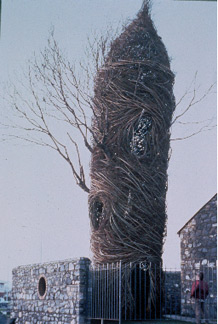
One doesn't expect to happen upon a contemporary art installation made entirely of tree saplings in Collegetown, but that is part of artist Patrick Dougherty's vision. "It's nice to have a first-strike capability with your work, in the sense that people are kind of shocked that it's in that space," says Dougherty, an artist-in-residence at Cornell until Sept. 21."I try to blend the site, the sculpture and people's imagination."
Since Sept. 1 Dougherty has been erecting arboreal art on a triangular plaza in front of the Sheldon Court residence hall with the assistance of Cornell students and Ithaca residents. The College Avenue site is at the border of the Cornell campus and Collegetown, and this, too, was intentional.
"Art disciplines our minds and sharpens our perceptual consciousness," says Milton Curry, associate professor architecture and director of the Cornell Council for the Arts (CCA). "Public art forces us to interact with 'otherness,' something that is out of the ordinary. How this particular construction will transform the space of Collegetown will be quite interesting and unexpected."
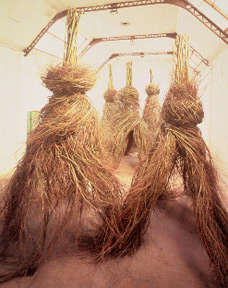
Since 1982 Dougherty has created more than 200 installations in the United States, Europe and Asia, each entirely composed of tree saplings. His works evoke giant birds' nests, igloos, urns, pueblos, writhing cornucopia, wreathes or primordial huts straining against gusts of wind. Depending on sky and setting, they soothe or disturb, enchant or befuddle.
"Patrick's site-specific work is part of an extensive effort to reimagine the threshold of Collegetown, where Cornell begins to project itself into the city of Ithaca," says project curator Amaechi Okigbo, a CCA member and the associate professor of landscape architecture who brought Dougherty to campus in 2005 to lecture. "He is dealing with issues of urban spatial environment and temporality."
Dougherty is the first of five artists to participate in CCA's "5 Years/5 Contemporary Installations" program. As part of his three-week residence, Dougherty will offer an informal master class Sept. 16. A documentary crew is filming construction of the installation, excerpts of which appear on the CCA Web site at http://www.arts.cornell.edu/cca.
Dougherty uses sustainable, natural materials and constructs his work in full public view. All of the raw materials for his Ithaca sculpture will be harvested locally; a portion will come from the Cornell Plantations. He says his work "provokes an interest in all things natural, the sense of the woods and some sense of our existence in prehistory, when we used sticks as one of our major material sources.
"Introducing wit and whimsy into an artistic work -- weaving it into an already conceptual/nonfigurative work -- is very tricky," says Curry, who notes that Doughtery's approach runs counter to fashions in contemporary art. "I think of Patrick and only a handful of other artists who can pull this off, including Andy Goldsworthy."
Dougherty's piece will progress from thumbnail sketches and considerations of how it functions in the available space to its impact and scale. "I'm planning to use the trees at the site as a foil to build something in and around," he explains. "People are concerned about loss of species, and I think that my work provokes associations with nature, drawing, making line patterns that are interesting and provocative. The sheer beauty of what you can do with these sticks is amazing."
The installation, which will remain in place for one year, is Collegetown's first outdoor art project. The project is sponsored by the CCA with support from the Department of Theatre, Film and Dance, Hilton Garden Inn and Stella's Cafe/Olivia Restaurant.
Media Contact
Get Cornell news delivered right to your inbox.
Subscribe